

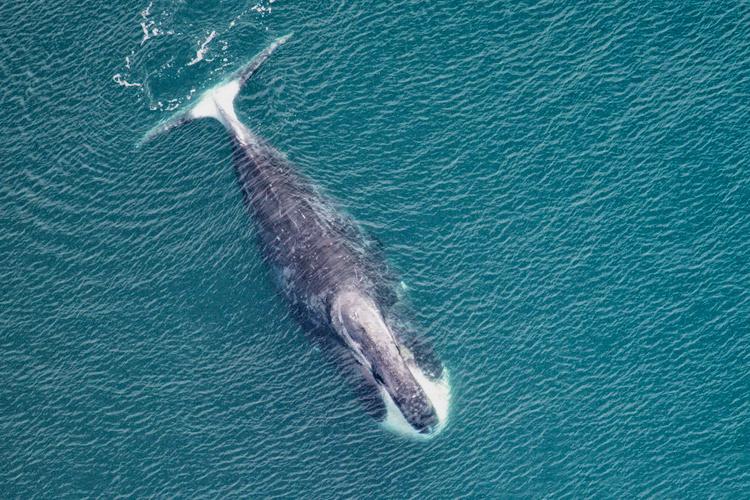
A bowhead whale moving beneath Arctic ice today could, in principle, have been born before the American Civil War. At 165 years old in 2026, it would have entered the world before fighting began at Fort Sumter. At 200, it would predate the first photograph of a person, the telegraph and the modern petroleum industry.
This is not just an arresting comparison. Chemical dating of bowhead eye lenses has produced age estimates beyond two centuries, while stone points and 19th-century bomb-lance fragments recovered from harvested whales provide independent physical evidence that the animals can survive for well over 100 years. The methods do not identify the birthday of a particular whale alive now, but together they have made Balaena mysticetus the longest-lived mammal known.
A mammal living on a historical timescale
Bowheads are creatures of the Arctic and subarctic, ranging through the Bering, Chukchi and Beaufort seas and other ice-associated waters. They can reach about 19 metres and 90 tonnes, have no dorsal fin and carry the thickest blubber of any whale. Their huge, arched skulls can break breathing holes through ice.
For much of the 20th century, researchers assumed bowheads lived roughly as long as other large whales, perhaps 60 or 70 years. There was no easy way to count annual growth layers. Bowheads do not have teeth that preserve a readable lifelong record, and baleen plates wear away rather than accumulating indefinitely.
Today, NOAA Fisheries lists their lifespan as unknown but possibly over 200 years. “Unknown” matters. No bowhead has carried a tag for two centuries, and no named individual has a verified pre-Civil War birth date. The claim is an inference from several clocks, each with different strengths and uncertainties.
The molecular clock sealed inside an eye
The most famous quantitative evidence came from a 1999 study led by Craig George of Alaska’s North Slope Borough. The researchers used aspartic acid racemization in the nucleus of the eye lens. Lens proteins are formed early in life and remain metabolically stable. As the animal ages, molecules of the amino acid aspartic acid slowly change from a left-handed to a right-handed form. The ratio works as a chemical clock when its rate is calibrated for the species and body temperature.
Most of the whales yielded ages consistent with their body lengths and reproductive status. Four males were estimated to be older than 100. The oldest estimate was 211 years, with a standard error of 35 years. That uncertainty is large: it does not mean the whale died on its 211th birthday. It means the chemistry placed the animal deep into a range that made a two-century lifespan plausible.
Later work improved the laboratory procedures, but eye-lens racemization still depends on assumptions about reaction rates and calibration. Its power is statistical and comparative, not documentary. A second line of evidence was therefore crucial.
The Arctic returned weapons from another century
During Alaska Native subsistence harvests, hunters and biologists have recovered old weapon points from bowhead blubber and bone. The finds included stone, slate, ivory and metal pieces. Some traditional forms had largely disappeared when manufactured whaling equipment became widespread in northern Alaska during the late 1880s.
The most precisely dated evidence came from bomb lances. In May 2007, hunters at Barrow, now Utqiaġvik, harvested a 14.9-metre male carrying a metal fragment near its right shoulder blade. John Bockstoce of the New Bedford Whaling Museum identified it as part of a bomb lance probably manufactured between 1879 and 1885. A similar fragment recovered from another bowhead around 1980 was traced to the same period.
George and Bockstoce documented both artifacts in a 2008 Polar Biology paper. Even using the latest plausible manufacture date, the 2007 whale had carried the weapon for at least 122 years. It had survived a failed commercial hunt, healed around the metal and continued crossing Arctic waters through enormous technological and political change.
Harpoons are minimum ages, not birth certificates
An embedded weapon starts a clock at the moment a whale was struck. It proves the animal was already alive, and large enough to be hunted, before surviving until a later harvest. That makes the elapsed time a minimum age. The whale could have been a juvenile or an adult when first hit, but the fragment alone cannot say which.
The artifacts also differ in dating precision. A patented bomb-lance design manufactured during a narrow period is more useful than a stone point whose style persisted across generations. The early finds nevertheless mattered because several old technologies appeared in different harvested bowheads. The pattern was harder to dismiss as an error in one chemical assay.
This is why the harpoon story and the 211-year estimate should not be blended into a claim that a single whale carried one weapon for 200 years. The 19th-century fragments directly demonstrate survival beyond a century. Eye-lens chemistry extends the estimated lifespan beyond 200. They are independent, complementary arguments.
Why a 100-tonne mammal does not age like us
Extreme lifespan creates an enormous maintenance problem. A bowhead has vastly more cells than a human, and those cells must avoid cancer and tissue failure for perhaps twice as long as the longest-lived person. Slow growth and cold Arctic conditions may help, but researchers are also studying cellular systems that preserve the genome.
A 2015 bowhead genome study identified changes in pathways involving DNA repair, cell-cycle control and cancer resistance. More recent cell experiments have highlighted proteins that may make repair of dangerous DNA breaks unusually accurate. As a previous SpaceDaily investigation explained, those results offer mechanisms worth testing, not a single proven “longevity gene.”
Avoiding cancer is only one part of staying alive for two centuries. Tissues must retain function, proteins must be maintained, immune responses must remain balanced and organs must tolerate decades of environmental stress. The bowhead’s lifespan is therefore almost certainly a whole-body outcome produced by many interacting adaptations, not a molecular switch that can simply be copied into another mammal.
Longevity also has costs. Bowheads mature slowly and females usually produce one calf every three or four years. Commercial whaling devastated populations precisely because animals with such a slow life history cannot quickly replace large losses. NOAA says bowheads were reduced worldwide to fewer than 3,000 by the 1920s, though the Western Arctic population has since recovered substantially under protection and Indigenous co-management.
The mammal record, carefully stated
NOAA calls the bowhead the longest-lived marine mammal, and the evidence supports the broader description of longest-lived mammal known. That does not make it the longest-lived vertebrate or animal. Greenland sharks have age estimates approaching four centuries, while ocean quahog clams and some corals can persist longer.
The bowhead record is unusual because it rests on convergence. Eye chemistry provides numerical ages, weapon fragments provide hard historical minimums, and genomic and cellular studies make exceptional maintenance biologically plausible. None is perfect alone. Together they overturn the old assumption that a wild mammal of such size could not remain functional across two human lifetimes.
So the pre-Civil War whale should be understood as a real possibility, not a documented individual. Somewhere in the Arctic, a bowhead born before 1861 could still be surfacing through the ice. Science cannot point to it by name, but an amino-acid clock and metal forged in the 1880s show that the species operates on that extraordinary timescale.