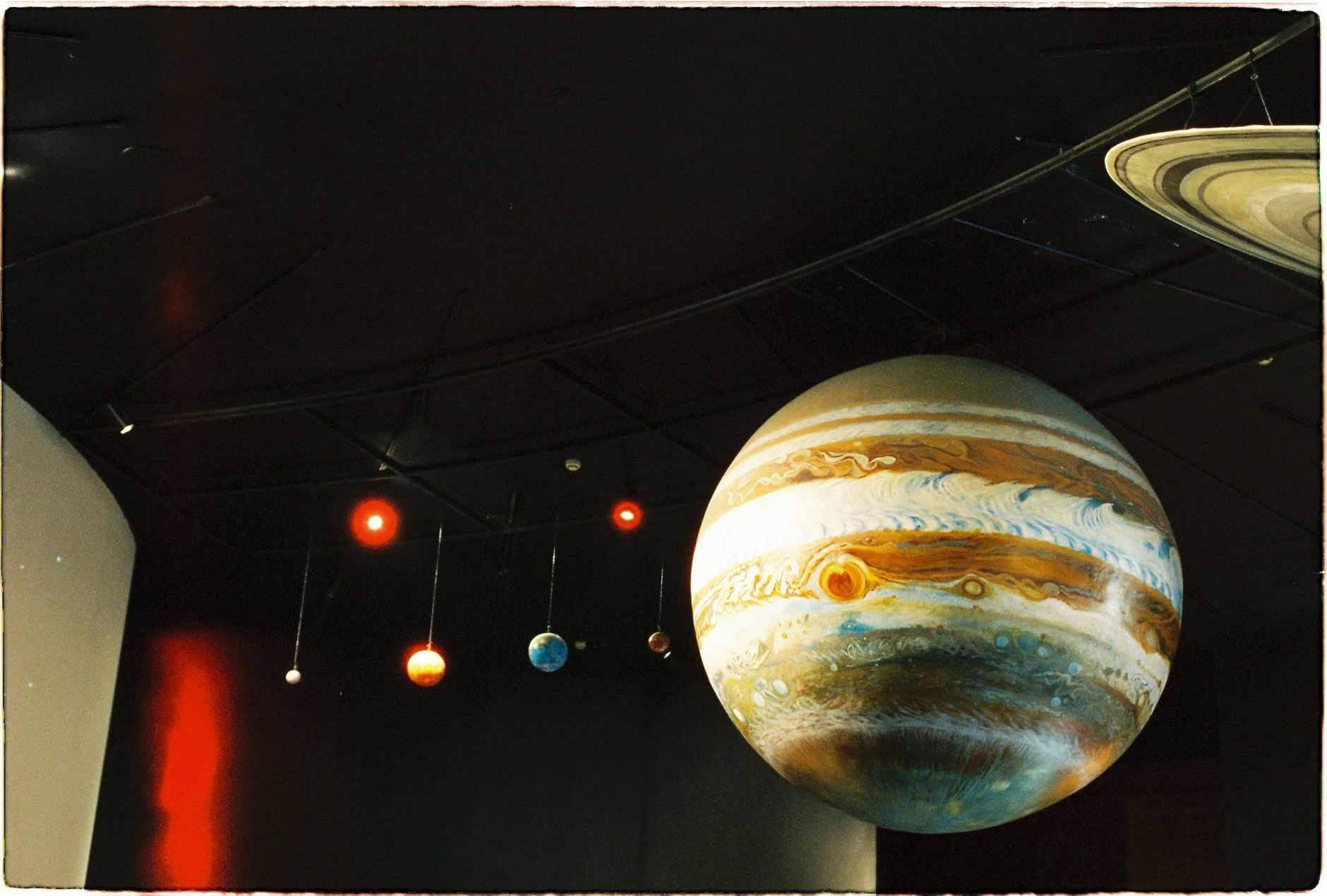
Jupiter orbits the Sun, but it does not circle a star that sits perfectly still at the middle of the arrangement.
The gravity runs both ways. Jupiter pulls on the Sun while the Sun pulls on Jupiter, so both bodies move around a shared centre of mass called the barycentre.
At Jupiter’s average distance, that point lies roughly 742,000 kilometres from the Sun’s centre. The International Astronomical Union’s nominal radius for the Sun is 695,700 kilometres, which puts the Sun-Jupiter barycentre about 46,000 kilometres beyond the visible solar surface.
This is the useful fact inside the popular claim that Jupiter “doesn’t technically orbit the Sun”. I would phrase it more carefully. Jupiter does orbit the Sun in the ordinary and scientifically useful sense, but it does not orbit the Sun’s centre while the Sun remains fixed. Both trace paths around the same off-centre point.
Nothing in that picture is actually still.
What a barycentre measures
A barycentre is the balance point of two or more masses. The European Space Agency’s explanation of two-body motion makes the principle plain: whenever two objects are gravitationally bound, they orbit a common centre of mass rather than one object remaining stationary.
If the two objects have equal mass, that point sits halfway between them. If one is much heavier, the point shifts towards the heavier object. The familiar example is a light person and a heavy person on a seesaw. The balance point must sit closer to the heavier person.
For Earth and the Sun, Earth’s share of the mass is so small that their two-body barycentre sits deep inside the Sun. Jupiter changes the scale. NASA notes that it has about 318 times Earth’s mass, and its average distance from the Sun is about 778 million kilometres. That combination of mass and distance moves the balance point beyond the photosphere.
The arithmetic behind the 46,000-kilometre figure
The distance from the larger body’s centre to a two-body barycentre is the separation between the objects multiplied by the smaller object’s share of their combined mass. Astronomers normally use gravitational parameters, written as GM, because these are measured more precisely than mass and the gravitational constant separately.
JPL’s DE440 astrodynamic parameters give a solar GM of about 1.3271 × 10²⁰ cubic metres per second squared and a Jupiter-system GM of about 1.2671 × 10¹⁷ in the same units. Put those values into the centre-of-mass calculation with the average 778-million-kilometre separation, and the Sun’s side of the orbit has a radius of roughly 742,000 kilometres.
The IAU’s nominal solar radius is 695,700 kilometres. Subtracting it leaves about 46,000 kilometres.
That is an average-scale calculation, not a claim that the geometry is frozen. Jupiter’s orbit is elliptical, the other planets are also pulling on the Sun, and the Sun is not a hard, sharply edged sphere.
The Sun’s “surface” is a useful boundary, not solid ground
When astronomers speak of the solar surface, they usually mean the photosphere, the layer from which most visible light escapes. Below it is hot plasma, and above it the solar atmosphere continues through the chromosphere and corona. Saying the barycentre is outside the Sun’s surface therefore means outside a defined visible radius, not outside every trace of solar material.
NASA’s own barycentre explainer uses the same accessible description: the Jupiter-Sun barycentre sits just outside the Sun’s surface. It also distinguishes that two-body point from the barycentre of the entire solar system, whose location changes as all the planets move.
Why the Sun’s small orbit matters
The Sun’s movement is tiny beside Jupiter’s 778-million-kilometre orbit, but it is not merely a wording trick. The same gravitational response lets astronomers find planets around other stars. A planet tugs its star around their barycentre, shifting the star’s motion towards and away from Earth.
NASA describes this as the radial-velocity or wobble method. Astronomers look for repeated Doppler shifts in the star’s spectrum. The period of that signal helps reveal the orbit, while its size helps constrain the planet’s mass.
I touched on this technique in an earlier article about a possible exomoon inferred from a radial-velocity signal. The same basic physics applies here, although the full Jupiter system includes the planet and its moons, and real measurements must separate several overlapping gravitational effects.
The full solar system is less tidy than the textbook picture
The Sun contains about 99.8 per cent of the solar system’s mass, so a Sun-centred diagram remains an excellent practical model. It is also why “Jupiter orbits the Sun” is not wrong. Reference frames are chosen for the problem at hand, and a heliocentric frame is often the clearest one.
For precise navigation and ephemerides, however, JPL distinguishes the Sun, individual planets, planetary-system barycentres and the solar-system barycentre. Jupiter is not acting alone. Saturn and the other planets continually shift the combined balance point, which can lie inside or outside the photosphere depending on their positions.
I have written before about how the tidy classroom diagram compresses several different meanings of the solar system. The barycentre is another useful correction to that picture. Jupiter circles the Sun, the Sun moves in response, and the exact centre depends on which bodies and reference frame the calculation includes.