

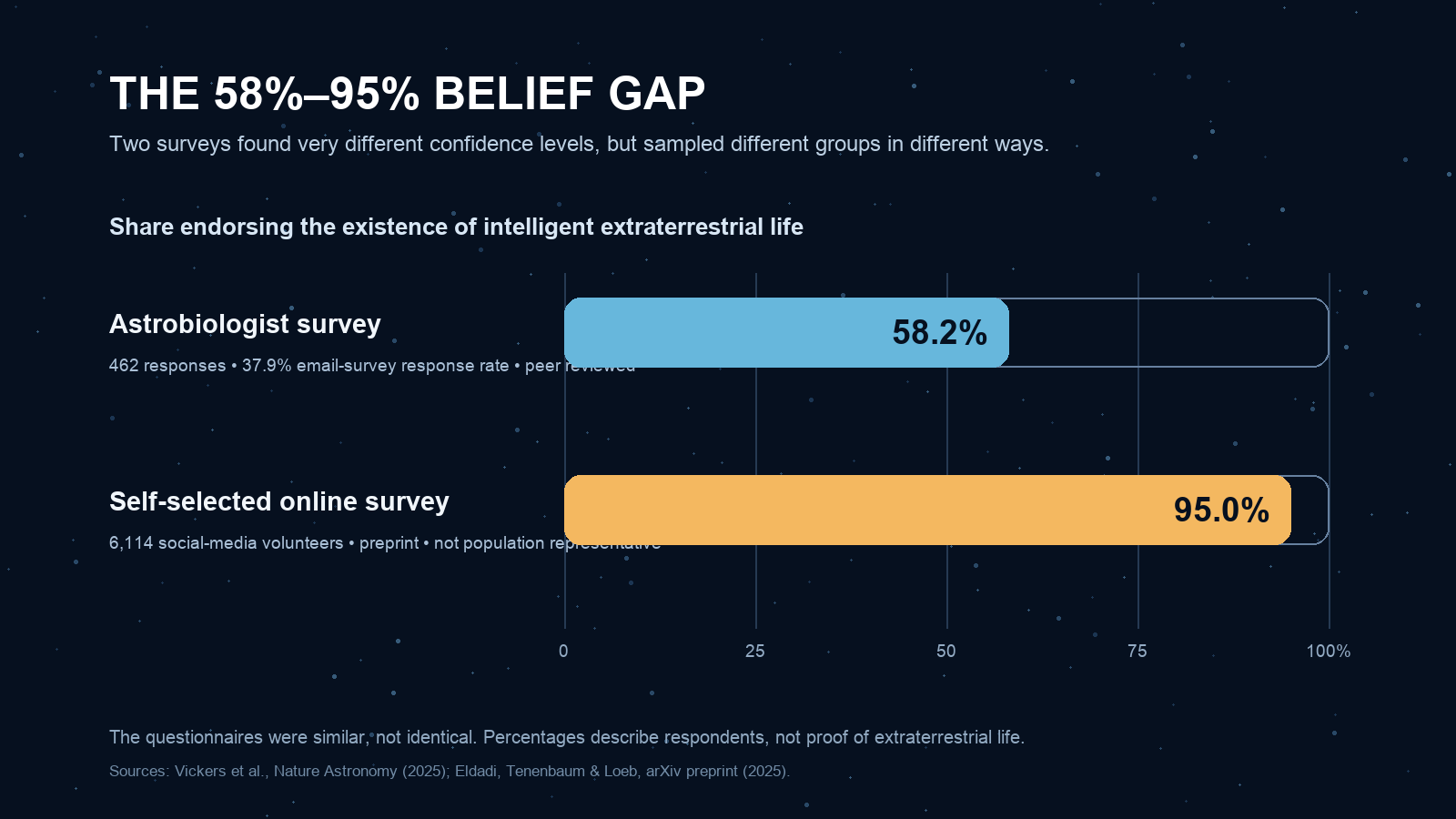
Ask a room of astrobiologists whether intelligent life probably exists somewhere beyond Earth and a majority will say yes. Ask a large online group that is already highly engaged with science, and almost everyone may say the same. That is the divide produced by two recent surveys: 58.2 percent agreement in the expert sample and 95 percent belief in the online one.
The difference is real within the responses collected, but it is not a clean experts-versus-public opinion poll. The first study contacted a defined scientific community by email. The second recruited volunteers through social media, and its respondents were unusually educated, interested in science and predominantly male. The 95 percent figure describes that self-selected audience, not humanity at large.
The surveys are most revealing when treated as studies of confidence and sampling rather than as votes on whether aliens exist. Neither result is observational evidence for extraterrestrial life. Both show how people approach a question for which science still has only one confirmed inhabited world.
What the expert figure actually counted
The peer-reviewed Nature Astronomy study surveyed a broadly defined astrobiology community during 2024. Its intelligent-life statement was specific: “It is likely that extraterrestrial organisms with advanced cognitive abilities comparable to or superior to those of humans exist somewhere in the universe.” Respondents could strongly agree, agree, remain neutral, disagree or strongly disagree.
The intelligent-life survey received 462 responses, equivalent to a 37.9 percent response rate. The published source data show that 109 respondents, or 23.6 percent, strongly agreed and 160, or 34.6 percent, agreed. Together they produced the headline 58.2 percent. Another 146 respondents, 31.6 percent, selected neutral. Forty-seven, or 10.2 percent, disagreed or strongly disagreed.
That distribution is more informative than the majority alone. Most experts leaned toward existence, yet nearly one in three declined to lean either way. The paper notes that neutral responses can express reduced confidence or a reluctance to speculate. Calling the result cautious does not mean the experts rejected intelligent life. It means their majority was accompanied by a large zone of uncertainty.
What produced the 95 percent figure
The later survey appeared as an arXiv preprint, not a peer-reviewed paper. Its authors recruited adults using links distributed through Medium, Twitter, LinkedIn and WhatsApp from 10 to 16 November 2025. A total of 6,114 people completed the questionnaire.
Participants rated whether intelligent extraterrestrial life definitely does not exist, probably does not exist, was uncertain, probably exists or definitely exists. The result was heavily concentrated at the confident end: 62.59 percent chose “definitely exists” and 32.42 percent chose “probably exists.” Combined, that was 95.01 percent, rounded to 95 percent in the headline. Just 3.97 percent were uncertain and 1.02 percent selected either form of nonexistence.
This was a distinctive audience. Its average age was 49.2 years, 78 percent were male, and respondents came from 112 countries, although 38.5 percent lived in the United States. Some 77.6 percent held at least a bachelor’s degree, while 68 percent rated their engagement with science as high or very high. Those traits are worth reporting, but they do not make the group a representative sample.
Six thousand volunteers are not a population poll
A large sample reduces random sampling noise only when the route into the sample gives the population a meaningful chance of being selected. It cannot repair self-selection. People who follow posts about extraterrestrial intelligence, choose to open a survey on the subject and finish it may be much more interested in, and confident about, alien life than those who scroll past.
A useful contrast comes from a 2021 Pew Research Center survey. Pew used a panel recruited through random residential-address sampling and weighted the results to represent US adults. In that study, 65 percent said their best guess was that intelligent life exists on other planets. The country, year and wording differ, so 65 percent is not a replacement for either new result. It does show why the 95 percent online figure should not be labelled “the public.”
The expert survey is not immune to selection either. Roughly 62 percent of invited astrobiologists did not answer the intelligent-life questionnaire. Believers, sceptics or people comfortable speculating might have been more willing to respond. The email sampling frame is far more targeted than an open social-media link, but neither survey can prove that nonrespondents would have answered like respondents.
The questionnaires were similar, not identical
The percentages also come from different instruments. Experts agreed or disagreed that advanced cognitive life was “likely” to exist. Online respondents chose whether it “probably” or “definitely” exists. Combining the positive categories creates a sensible broad comparison, but it is not the same as administering an identical question to two randomly selected groups.
Definitions add another layer. The expert statement defined intelligence by cognitive abilities comparable to or above those of humans. SETI searches often use detectable technology as a practical proxy. As an earlier SpaceDaily discussion of dolphins, aliens and intelligence explored, cognition and technology are related concepts, not synonyms.
Neither survey asked whether an extraterrestrial civilisation is close enough to detect, exists at the same cosmic time as humanity, transmits radio signals or has visited Earth. Belief that intelligence exists somewhere in the observable universe is a much broader proposition than belief that a telescope can find it now.
The experts followed a confidence ladder
The expert project asked three separate astrobiology samples about increasingly demanding forms of life. Agreement was 86.6 percent for at least basic extraterrestrial life, 67.4 percent for organisms significantly larger and more complex than bacteria, and 58.2 percent for advanced cognitive life. Disagreement on the intelligence statement was only 10.2 percent; much of the decline appeared as neutrality rather than outright rejection.
This ladder reflects uncertainties that accumulate. Science does not yet know how readily life begins, how often it becomes complex, how often advanced cognition evolves, or how long technological societies remain detectable. The Drake equation gave those unknowns a durable framework, but several terms remain estimates rather than measured frequencies.
The expert paper itself distinguishes agreement from evidence. A scientific community can agree that a claim is likely while acknowledging that its evidential base is weak. With no confirmed extraterrestrial organism and a known sample of one inhabited planet, 58.2 percent should be read as a distribution of informed prior beliefs, not a measured prevalence of civilisations.
Showing the expert number barely moved the online group
The preprint did more than collect a yes-or-no view. Before being shown the expert result, participants estimated that 67.63 percent of astrobiologists believed intelligent life exists, overshooting the reported 58.2 percent by 9.43 percentage points. They also thought only 21.1 percent of experts would choose the strongest “definitely exists” position, far below the 62.59 percent definitive conviction within their own group.
Participants were then told the expert percentage. For the intervention analysis, the researchers retained 5,106 people who correctly identified 58.2 percent in a manipulation check. Their personal belief declined only slightly, with a reported effect size of d = -0.11. Their estimate of belief within their close social circle rose slightly, with d = 0.14.
The authors interpret this as resistance to belief revision even in a scientifically engaged audience. That conclusion deserves testing with preregistered, representative samples and peer review. A tiny movement inside a highly selected group cannot establish how the wider public would react to expert information.
Belief is not a detection
Surveys matter because assumptions about extraterrestrial life influence research priorities, risk communication and interpretations of ambiguous data. They reveal how experts and interested nonexperts distribute confidence before decisive evidence arrives. They do not make that evidence arrive.
A recent SpaceDaily report described how two powerful radio arrays searched K2-18 b for artificial radio signals and found none. That non-detection ruled out a narrow class of persistent transmitters during the observations, not all life or all technology. It illustrates the distance between a general belief and a testable astronomical claim.
The two percentages therefore describe different kinds of caution. Most surveyed astrobiologists considered intelligent life likely, while leaving substantial room for uncertainty. The online respondents were much more certain, but they had selected themselves into a survey reached through social media. The gap is worth studying. It is not a referendum result for the universe.