
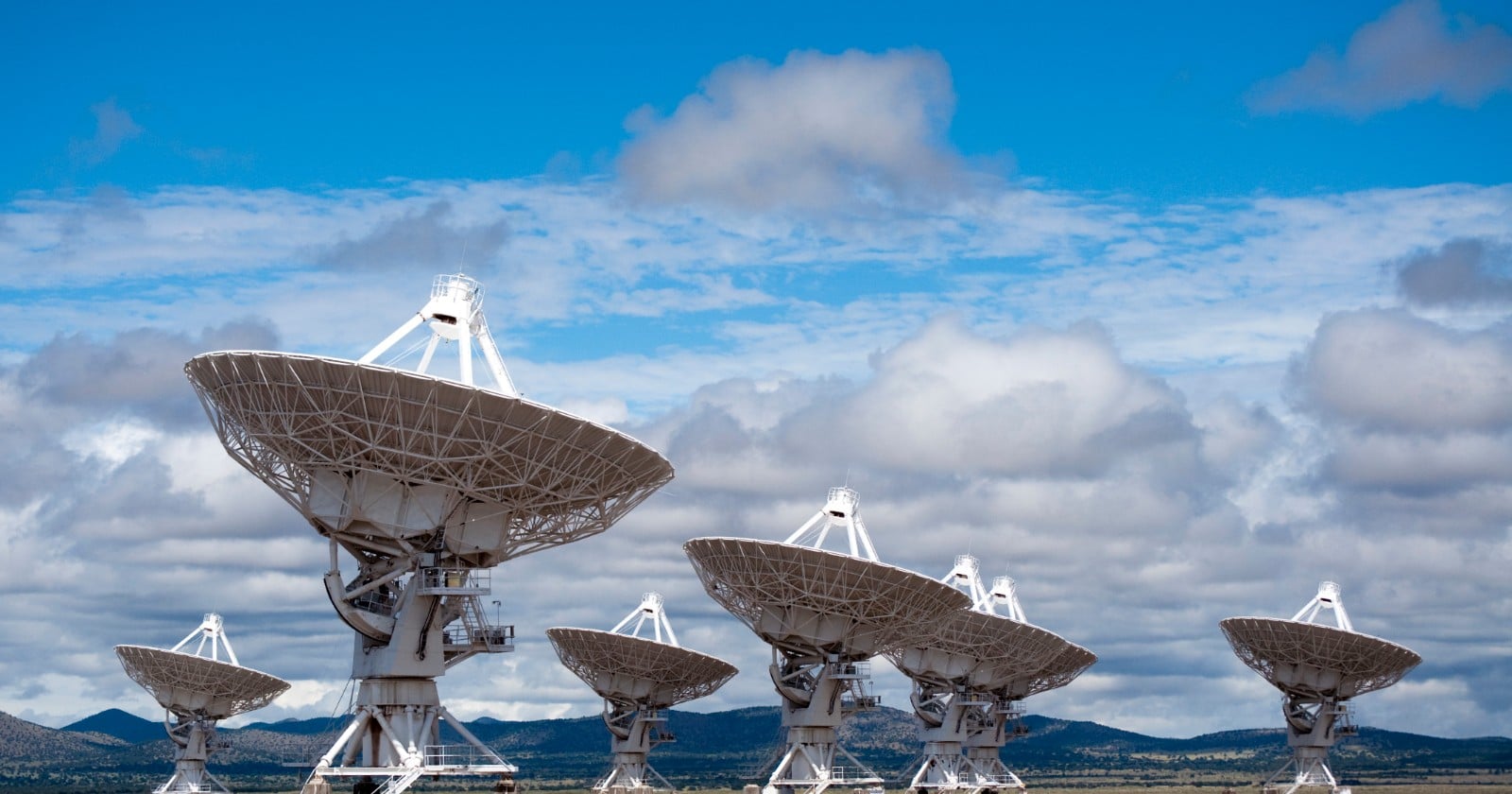
Two of the most powerful radio observatories on Earth took turns aiming at a single faint star 124 light-years away, listening for any sign that a technological civilization might be broadcasting from the planet that circles it. That planet is K2-18b, the sub-Neptune that has become the most talked-about candidate for a habitable world beyond the Solar System. Across a full orbit, over months in late 2023, the answer that came back on six radio bands was silence.
That is the headline result of a new study, accepted by The Astronomical Journal, from a team led by Chenoa Tremblay of the SETI Institute. Using the Very Large Array in New Mexico and the MeerKAT array in South Africa, the researchers searched from 544 megahertz up to 9.8 gigahertz and found no narrowband radio signals that could be traced to the K2-18 system. Every candidate that survived the first cuts turned out to be interference from Earth or an artifact of the instruments themselves.
The planet everyone keeps aiming instruments at
K2-18b is a sub-Neptune, roughly eight and a half times the mass of Earth and about two and a half times its width, orbiting a cool red dwarf every 33 days inside the zone where liquid water is possible. What made it famous is its air. Observations with the James Webb Space Telescope found methane and carbon dioxide in its atmosphere, a combination that fits models of a “Hycean” world: a deep global ocean beneath a thick hydrogen envelope. A later, hotly debated claim that Webb had also glimpsed a molecule made mostly by living things on Earth pushed the planet further into the spotlight, though that reading remains tentative and contested. Independent teams have since argued the signal is weak or absent, and even its proposers frame it as a possible hint rather than a finding. The habitability question is wide open, which is exactly what makes a second, independent line of evidence worth chasing.
An atmosphere hinting at habitability is one kind of evidence. A radio broadcast would be another, and a far less ambiguous one. Nature builds many things, but it does not squeeze radio energy into a band a few hertz wide; transmitters do. That is why searches for extraterrestrial intelligence hunt for narrowband signals, an idea that goes back to a 1959 proposal by two physicists who pointed out that such tones would stand out cleanly against the broadband hiss of the cosmos. If anything on or near K2-18b were transmitting that way, and doing it toward us, a sensitive enough dish should hear it.
Sifting twenty million blips down to nothing
The hard part is not detecting signals. It is telling a genuine one from the ocean of radio noise that humans generate. Across all six bands, the pipelines flagged more than twenty million hits. Almost all of it was terrestrial: phones, satellites, radar, the observatories’ own electronics.
To strain the real from the false, the team leaned on the fact that a signal truly coming from K2-18b would behave in specific ways. It would drift steadily in frequency as the planet and Earth moved, rather than sitting stock-still like a ground transmitter. It would appear in the one telescope beam aimed at the star and not in the dozens of other beams pointed elsewhere in the field. And it would show the right relationship between the arrays’ combined and single-dish views. In principle it should also blink off when the planet slips behind its host star and return when the planet reappears, a timing check that ties a signal to the orbit. MeerKAT’s system forms 64 beams on the sky at once, which turns local interference, present in many beams, into something easy to reject.
To calibrate how much to trust the pipeline, the team even fed it fake signals to measure how often it cried wolf. At low strength, close to 80 percent of its detections turned out to be phantoms, so the researchers set a floor and discarded the weakest candidates outright.
Band by band, the filters then ate the survivors alive. In one VLA band a haul of nearly ten million signals fell to a few thousand, then to 86, then to zero once each was plotted and inspected by eye and found to be interference. In MeerKAT’s lowest-frequency band, roughly 83 percent of the initial detections were not drifting at all, the fingerprint of a stationary emitter here on the ground. Nothing was left that looked like it came from the K2-18 system.
The narrow reach of a silence
The result is real, and its reach is specific. The search was sensitive to transmitters radiating somewhere around a trillion to ten trillion watts, comparable to or below the power of the old Arecibo telescope. So it is genuinely constraining: if K2-18b were home to a steady, powerful narrowband beacon of roughly that strength, pointed our way and broadcasting in the bands observed, this campaign would very likely have caught it. It did not.
The limits are also narrower than they might sound. They apply only to transmitters that are narrowband, persistent over the minutes each observation lasted, roughly the same in all directions, and aimed such that Earth fell inside the beam during those particular hours. A civilization that transmits in bursts, spreads its signal across a wide band, points a tight beam somewhere other than here, or communicates by means that are not radio at all would slip straight through. The campaign also sampled only a thin slice of the planet’s possible transmission schedules, and the telescopes were never watching during the hours the planet passed behind its star, so the sharpest test the team describes, checking whether a signal blinks off on cue, could not be applied this time.
The result also says nothing about whether K2-18b is habitable or inhabited. As the authors put it, the planet may be lifeless, may host life that never built a radio, or may be home to something whose signals this search was never designed to hear. A non-detection rules out one specific kind of transmitter and leaves everything else where it was.
The uses of an empty result
The deeper value of the work is less about K2-18b than about how the listening was done, and what a careful non-detection is worth. Older technosignature searches typically stared at one target with one dish. This campaign used two arrays whose specialized SETI backends form many beams at once and search them in parallel, then ran everything through a uniform, largely automated pipeline. Filtering twenty million signals by hand would have been impossible; the software did it, and the recipe is written down so the same method can be turned on the next planet, and eventually on the flood of data that instruments like the Square Kilometre Array will produce.
That is the real product here: not a verdict on K2-18b, but a repeatable way to put a number on the silence. Each such null trims the range of transmitters a nearby system could plausibly host, and the constraints tighten as more worlds are surveyed the same way. What the campaign could not touch is the question it was built around: not only whether anyone is there, but whether a civilization would ever broadcast in a way a radio telescope could catch. On that, six bands of silence say nothing at all. The question is left exactly as open as it was found.
