
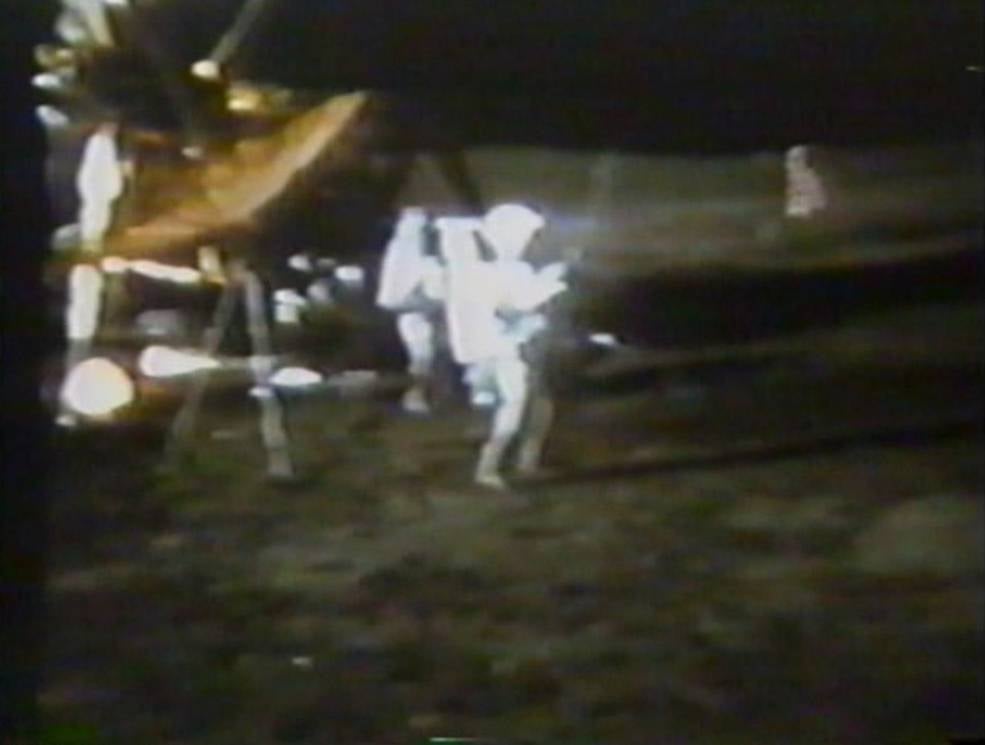
On 6 February 1971, near the end of Apollo 14’s second and final moonwalk, Alan Shepard faced the mission’s television camera with an object no lunar checklist normally required: a golf club. It was not a complete club. A modified six-iron head had been made to fit the handle of a contingency sample-return tool, and Shepard had carried two golf balls to the surface.
His bulky pressure suit made a conventional swing impossible. Using one hand, he eventually sent both balls across the Fra Mauro landing site and joked that the second had travelled “miles and miles and miles”. Fifty years later, enhanced Apollo imagery produced much shorter measurements: about 24 yards for the first ball and 40 yards for the second.
A private idea with official permission
Shepard was an enthusiastic golfer as well as the commander of Apollo 14, the third mission to land astronauts on the Moon. He had already been the first American in space in 1961, but an inner-ear disorder kept him grounded for much of the decade. Corrective surgery returned him to flight status, and he reached the Moon at 47.
In a 1998 NASA oral history, Shepard recalled thinking about how far a ball might travel in lunar gravity and vacuum. Management initially rejected the proposal. He won approval by promising that the demonstration would happen only at the very end of surface operations, and only if the mission had gone well. If there had been an equipment failure or anything embarrassing, he would leave the club head packed away.
Shepard also said he paid for the club head and balls himself. The small head could travel in his spacesuit pocket, while the handle was already on the Moon for collecting emergency samples. The Smithsonian’s replica shows how the six-iron head attached to the contingency tool. Shepard gave the original to the United States Golf Association.
The suit dictated the swing
The golf demonstration began at about 135 hours into the mission, after Shepard and Edgar Mitchell had completed the serious work of the second moonwalk. They had travelled towards Cone Crater, collected geological samples and returned to the lunar module Antares. The two moonwalks together lasted more than nine hours.
Facing the live camera, Shepard identified the sample-tool handle and six iron, then dropped what he called a familiar little white pellet. His explanation was direct: “Unfortunately, the suit is so stiff, I can’t do this with two hands.”
Pressurised Apollo suits resisted bending because every movement worked against the gas inside. The thick gloves reduced grip and feel. The helmet and life-support backpack restricted the turn of Shepard’s shoulders, while the visor made it difficult to see the ground near his boots. A two-handed backswing was out of the question.
The surface provided no tee or fairway. The ball rested on loose, dusty regolith scattered with small rocks, so Shepard described the attempt as a sand-trap shot. He made a short, one-handed swing with little body rotation, using an improvised shaft that had never been designed to flex like a golf club.
Two balls required four swings
The famous sequence was less effortless than later retellings sometimes suggest. As NASA’s Apollo 14 history recounts, Shepard’s first attempt caught more lunar dirt than ball. His second made contact but sent the first ball only two or three feet sideways, drawing a joke from mission control about a slice.
On the third swing, Shepard launched that first ball about 24 yards into a nearby crater. He then dropped the second ball, took his fourth swing and sent it towards the Apollo Lunar Surface Experiments Package. Watching it leave the television camera’s useful view, he delivered the line that endured: “Miles and miles and miles.”
The words were a joke, not telemetry.
Mitchell followed with his own piece of lunar sport. He threw the staff from the Solar Wind Composition experiment like a javelin, and it landed in the same crater as Shepard’s first ball. Minutes later, the astronauts climbed into Antares and closed the hatch for the last time.
Why low gravity did not guarantee miles
Lunar surface gravity is about one-sixth of Earth’s, and the Moon has virtually no atmosphere to create drag. If a golfer could give a ball the same initial speed and angle there, it would remain in flight far longer. With no air, the dimples would not generate the familiar aerodynamic lift or sideways curve. The trajectory would be governed mainly by launch conditions and lunar gravity.
Those advantages could not compensate for Shepard’s one-handed quarter swing, thick gloves, rigid suit, makeshift club and poor lie. Even seeing the ball clearly was difficult. A powerful, properly equipped golfer could theoretically send a ball for miles under lunar conditions; Shepard was trying to make contact from what was effectively a rock-strewn bunker while wearing a small spacecraft.
The distance was therefore never the most impressive part. The shot turned lunar gravity and the absence of air into something a television audience could grasp immediately. Later in 1971, Apollo 15 commander David Scott used a geological hammer and falcon feather for a more controlled televised demonstration of motion in vacuum.
How 2021 imagery found both balls
For decades, estimates of Shepard’s shots ranged from a few hundred yards to the playful miles of his commentary. The balls were far too small for an orbital camera to resolve directly, and the television transmission did not preserve a clear view of their final resting places.
Imaging specialist Andy Saunders revisited the evidence for Apollo 14’s fiftieth anniversary. The USGA’s 2021 account describes high-resolution scans of the original flight film being enhanced and stitched into a panorama. Photographs taken through Antares’ window after the moonwalk showed the work area from another angle, helping to identify both balls and one of the divots.
Saunders also stacked multiple frames from 16 mm footage made around lunar-module liftoff. Boulders, craters, astronaut tracks and experiment locations could then be cross-checked against later Lunar Reconnaissance Orbiter images. The orbital pictures could not show a golf ball, but they supplied a scale for surface features visible in the Apollo material.
The reconstruction placed ball number one about 24 yards from the swing point and ball number two about 40 yards away. The second had travelled farther, but not even the length of a modest terrestrial golf hole.
Both balls remain at Fra Mauro. The club head came home, but the targets of the first extraterrestrial golf game became part of the landing site, resting near scientific instruments, discarded tools and astronaut tracks. Shepard did not drive a ball for miles. He did something more exclusive: he played the first game of golf anywhere beyond Earth.