

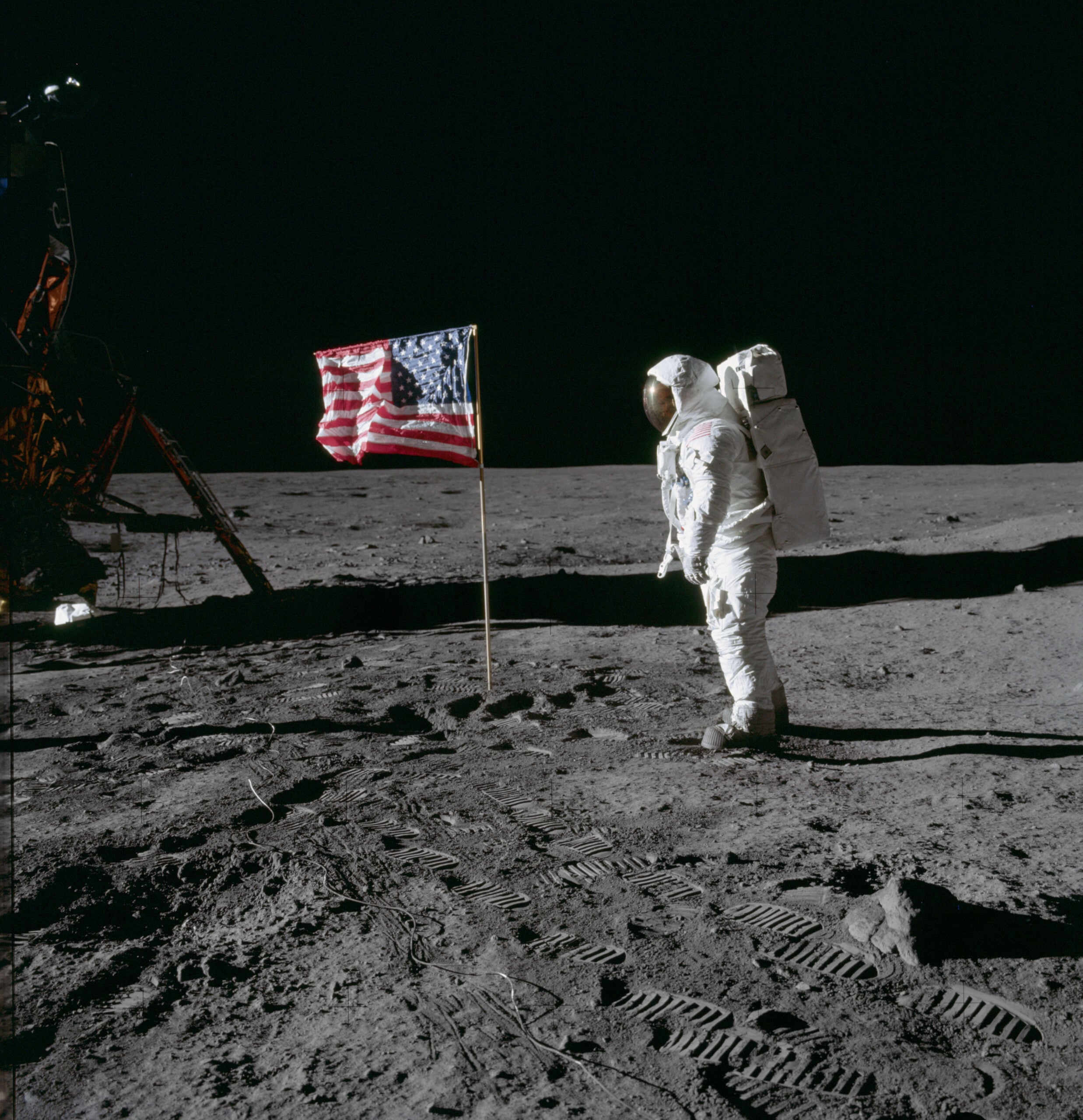
The most famous American flag on the Moon may have remained upright for less than a day.
Neil Armstrong and Buzz Aldrin planted it during Apollo 11’s only moonwalk on 20 July 1969. Roughly 21 hours after Eagle landed, the lunar module’s ascent stage fired and carried both men back towards Michael Collins in lunar orbit. Aldrin later wrote that he looked out long enough to see the flag fall.
That glimpse is the strongest direct evidence of the first lunar flag’s fate. The event was not captured clearly on film, and no visitor has inspected the site since. What exists instead is an unusually persuasive chain of clues: Aldrin’s eyewitness account, the flag’s absence from later shadow sequences, and the punishing limits of ordinary nylon left unprotected on the Moon.
A familiar flag with an unfamiliar support
The flag itself was not an exotic space-age textile. NASA’s history of the Lunar Flag Assembly describes a standard 3-by-5-foot nylon flag, modified by sewing a hem along its upper edge. A telescoping metal rod passed through that hem so the cloth would project from the vertical staff.
It needed the rod because the Moon has no atmosphere and therefore no wind. The folds seen in Apollo photographs are sometimes mistaken for a flag fluttering in air, but they were wrinkles held in place by the crossbar and the way the fabric had been packed. Armstrong and Aldrin could not fully extend that horizontal rod, which left the cloth with its distinctive gathered appearance.
The entire assembly had been designed quickly. NASA selected engineer Jack Kinzler to develop it less than three months before the flight. His team produced an eight-foot staff made from gold-anodised aluminium tubing and a protective case mounted on Eagle’s forward landing leg. The complete package weighed 9 pounds 7 ounces, or about 4.3 kilograms.
Deploying it was less graceful than the finished photographs suggest. The crew had trouble driving the staff into the compacted material beneath the powdery surface. Their post-flight technical debriefing records the concern that its position had shifted even before departure. Yet it remained standing through the ceremony, President Richard Nixon’s telephone call and the rest of the moonwalk.
The last glimpse from Eagle
Apollo 11 touched down at 20:17 UTC on 20 July. Eagle’s ascent stage left Tranquility Base at 17:54 UTC the next day, using the descent stage as its launch platform. Armstrong and Aldrin had been on the Moon for about 21 hours and 36 minutes.
A vacuum does not make rocket exhaust harmless. A rocket carries its own propellants and produces a fast, expanding stream of gas whether air surrounds it or not. Near the nozzle, that exhaust can move dust, foil and light hardware across the surface. Apollo 11’s flag had been placed close enough to Eagle to receive the blast.
The 16-millimetre camera inside the cabin did not begin filming until about six seconds after liftoff, when the flag was already out of view. Aldrin supplied the missing moment in his memoir Return to Earth: while concentrating on Eagle’s computers, he looked up long enough to “see the flag fall over”. NASA’s later account treats that as the likely explanation for why the first flag is no longer upright.
There was an earlier warning. Photographs through Eagle’s window, compared before and after the crew’s short rest, show that the flag had changed orientation overnight. NASA’s reconstruction of the journey home attributes the shift to the staff settling in loose regolith. The evidence does not show whether the exhaust bent the pole, pulled it out or merely laid the whole assembly down.
The lesson carried into later landings
Five later Apollo crews reached the lunar surface, and each successful landing left another United States flag. Mission planners did not repeat Apollo 11’s exact placement. The later crews planted their flags farther from the lunar modules to give them a better chance of surviving ascent.
Those flags were broadly similar, though not identical in every detail. Apollo 12’s horizontal support failed to latch properly, leaving its flag drooping. Apollo 17’s was larger and had an unusual history: it had travelled to the Moon and back aboard Apollo 11, then hung in Mission Control before Gene Cernan and Harrison Schmitt carried it down to Taurus-Littrow in 1972.
The little engineering decisions around these missions sit beside much larger human risks. As SpaceDaily previously reported, Armstrong, Aldrin and Collins signed hundreds of autographs before Apollo 11 because conventional life insurance was beyond their reach. The flag assembly was another small, improvised part of a mission whose public certainty concealed how much had been solved at speed.
Reading flagpoles from moving shadows
NASA’s Lunar Reconnaissance Orbiter, launched in 2009, finally gave historians a way to revisit all six landing sites from above. The orbiter’s narrow-angle camera has recorded the lunar module descent stages, scientific instruments, rover tracks and paths where astronauts disturbed the soil.
The flags present a harder problem. The orbital images do not provide a detailed photograph of cloth and stitching. Researchers instead compare frames taken under different Sun angles. A thin upright pole produces one part of a shadow; a raised flag produces a broader segment displaced from its base. As the Sun moves, a genuine shadow changes direction in a predictable way, helping distinguish it from patches of rough terrain.
The careful site-by-site NASA history assessment identifies strong moving shadows at Apollo 12, Apollo 16 and Apollo 17. Those sequences show that something matching each flag assembly remained above the ground when LRO photographed it.
Apollo 14 and 15 are less certain. Hardware, churned soil, image brightness and the flags’ orientation make their shadows ambiguous. Surface television showed Apollo 15’s flag still standing several hours after Falcon departed, but LRO has not supplied an equally clear later signature. Some broad NASA summaries describe shadows at more sites; the focused comparison is stricter and supports three unambiguous cases.
At Apollo 11, there is no flag shadow at the mapped location. That does not independently prove exactly how it fell, but it agrees with what Aldrin said he saw.
What 57 years probably did to nylon
The absence of wind and rain does not make the lunar surface gentle. It removes two familiar forms of weathering while exposing objects to others that Earth’s atmosphere and magnetic environment soften.
For nearly 57 years, the Apollo 11 flag’s nylon has experienced unfiltered ultraviolet light, energetic radiation, hard vacuum, micrometeorite impacts and extreme thermal cycling. A lunar location spends roughly two Earth weeks in sunlight and two in darkness. Materials expand, contract and chemically degrade through hundreds of those cycles.
The flags were not qualified as permanent monuments. NASA’s historical review collected expert expectations ranging from severe fading to embrittlement and physical disintegration. These remain informed expectations, not observations. The least dramatic likely change is that the red and blue dyes have bleached, perhaps leaving pale or white material. A harsher possibility is that much of the cloth has broken down altogether.
Still, “likely” matters. LRO sees shadows and surface brightness at limited resolution; it does not measure the condition or colour of the nylon. Even the upright assemblies could now be bare poles, ragged remnants or faded cloth. Apollo 11’s flag may be partly covered by exhaust-scattered dust, and the side facing the ground may have experienced a different exposure history from the side facing space. No available image settles any of that.
A monument that was only meant to survive the moment
The most defensible reconstruction is straightforward. Apollo 11’s flag stood through the photographs and ceremony, shifted slightly while the crew rested, and fell in Eagle’s exhaust during departure. It has probably spent almost all of the intervening 57 years lying in the lunar dust.
Three later flag assemblies can still be traced by their shadows from orbit. Their survival as upright structures is remarkable, but it should not be confused with proof that their nylon remains recognisable.
Only a future surface mission could answer the material question directly, and any visit would need to respect Tranquility Base as a historic site rather than treat it as a place to retrieve souvenirs. Until then, Armstrong’s photograph preserves the flag at a moment when it was demonstrably intact: a modest piece of nylon held open by aluminium tubes, standing briefly beside Eagle before Eagle carried its crew safely home.