
At orbital speed, the space shuttle crossed a continent in minutes. It circled Earth about once every 90 minutes, moving fast enough for its crew to see a sunrise or sunset roughly every 45 minutes.
That speed was about 28,000 kilometres per hour. It sounds enormous because it is enormous on a human scale. Applied to the distance between stars, however, it almost disappears.
A simple division puts the contrast in view. The nearest member of the Alpha Centauri system is about 4.24 light-years away. A vehicle maintaining the shuttle’s orbital speed in a straight line would need approximately 164,000 years to cover that distance. Use the slightly greater distance to the bright Alpha Centauri A and B pair and the result is about 168,000 years. Roughly 165,000 years is a fair shorthand for the scale.
Breakthrough Starshot proposes a different answer: reduce the spacecraft to a chip weighing grams, attach it to a reflective sail roughly a metre wide, and push it with an immense phased array of lasers based near Earth. The target speed is about one-fifth of light speed. The resulting trip would take just over 20 years.
The physics behind that number is straightforward. The engineering behind it is not. No complete Starshot vehicle or full-scale laser propulsion system exists, and there is no confirmed launch date.
The 165,000-year journey is arithmetic, not a shuttle mission
NASA gives the shuttle’s orbital speed as about 17,500 miles, or 28,000 kilometres, per hour. The number describes an orbiter moving sideways fast enough to keep falling around Earth without reaching the ground.
It does not mean a shuttle could point towards Alpha Centauri and preserve that speed indefinitely. The main engines used during ascent drew propellant from the external tank, which was discarded before orbit. The smaller orbital manoeuvring engines could adjust the orbit and begin the journey home, but the vehicle had neither the propulsion nor the lifetime for an interstellar departure.
The comparison is still useful. One light-year is about 9.46 trillion kilometres. The roughly 4.24 light-years to Proxima Centauri therefore amount to a little over 40 trillion kilometres. At 28,000 kilometres per hour, a craft covers about 245 million kilometres in one year. Dividing one by the other yields about 164,000 years.
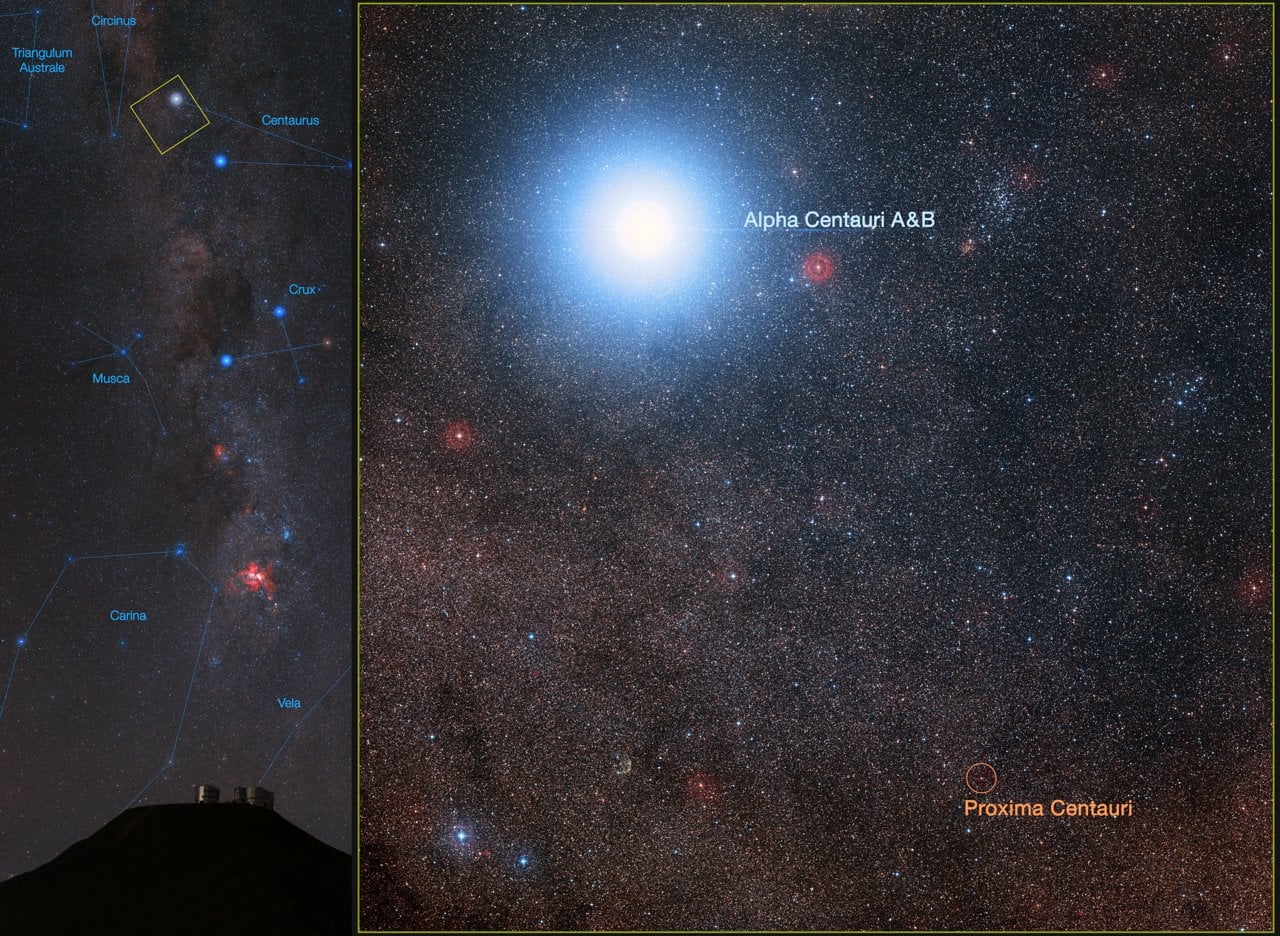
The label Alpha Centauri hides a small distance difference. The European Southern Observatory’s view of the system shows the bright Alpha Centauri A and B pair together with faint Proxima Centauri. Proxima is the closest individual star at roughly 4.24 light-years; A and B are about 4.37 light-years away. That is why careful versions of the calculation produce figures between about 164,000 and 168,000 years.
Space Daily has previously examined why the nearest star remains beyond conventional spacecraft timescales. The essential obstacle is not that rockets are slow near Earth. It is that interstellar distance makes impressive local speeds inadequate.
While Starshot remains a design study, one object has already made it into interstellar space for real: Voyager 1, launched in 1977, crossed the boundary in 2012 and has been transmitting from out there ever since. If missions like this fascinate you, the video here is worth a watch — Voyager’s power is finally running out, but before it goes silent, it picked up a signal nobody expected from that same dark between the stars.
Starshot begins by throwing away almost all the mass
The Breakthrough Starshot proposal does not attempt to send a shuttle, a crew or even a conventional robotic spacecraft. Its nanocraft would consist of a StarChip and a lightsail.
The StarChip is envisaged as a gram-scale wafer carrying cameras, other sensors, processing, a power supply, navigation equipment and a communications system. The sail would be about a metre across, extremely thin and highly reflective. The complete vehicle would weigh only a few grams.
That mass choice changes the propulsion equation. Chemical rockets carry fuel, tanks and engines, then spend energy accelerating those items along with the payload. Starshot would leave its main power source at home. A ground-based phased array would aim coherent light at the sail. Photons have no rest mass, but they carry momentum; reflecting them produces pressure.
Ordinary sunlight produces too little pressure for a 20-year crossing. Starshot’s photon-engine specification described a gigawatt-scale ground laser, while the broader concept has discussed an array scalable to roughly 100 gigawatts. The beam would accelerate each nanocraft for minutes rather than follow it across interstellar space.
The intended cruise speed is approximately 0.2 times the speed of light, close to 60,000 kilometres per second. That is around 7,700 times the shuttle’s orbital speed. Dividing 4.24 light-years by 0.2 light-years per year gives a crossing time a little above 21 years.
The acceleration would be short, intense and strictly robotic
Most of the 20-year journey would be coasting. The dramatic part would occur near Earth, as the beam raised the sail from orbital speeds to a substantial fraction of light speed in minutes.
Depending on the final acceleration profile, the nanocraft would experience forces amounting to thousands of times Earth’s gravity. A human body could not tolerate that. A solid-state payload weighing grams can be built without seats, pressure vessels, life support or delicate full-sized mechanisms, although its electronic and optical components would still have to survive the load.
The distinction is easy to lose when the crossing time is compared with a human lifespan. Starshot is not a plan to carry people to another star in 20 years. It is a proposal to send large numbers of tiny autonomous probes on one-way, high-speed flybys.
Nor does 20 per cent of light speed approach the ultimate limit in the casual sense. Space Daily recently explained why any spacecraft with mass cannot reach light speed. Starshot’s target remains below that boundary, but the energy and precision needed to reach even 0.2 times light speed are far beyond those of any completed spacecraft propulsion system.
The sail must be both featherlight and almost perfect
A metre-scale film pushed by an extreme laser beam cannot simply be shiny. It must reflect nearly all the incoming light. Even a small absorbed fraction can heat an ultrathin material until its optical properties change, it bends out of shape or it fails.
The sail must also remain centred and correctly angled within the beam while it accelerates. A phased array has to make many laser elements behave as one optical instrument, compensate for atmospheric turbulence and hold its focus as the nanocraft recedes over a distance of millions of kilometres.
Research has begun to isolate pieces of that problem. In 2025, Caltech researchers reported direct radiation-pressure measurements on a 50-nanometre silicon nitride membrane. They measured forces around 70 femtonewtons and investigated how beam angle, spot size and edge scattering altered the response.
That work matters because stable propulsion depends on accurately predicting tiny forces and unwanted sideways motion. It was nevertheless a tethered microscopic laboratory membrane illuminated at 110 watts per square centimetre, not a free-flying metre-wide sail under a 100-gigawatt array. As Space Daily reported when the experiment appeared, it was an early measurement tool for possible future sails.
Reaching the system would create a new set of problems
Interstellar space is thin, not empty. At 0.2 times light speed, individual gas atoms and dust grains strike with enough energy to damage exposed material. A quantitative study of relativistic spacecraft and the interstellar medium found that gas bombardment, dust erosion, cratering and local melting could all matter on the route to Alpha Centauri. Its estimates depended on material and assumed particle populations, but the hazard cannot be dismissed merely because the space between stars looks vacant.
Possible responses include presenting a narrow edge to the direction of travel, adding a sacrificial shield and sending many probes so that the mission does not depend on one survivor. Every protective layer consumes a mass budget measured in grams.
Arrival would be a flyby, not a rendezvous. No second laser array would be waiting at Alpha Centauri to remove the probe’s speed. At 0.2 times light speed, a nanocraft would cover the Earth-Sun distance in about 42 minutes. It could cross the most valuable observing region in hours, so pointing, exposure choices and target selection would have to happen autonomously.
Returning the observations could be harder than taking them. A gram-scale craft must power and aim a transmitter across more than four light-years while Earth attempts to detect the extremely faint signal. The first bit sent at arrival would then need another 4.24 years to get home. A launch-to-data timeline would therefore be closer to 25 or 26 years even if the flight worked exactly as intended.
Twenty years is a design result, not a launch forecast
Breakthrough Starshot was announced in 2016 as a research and development programme. Its stated goal is to demonstrate the feasibility of light-driven nanocraft and lay foundations for a possible interstellar mission. The initiative’s own engineering challenge list includes the laser array, energy storage, atmospheric correction, sail stability, dust, navigation, imaging and communication.
There is no approved operational nanocraft, completed photon engine or confirmed Alpha Centauri launch date. Laboratory progress on materials and optical forces should not be confused with an integrated flight system. A useful design can remain scientifically serious while still being a long distance from construction.
The 165,000-year comparison and the 20-year proposal are therefore not predictions of equal maturity. The first is a thought experiment using a speed humanity repeatedly achieved in low Earth orbit. The second is a calculation for a machine whose individual principles obey known physics but whose complete architecture has never been demonstrated.
One number shows how little conventional orbital speed buys across 40 trillion kilometres. The other shows the extraordinary price of shortening the journey: discard almost all the spacecraft, keep the engine on Earth, accelerate a sail with an unbuilt laser and trust a gram of electronics to cross the dark for two decades.
