
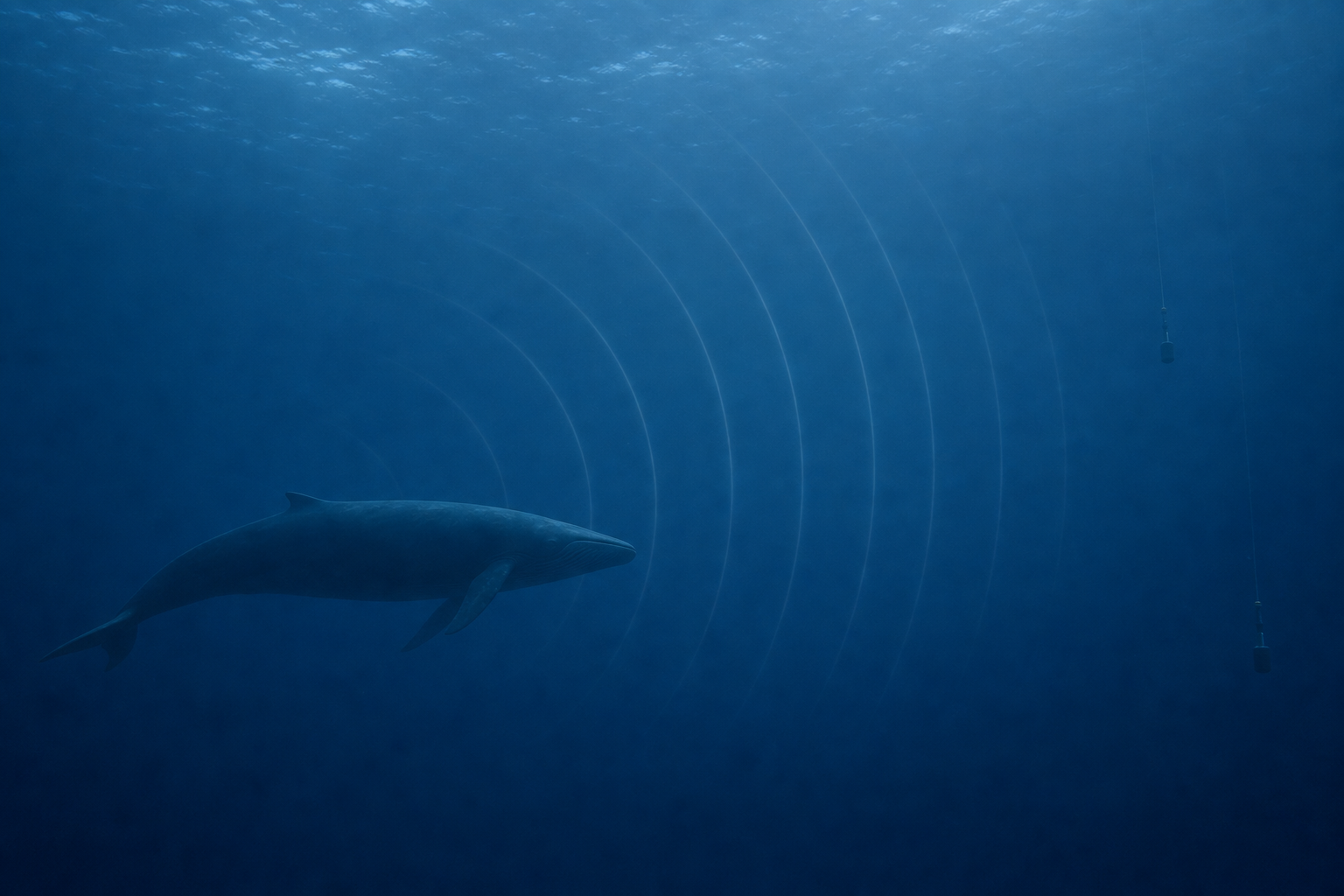
Somewhere in the North Pacific, an unidentified animal once produced a call unlike any other signal in a vast archive of whale sounds. Its notes clustered near 52 hertz, substantially higher than the stereotyped calls of the blue and fin whales that travelled through the same ocean.
Correction, September 20, 2026: The headline was revised because the acoustic record does not establish that no other whale answered or that other whales could not hear the call.
Researchers followed that acoustic signature across thousands of kilometres and multiple migration seasons. They never matched it to a sighting, a photograph, a tissue sample or a tag. What they had was a moving voice, heard by military hydrophones but never connected with certainty to a body.
The record is real. The familiar story attached to it is much less secure. No study established that the caller was lonely, that other whales could not hear 52 hertz or that it called without receiving an answer. The phrase “world’s loneliest whale” turned a careful acoustic paper into a parable about isolation, filling the largest gaps in the evidence with a human emotion.
Cold War hydrophones heard a biological signal
The unusual calls emerged from recordings made by the US Navy’s Sound Surveillance System, or SOSUS. Built to detect submarines across ocean basins, its deep-water hydrophone arrays also captured low-frequency sounds produced by large whales. The resulting technical record is preserved by the US National Technical Reports Library.
Biologist William Watkins and colleagues at Woods Hole Oceanographic Institution used access to those recordings to track whale movements that would have been almost impossible to follow from a ship. A single low-frequency call can travel far underwater, allowing several hydrophones to estimate the caller’s position from differences in arrival time.
The team detected the unusual source in 1989 and 1990, then tracked it repeatedly from 1992 through 2004. Their main report, published in Deep-Sea Research Part I, described 12 years of seasonal detections across the eastern North Pacific.
The call sequences appeared from roughly August or September through January or February. The source travelled between waters off California and the Aleutian Islands, covering distances consistent with a migratory baleen whale. Its routes varied from year to year but overlapped broadly with areas used by blue and fin whales.
Only one series of 52-hertz calls was recorded at a time, with no overlapping calls of the same distinctive type. That supported the researchers’ interpretation of a single source. It did not prove that one individual generated every detection across every year, although the stable call structure and repeated seasonal pattern made that a reasonable working hypothesis.
Why 52 hertz stood out
Frequency is the number of pressure-wave cycles per second. A 52-hertz tone sits near the low edge of human hearing, though whale recordings are often shifted or accelerated to make their structure easier to hear through ordinary speakers.
Blue and fin whales produce many kinds of sound, but their best-known long-distance calls in the North Pacific often carry dominant energy closer to 10 to 30 hertz. The mysterious source used higher fundamentals and a distinctive sequence of brief pulses. A Woods Hole account of the original work described the calls as having the repeated low-frequency characteristics of a whale while remaining unlike those attributed to a known species.
The pitch also changed. Watkins and colleagues found that the mean frequency declined over the study period, from near 52 hertz towards the upper 40s. That gradual deepening could reflect the animal’s growth or a broader change in vocal behaviour, but the acoustic record alone could not identify the cause.
Calling it “the 52-hertz whale” makes the number sound fixed. It was really a convenient name for a recognisable call pattern whose frequency varied with time. Whale vocalisations are not tuning forks, and many populations change their song frequencies over years.
Other whales could almost certainly hear it
The claim that no other whale can hear 52 hertz is not supported by whale acoustics. NOAA summarises baleen-whale sounds as generally occupying a broad low-frequency range extending up to several kilohertz. Fifty-two hertz lies comfortably inside that broad acoustic territory.
Direct hearing tests are difficult to conduct on the largest whales, so their exact sensitivity curves are reconstructed from anatomy, models, vocalisations and behavioural responses. The details remain uncertain. The broad conclusion does not: blue, fin and humpback whales are not acoustically deaf at 52 hertz simply because their most familiar calls peak lower.
Woods Hole’s overview of marine mammal hearing notes that baleen-whale ears are specialised for low-frequency sound. NOAA’s operational acoustic systems similarly monitor baleen calls across a range beginning around 10 hertz and extending into the thousands. A 52-hertz call is unusual in form and pitch, not inaudible to the rest of the ocean.
Hearing a signal is not the same as recognising it as a normal social call. A whale could detect the sound but respond differently because its pattern, timing or spectral structure does not match a familiar call. Even that is only a possibility. No behavioural observation linked the 52-hertz source with another whale, so researchers could not test recognition or response.
The hydrophones could not measure loneliness
Passive acoustic monitoring records sounds that reach a sensor. It does not show every animal around the caller, and silence in a recording does not mean silence throughout the surrounding ocean. Another whale might answer with a different call, vocalise outside the monitored band, respond beyond the array’s useful range or interact without calling at all.
NOAA’s description of marine mammal acoustic research makes the limitation clear: calls can reveal presence, movement and sometimes population patterns, but the record depends on animals vocalising and on instruments being able to distinguish the signal from noise. Shipping, seismic surveys and other human activity occupy some of the same low-frequency soundscape.
The original study did not report a systematic search for replies to each 52-hertz call. Its purpose was to describe and track the unusual source. The absence of an identified matching call series therefore cannot be converted into evidence that nobody answered.
Nor does travelling alone establish emotional loneliness. Some large baleen whales naturally spend substantial time separated from visible companions, maintaining contact through sound over long distances. Scientists can study social association, stress hormones and behaviour, but they cannot diagnose an unseen animal’s subjective state from the frequency of one call.
What kind of whale made the sound?
The animal was never conclusively sighted, so its species, sex, appearance and health remain unknown. The migration track resembled those of blue and fin whales without matching either species perfectly. The call likewise carried features that invited comparison while remaining distinctive.
One possibility is an individual blue or fin whale with an unusual voice. Another is a hybrid between the two species. Blue-fin hybrids are biologically plausible and have been documented, including fertile individuals. A recent review of blue and fin whale hybridisation shows that hybrid ancestry occurs across ocean basins, but it does not identify the 52-hertz caller. Without a verified visual encounter or genetic sample, “hybrid” remains a hypothesis.
An anatomical difference could also alter vocal production. Deafness has been proposed in popular accounts, but the recordings do not demonstrate it. The animal’s orderly seasonal movements and repeated call sequences indicate that it functioned for many years. They say little about its hearing.
There may also have been more than one animal capable of producing a similar call. The Watkins record showed one active source at a time within the monitored data. It could not survey every part of the Pacific continuously, and it did not establish that no comparable caller existed elsewhere.
A mystery made larger by the story told about it
The lonely-whale interpretation has endured because it offers a complete emotional narrative where the science provides an unresolved signal. A voice is different from every other voice. It calls across a huge dark ocean. Humans hear it, but its own kind apparently does not. Each step feels natural, yet the final two are inferences rather than observations.
The careful version is still compelling. Researchers used a submarine-detection network to follow what was probably one whale across the North Pacific for more than a decade. They recognised an individual-like acoustic signature without ever seeing its source. The work demonstrated how passive hydrophones can localise low-frequency baleen-whale calls over water where visual surveys are intermittent and difficult.
It also exposes the boundary between detecting communication and understanding it. A spectrogram can measure frequency, duration, repetition and direction. It cannot reveal what the caller intended, whether a distant whale recognised the message or how the animal experienced its social world.
So no one can say whether the 52-hertz caller was truly alone. But “speaking a language the rest of the ocean cannot hear” goes beyond the evidence as well. Other baleen whales could almost certainly hear the frequency. What remains unknown is whether they recognised the call, responded in ways the old hydrophone record missed, travelled beside the caller without vocalising, or had no relationship with it at all.
The voice became famous because humans heard loneliness in the gaps. The scientific record preserves something quieter and more honest: an unidentified whale, a distinctive moving signal and a question that the microphones were never designed to answer.
