

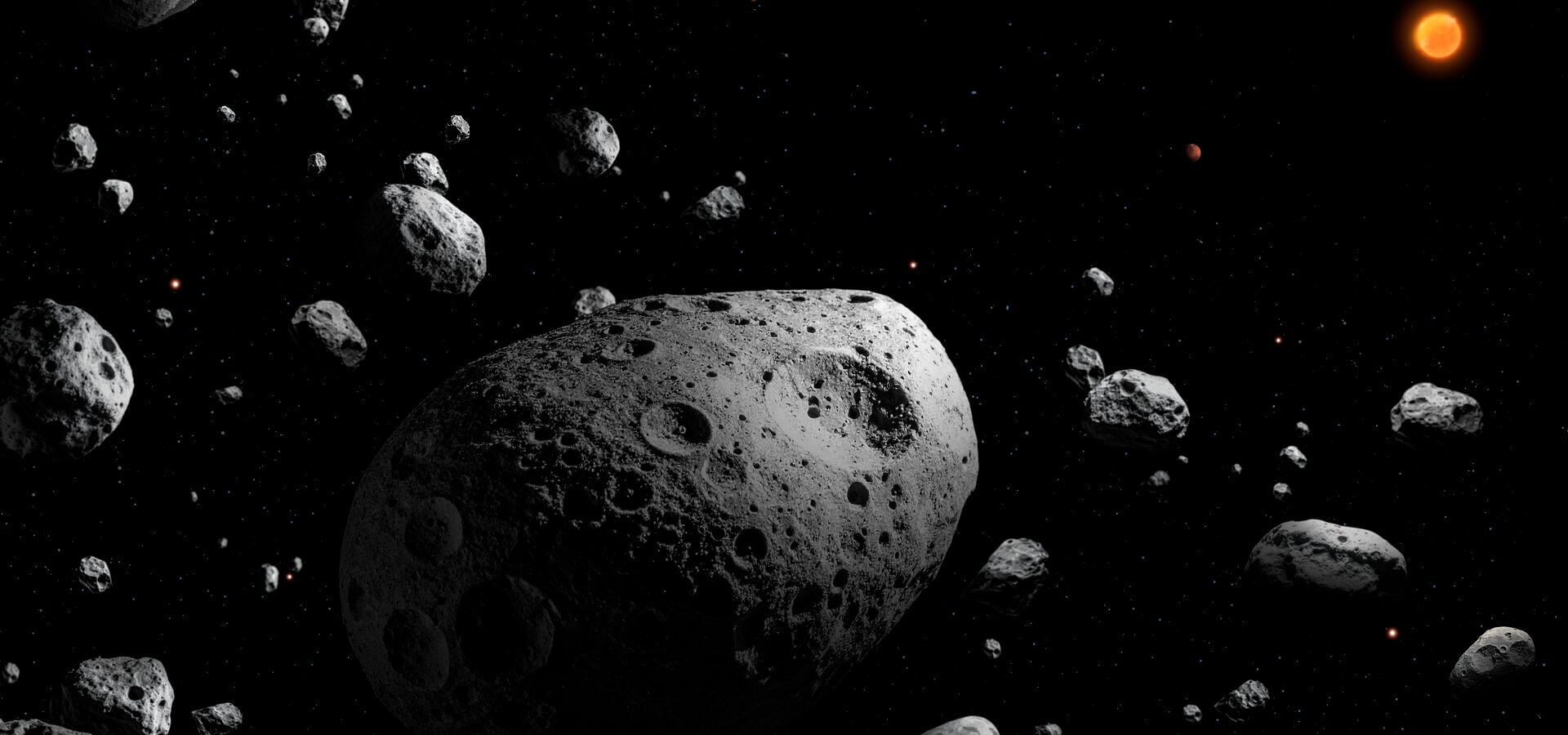
Somewhere in the main asteroid belt, a body estimated to be 710 metres wide completes a full turn every 1.88 minutes. Its landscape would sweep past again before an average pop song reached the chorus.
That measurement belongs to 2025 MN45, found in commissioning data from the NSF-DOE Vera C. Rubin Observatory in Chile. Sarah Greenstreet and colleagues reported it in The Astrophysical Journal Letters on 7 January 2026. Its rotation is roughly 70 times faster than the 2.2-hour spin boundary at which a loose asteroid of this size should begin pulling itself apart.
The researchers’ model says keeping it intact requires about 9 megapascals of cohesion, a value comparable to strong clay or rock.
Rubin did not film it spinning
At main-belt distances, Rubin sees 2025 MN45 as an unresolved point of light. An irregular asteroid reflects different amounts of sunlight as it turns, so a repeating pattern in its brightness can reveal the rotation period.
The team had 517 observations across 12 days. The same 0.031-hour period appeared when the data were separated by night and colour filter, and two independent techniques recovered it. Those checks matter because an extreme period can otherwise be an alias created by observing cadence.
This is one study, not settled consensus. Follow-up work can refine the result, but the reported spin is a repeated signal that survived several sensible attempts to make it disappear.
The 2.2-hour barrier is more than a rule of thumb
Many asteroids are rubble piles, collections of blocks and dust reassembled after collisions and held together largely by weak self-gravity. For nearly cohesionless main-belt asteroids larger than about 150 metres, observations show a spin barrier near 2.2 hours.
Below that period, rotation can make a typical rubble pile deform, shed stones or break apart. MN45’s reported period is about one-seventieth as long.
Using the nominal diameter and 112.8-second period, its equator would travel at roughly 71 kilometres per hour. That is illustrative, since the real size and shape remain uncertain, but it conveys why the object fits the rubble-pile picture so poorly.
“Solid rock” is an inference, not a sample
The 710-metre diameter is an estimate. The researchers converted the asteroid’s brightness into a size by assuming a sphere with an albedo of 0.15. A darker surface would imply a larger body; a brighter one, a smaller body.
The strength figure has similar boundaries. An established model, assuming a sphere with a bulk density of 1,700 kilograms per cubic metre, produced the estimate of about 9 megapascals.
So the solid-rock comparison is meaningful, but it is not a direct material test. Change the assumed albedo, density, shape or internal arrangement and the answer changes. Most securely, the calculation says self-gravity cannot explain how an object with the nominal size and measured period stays together.
Rubin found a whole population of fast spinners
MN45 came from Rubin First Look observations. Across nine nights between 21 April and 5 May 2025, roughly 340,000 measurements included 2,103 new asteroids. The researchers obtained reliable periods for 76 objects, 75 in the main belt and one near Earth.
Nineteen crossed the 2.2-hour barrier, and three turned in under five minutes. Those included the roughly 120-metre 2025 MJ71 at 1.92 minutes and the roughly 540-metre 2025 MK41 at 3.78 minutes. MN45 combines the shortest period with a size well above half a kilometre.
As a previous SpaceDaily article explored, the real asteroid belt is overwhelmingly empty space. Its smaller members are faint, their lightcurves require repeated measurements, and unusual rotators can remain unrecognised because nobody has watched them with the right cadence.
A commissioning run offered the right kind of attention
Rubin’s commissioning observations repeatedly covered selected fields, producing dense lightcurves. Its 3.2-gigapixel camera also combines sensitivity with a view wide enough to capture many moving objects at once.
SpaceDaily recently described how the car-sized camera began taking a southern-sky image about every 40 seconds when the ten-year survey started on 30 June 2026. It will not follow every asteroid this intensely, but repeated visits should build an unprecedented archive of brightness and motion.
If 19 superfast rotators appeared among only 76 reliable periods, the main survey may reveal that cohesive fragments are an undercounted part of the asteroid population.
What could make an asteroid this strong?
One plausible history is a collision that shattered a parent body, leaving a compact fragment while looser material dispersed. The paper raises this possibility, but a lightcurve cannot reconstruct the event.
Thermal data could separate diameter from albedo. More lightcurves could constrain shape and spin axis, while spectroscopy could identify surface minerals. The interior would remain an inference, but a better constrained one.
The most interesting thing about 2025 MN45 may be how cleanly it exposes the difference between gravity and strength. A normal rubble pile of the estimated size should not survive one rotation every 112.8 seconds. Yet the light keeps repeating. Unless follow-up work overturns the period or substantially changes the physical assumptions, this asteroid is doing something gravity alone cannot manage: holding itself together.