

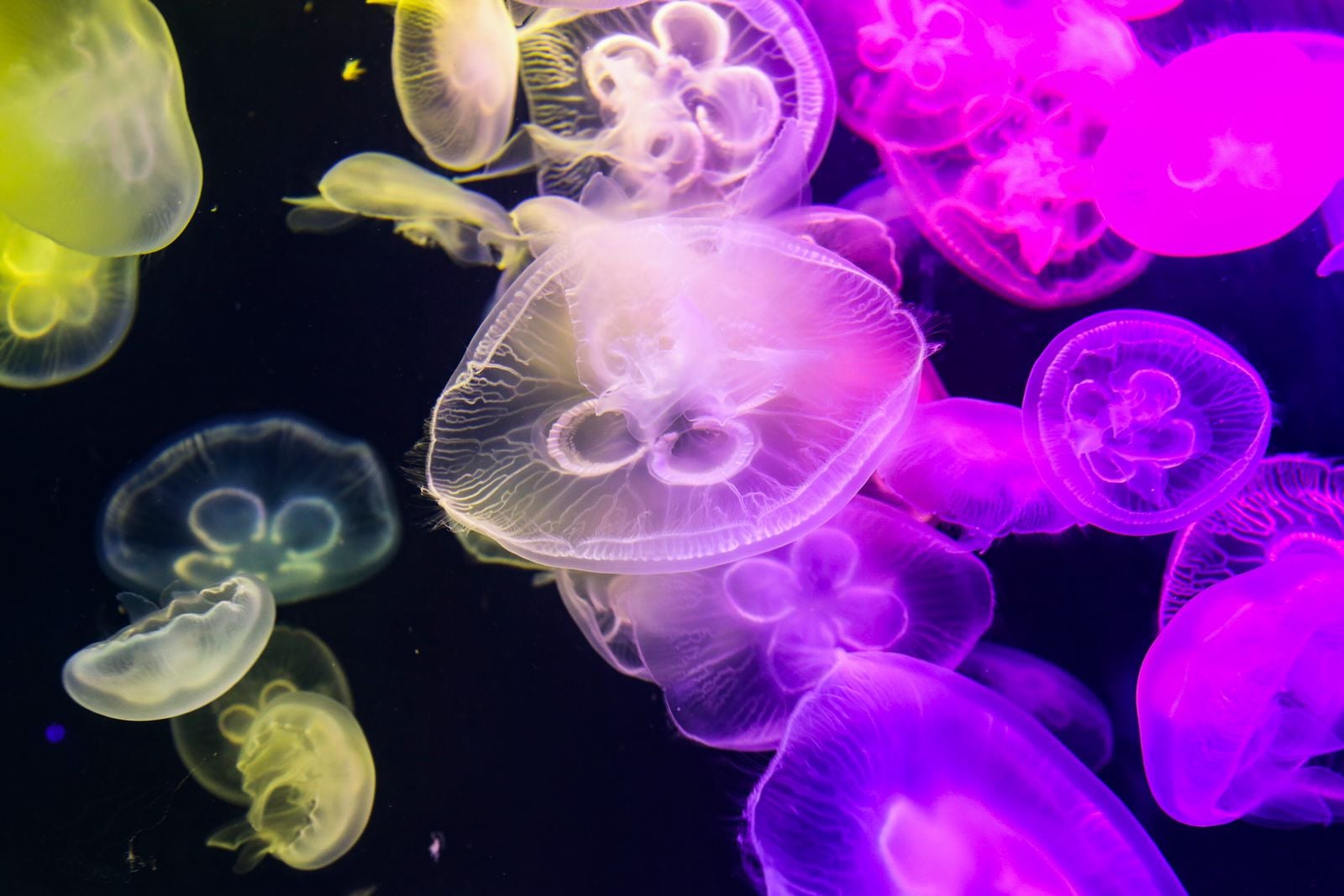
In the coastal shallows off Japan, a jellyfish no bigger than a fingernail responds to being sliced, starved, or otherwise pushed toward death by doing something no other animal on Earth is known to do: it collapses into a featureless blob on the seafloor, reorganises its cells over 24 to 48 hours, and buds off a fresh polyp carrying its own identical genome. The adult is gone. A juvenile stands in its place. And no upper limit has yet been found on how many times it can repeat the trick.
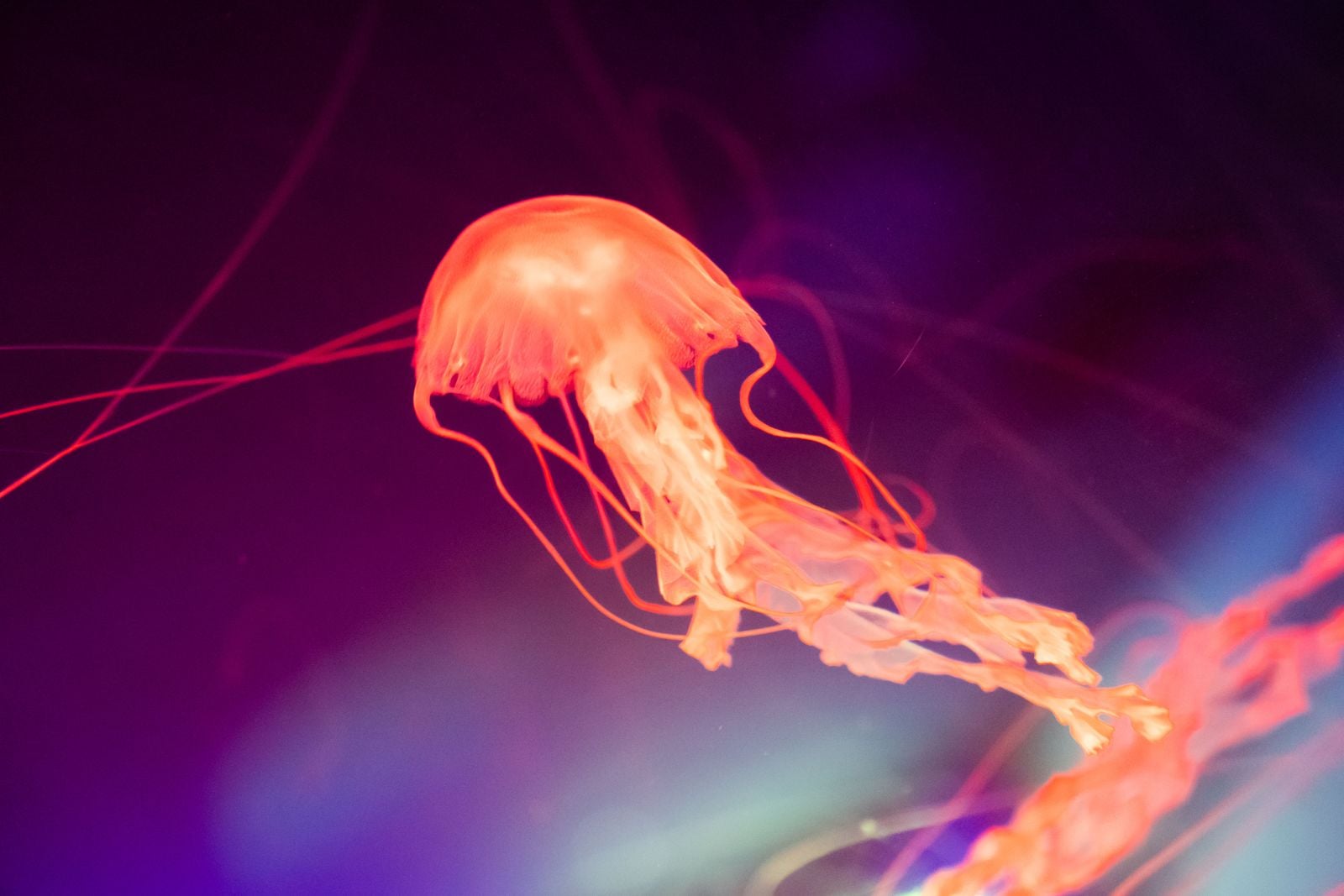
The animal is Turritopsis dohrnii. About 4.5 millimetres across. Transparent bell, bright red stomach, up to 90 trailing tentacles.
Under a microscope it looks almost too delicate to survive a wave. Under laboratory conditions it appears, on the available evidence, to be functionally ageless.
What the jellyfish actually does when it “dies”
Most hydrozoans follow a single-direction life cycle. A larva drifts, settles on the seafloor, becomes an anchored polyp, buds off free-swimming medusae, and those medusae grow up, reproduce, and die. It is a straight line from birth to end.
T. dohrnii can walk that line backwards. When a mature medusa is exposed to enough stress — sharp physical injury, starvation, disease, a temperature swing, chemical insult — it does not fight to stay a medusa. It retracts its tentacles, reabsorbs its bell, and sinks. On the seafloor it becomes what researchers call the cyst stage: an unstructured mass of tissue with no obvious body plan. Within a day or two, that mass reorganises and emerges as a functional polyp, ready to bud a new generation of medusae with the same genome as the animal that supposedly died.
Maria Pia Miglietta, a marine biologist at Texas A&M University who studies the species, put the point plainly in an interview reproduced by Mother Jones and the Guardian: “Turritopsis is unique, because when faced with unfavourable conditions — and I mean high temperature, physical cutting, starvation, chemicals in the water, you name it — when you try to kill the jellyfish, it doesn’t die.”
She has watched them do it. Over and over.
The word for it: transdifferentiation
The technical term is cellular transdifferentiation. Adult cells that had already committed to being muscle, nerve, or epithelial tissue abandon those identities and take on new ones. In almost every other animal, differentiation is a one-way road. A muscle cell becomes a muscle cell and stays a muscle cell. The developmental biology of essentially every species we study is built on that assumption of irreversibility.
T. dohrnii breaks the assumption.
The reversal was first documented in a 1996 paper in The Biological Bulletin and confirmed with electron microscopy. It is not metaphorical rejuvenation. It is a whole-body reorganisation in which the adult’s differentiated cells rewrite their own programming. As one biologist quoted by ZME Science described it, the process looks a little like a butterfly returning to a caterpillar.
What the 2022 genome comparison showed
For decades, the cellular mechanics of the reversal were poorly understood. In 2022, a whole-genome comparison published in the Proceedings of the National Academy of Sciences lined T. dohrnii up against its closest mortal relative, T. rubra — a near-identical species that cannot rejuvenate.
The differences were not subtle. T. dohrnii carried roughly twice as many genes associated with DNA repair and protection. It showed expansions in the machinery that maintains telomeres, the protective caps at the ends of chromosomes that fray a little more with each round of cell division and sit at the heart of how most organisms age at the cellular level. Genes governing stem cell populations, redox balance, and cell-to-cell communication were expanded or distinctly modified.
During the life-cycle reversal itself, the transcriptomic data showed something almost theatrical: developmental genes that had been active during the polyp stage switched back on, as though the animal’s genome were running a restoration from an earlier save point.
Earlier transcriptomic work had already suggested part of the answer. The jellyfish appears to deploy a version of the same reprogramming factors — Oct4, Sox2, Klf4, c-Myc — that Shinya Yamanaka used to turn adult human cells into induced pluripotent stem cells, work that won him a share of the 2012 Nobel Prize in Physiology or Medicine. The capacity for dedifferentiation may be older and more widely conserved than biologists once thought, with most animal lineages having lost it and this one having kept it and refined it.
How small, how many, and where they live
Immortal jellyfish are only a few millimetres across — smaller than the fingernail on your little finger. If you did not know what to look for, you would swim right past one.
They turn up in the Mediterranean, along the Atlantic coasts, off Panama and Brazil, and famously in the waters around Japan, where much of the early work on their reversal was done. A summary in the Ammon News wire coverage notes eight accepted species in the genus Turritopsis globally, of which only T. dohrnii is currently known to perform the full reset.
Ballast water in ocean-going ships has probably helped push the animal around the world. Populations that were once regional now show up in ports thousands of kilometres from where the species was first described.
What “immortal” does and does not mean
The species is not immortal in any everyday sense. It can be eaten by fish. It can be killed by pollution. It can be crushed. An injury severe enough to prevent the cyst stage from reorganising will end the animal like it would end anything else.
What the biology supports is narrower and stranger: in the absence of external mortality pressures, T. dohrnii appears capable of cycling through its life history without an obvious ceiling. Whether any individual actually does this in the wild is an open question — the ocean is not a safe place for a 4.5-millimetre animal — but in the lab, under careful conditions, biologists have watched the same lineage reset again and again.
The Natural History Museum in London notes that keeping the animal alive long-term is difficult. Few labs have managed sustained cultures. The care regime is intensive and daily.
Miglietta has framed the theoretical ceiling this way, quoted again in the Guardian coverage: “Theoretically it never has to die from getting old, it just keeps hitting the reset button.”
Why biologists care beyond the novelty
The most striking scientific puzzle is not the reversal itself. It is how the animal accomplishes the reversal without triggering runaway cell proliferation.
In human cells, the kind of dedifferentiation T. dohrnii performs routinely is the sort of process associated with cancer. Reprogramming cells is not the hard part. Cancer does it constantly. The hard part is doing it in a controlled, coordinated, whole-organism fashion that produces a functional animal at the other end rather than a tumour.
T. dohrnii has a solution to that problem. Biologists do not yet know what the solution is.
That places the animal at the intersection of three of the most consequential research fields in modern biology: ageing, regeneration, and oncology. And now, with the genome sequenced in full, the reversal can be studied gene by gene rather than only observed under a microscope.
What it is not
Life-extension marketing has, predictably, latched onto the jellyfish. It should be said clearly: T. dohrnii is not a pharmaceutical lead. There is no supplement derived from it that will slow human ageing. There is no near-term therapy. Anyone selling one is selling something.
What the animal offers instead is a different kind of value — a proof of concept. If a fully differentiated adult cell can be induced, in an intact organism, to abandon its identity and start again, then cellular senescence is not a wall that biology has never found a way over. Evolution has found a way over it at least once, in at least one lineage.
That does not mean the trick will translate. Most likely it will not, at least not directly. But the question it forces is a real one.
Where the jellyfish sits in the wider story of biological limits
Life on Earth keeps producing organisms that quietly break the rules other organisms live by. Space Daily’s Life Signs desk has looked at several of them — from migratory birds that may perceive Earth’s magnetic field through a quantum reaction in their eyes, to the possibility that free-living cellular life on this planet emerged independently more than once. Each case complicates a limit that once looked absolute.
The immortal jellyfish complicates the most absolute limit of all. Every organism ages. Every organism dies. That is biology’s most reliable law — except in this one animal, which appears to have found a workaround written into its genome.
Space Daily has covered the reversal itself in earlier reporting, and biologists’ astonishment at the trick has not worn off in the years since.
The strangeness of the fact itself
Lisa-ann Gershwin, a biologist who has spent much of her career on jellyfish, describes Turritopsis as “exquisite” and “the most beautiful little creature.” Speaking to the Guardian, she also put her finger on the strangest part of the fact:
“It’s so hardwired in humans to not want to die. And I think the drive that we have to survive, and the absurdity of that being in a jellyfish — the juxtaposition of those two just entertains me to no end.”
Human beings have spent centuries chasing eternal life through alchemy, cryonics, gene therapy, blood transfusions from young donors, and a long list of frauds. A thimble-shaped animal in the shallows off Japan has been doing it, on a technicality, the entire time.
The list of animals with unusual ageing biology is longer than most people realise — Greenland sharks, certain tortoises, some deep-sea corals — but no other known metazoan performs a true whole-body reset. Only this one.
The medusae in a laboratory tank in Texas or Kyoto tonight may be the same medusae that were there last year, and the year before, in a lineage sense that no human vocabulary quite handles. They collapsed. They dissolved into a blob. They came back as polyps. They budded new medusae. Same genome. Same animal, or something close enough that biologists still argue about the word.
Off the coast of Japan, at this hour, a jellyfish smaller than your smallest fingernail is drifting through dark water, carrying a genome that has already solved a problem the rest of the animal kingdom did not.