
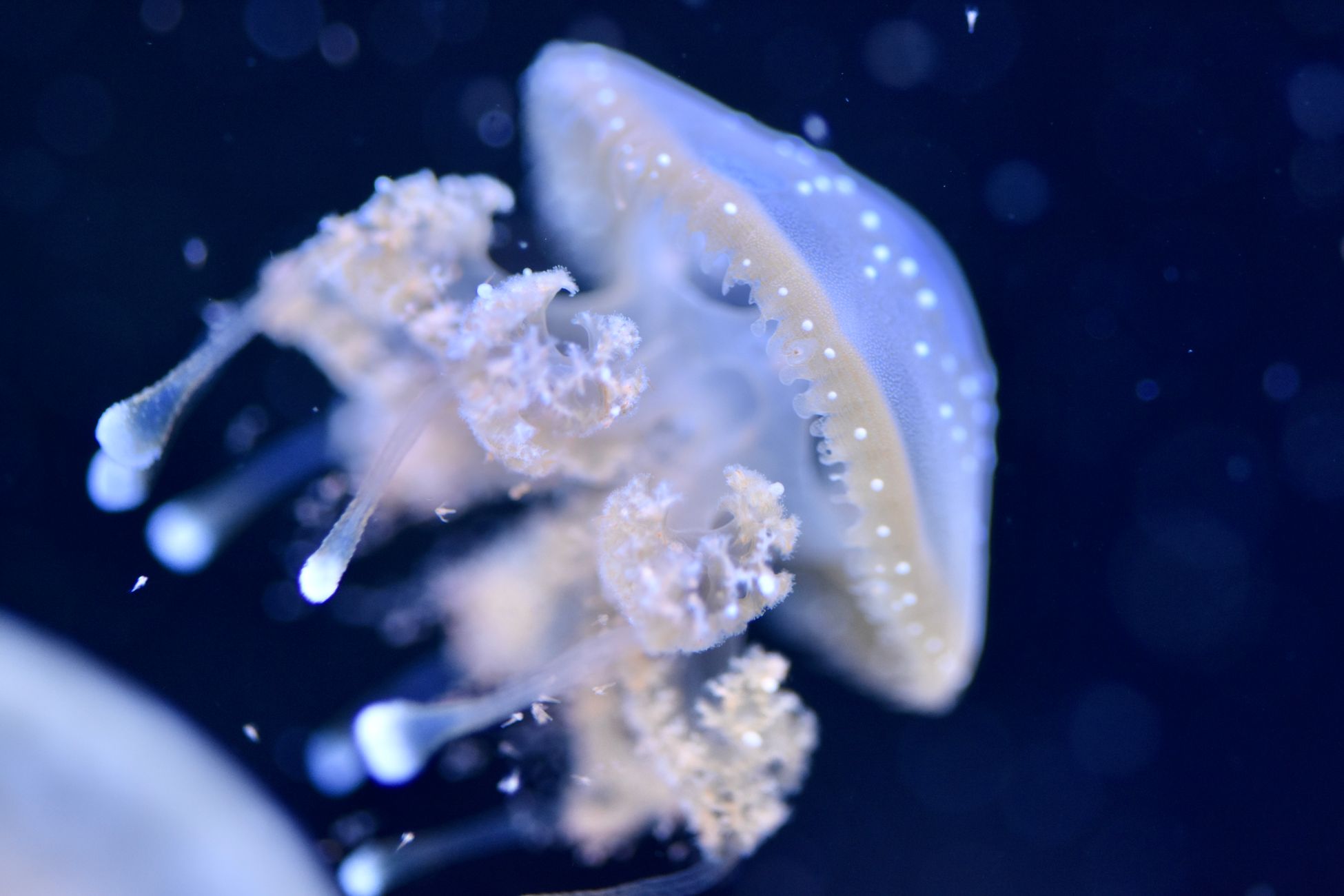
In a seawater tank at an aquarium in Japan, a jellyfish smaller than a pencil eraser is doing something no other complex animal is known to do. Turritopsis dohrnii, a hydrozoan from the Mediterranean about four millimetres across, has been injured by a researcher, and instead of dying it is collapsing inward — its bell folding, its tentacles retracting, its swimming muscles dissolving into a small blob of cells that will sink to the bottom of the tank, fasten itself to the glass, and grow back into the polyp stage it left behind when it was effectively a child. The same individuals have been observed doing this over and over again for years. The animal does not appear to age out of the trick.
The process is called transdifferentiation, and it is the reason Turritopsis dohrnii has been nicknamed the immortal jellyfish. The name overstates the case — the animal can still be eaten, crushed, or infected — but it is not metaphor. Under laboratory conditions, the jellyfish has been observed to reverse its own life cycle indefinitely, which makes it the only known multicellular animal with a built-in escape hatch from old age.
What the jellyfish actually does
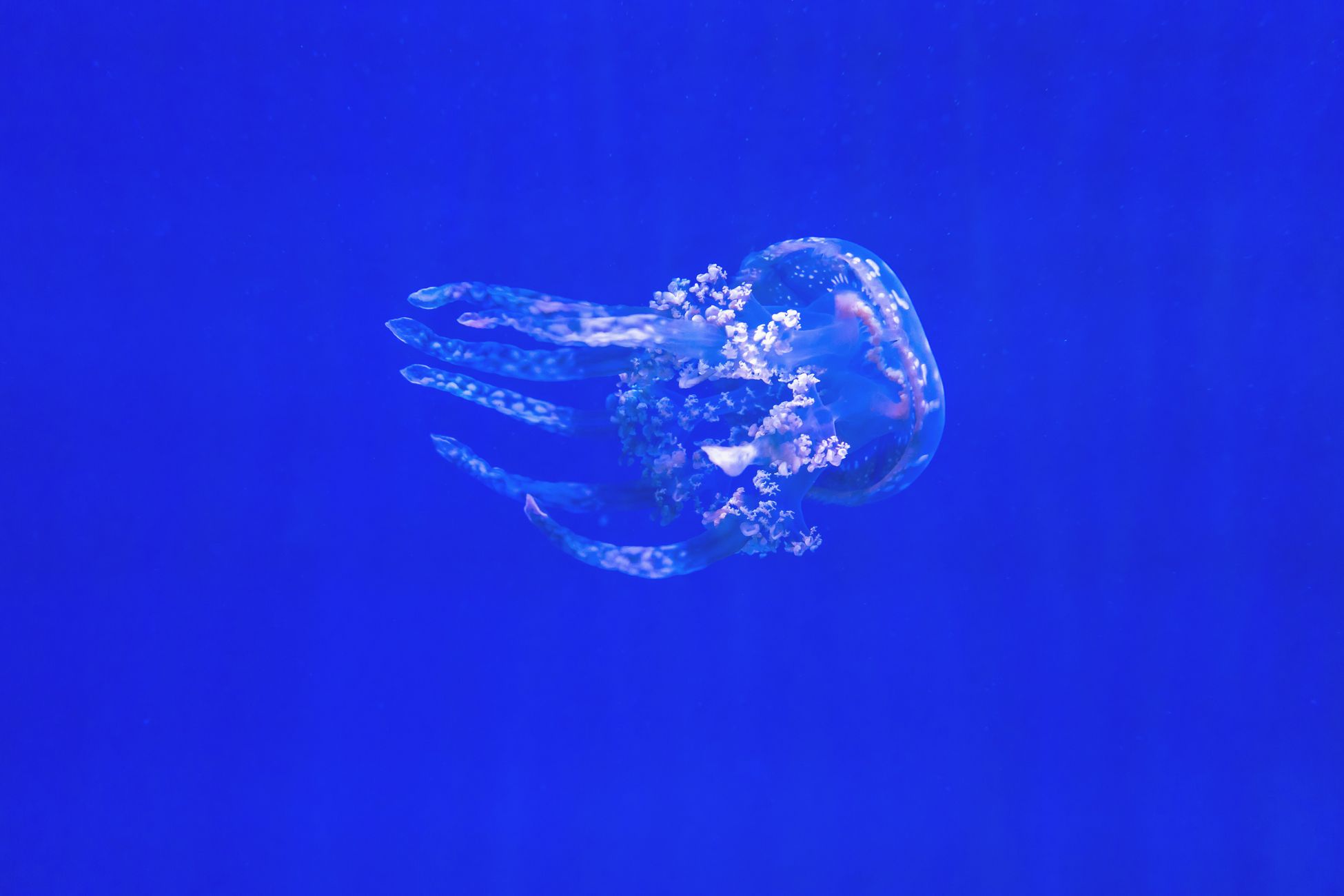
Most jellyfish go through two main life stages. They start as a fertilised egg that develops into a larva, the larva settles on a hard surface and grows into a polyp — a small stalk with a mouth and tentacles, attached to rock or shell — and the polyp eventually buds off free-swimming medusae, the pulsing umbrella-shaped form most people picture when they hear the word jellyfish. The medusa reproduces sexually, releases eggs, and then dies. The arrow points one way.
Turritopsis dohrnii can run the arrow backwards. When the adult medusa is wounded, starved, or exposed to sudden changes in temperature or salinity, it does not simply repair itself. It dismantles. Its cells lose their specialised identities — muscle cells stop being muscle cells, nerve cells stop being nerve cells — and reorganise into a cyst-like ball that attaches to a substrate and grows into a new polyp colony. From there it can bud off fresh medusae again. The animal that comes out is genetically identical to the one that went in. It is, in the most literal biological sense, its own younger self.
This is what makes the case strange. Plenty of animals regenerate lost parts — salamanders regrow limbs, starfish regrow arms, certain flatworms can be sliced apart and reconstitute themselves. But regeneration replaces tissue. Transdifferentiation rewrites identity. A muscle cell in a regrowing salamander leg stays a muscle cell. In Turritopsis dohrnii, the muscle cell becomes something else entirely.
How it was discovered
The reversal was first noticed almost by accident. Observations of Turritopsis medusae in laboratory conditions showed that instead of dying after spawning, they were sinking to the bottom of containers and turning back into polyps.
The finding sat quietly in the literature for years until specialists began examining strange life cycles in hydrozoans. Among the cases discussed was the unusual jellyfish, and in carefully controlled experiments, researchers confirmed that the reversal was real, repeatable, and not a fluke of stressed captive animals. The developmental sequence was documented in detail, giving the species its odd new claim to fame.
Shin Kubota and the indefinite reboot
The person who has spent more time watching Turritopsis dohrnii reverse itself than anyone alive is Shin Kubota, who keeps colonies in Japan. Kubota has kept individual jellyfish through the cycle dozens of times. In one stretch he documented a single specimen rejuvenating ten times in two years, and the broader pattern in his tanks is that the reversal does not appear to degrade with repetition. The polyp that emerges from the twelfth cycle looks like the polyp that emerged from the first.
That is the part that startles biologists. Most cells that divide many times eventually accumulate damage — telomeres shorten, mutations build up, mitochondria misfire. The reset in Turritopsis dohrnii appears to clear something. Whether it clears everything, indefinitely, is still an open question, but no one has yet caught the animal failing at the trick under good conditions.
What the genome shows
In 2022, a team led by Maria Pascual-Torner and Carlos López-Otín at the University of Oviedo in Spain published the first complete genome of Turritopsis dohrnii alongside its close relative Turritopsis rubra, which cannot reverse its life cycle. The comparison was the point. The Oviedo team found that the immortal jellyfish carried expanded or duplicated copies of genes involved in DNA repair, telomere maintenance, the stem-cell pool, and the protective handling of damaged proteins. The species also carried variants in genes that govern cellular senescence — the state in which damaged cells stop dividing and start leaking inflammatory signals — that appear to make it easier for its cells to escape that state.
The picture that emerged was not a single magic gene but a combination. Turritopsis dohrnii appears to have stacked several different anti-aging adaptations that, taken together, give its adult cells the option of reprogramming themselves back to an earlier developmental state. Some of those same pathways are well-studied in humans. The Oviedo group was explicit that the animal is being studied as a model for human ageing, not because anyone expects to bottle its trick, but because the genes it leans on are the same genes that go wrong in our own cells when they wear out.
Why this does not mean immortality is solved
The leap from a four-millimetre hydrozoan to a human being is enormous, and the people who study Turritopsis dohrnii are the first to say so. The jellyfish has no brain, no organs in the vertebrate sense, no skeleton. Its body plan is a handful of cell types arranged in two thin layers. The challenge of reorganising those cells is closer to rearranging the same Lego pieces than to rebuilding a cathedral from rubble. Human cells, organised into tissues with long developmental histories and complex epigenetic memories, cannot simply be told to forget what they are and start over without losing the information that makes a person a person.
There is also a measurement problem. A review published in December 2025 in Genomic Psychiatry argued that the field’s standard tools for measuring biological age in any organism are deeply flawed, which means that even calling the jellyfish ageless requires care about what ageing is being measured against. The animal certainly resets developmental stage. Whether it resets every clock biologists care about is a harder claim.
And in the wild, Turritopsis dohrnii almost certainly does not live forever. It gets eaten by larger jellyfish, fish, sea slugs and sea anemones. It gets pulped by storms. It gets dragged in ballast water across oceans — the species has now been found everywhere from the Mediterranean to Japan to Panama to the coast of Florida, and the global spread is thought to be partly the work of shipping. The immortality is conditional. It works in still water and gentle hands.
The thing that stays with you
Other animals are now being looked at with new interest because of what was found in the laboratory. Comb jellies have been observed reverting from their adult form back to a larval one, suggesting that the trick may not be unique to a single species but rather an old, deeply buried capacity in animals with simple body plans. The hydra, a freshwater cousin of the jellyfish, has long been known to renew its cells continuously and shows few signs of ageing in the lab. The immortal jellyfish may turn out to be the most extreme example of a more general pattern rather than a one-off miracle.
Shin Kubota is now in his late sixties. He has written karaoke songs about the jellyfish he studies, performed them on Japanese television, and described the animal in interviews as the most miraculous creature on Earth. The jellyfish in his tanks, having gone through their cycles many times, will outlast him. Some of them will be the same individuals — biologically continuous with the polyps he first collected — long after the man who watched them reset is gone.
