

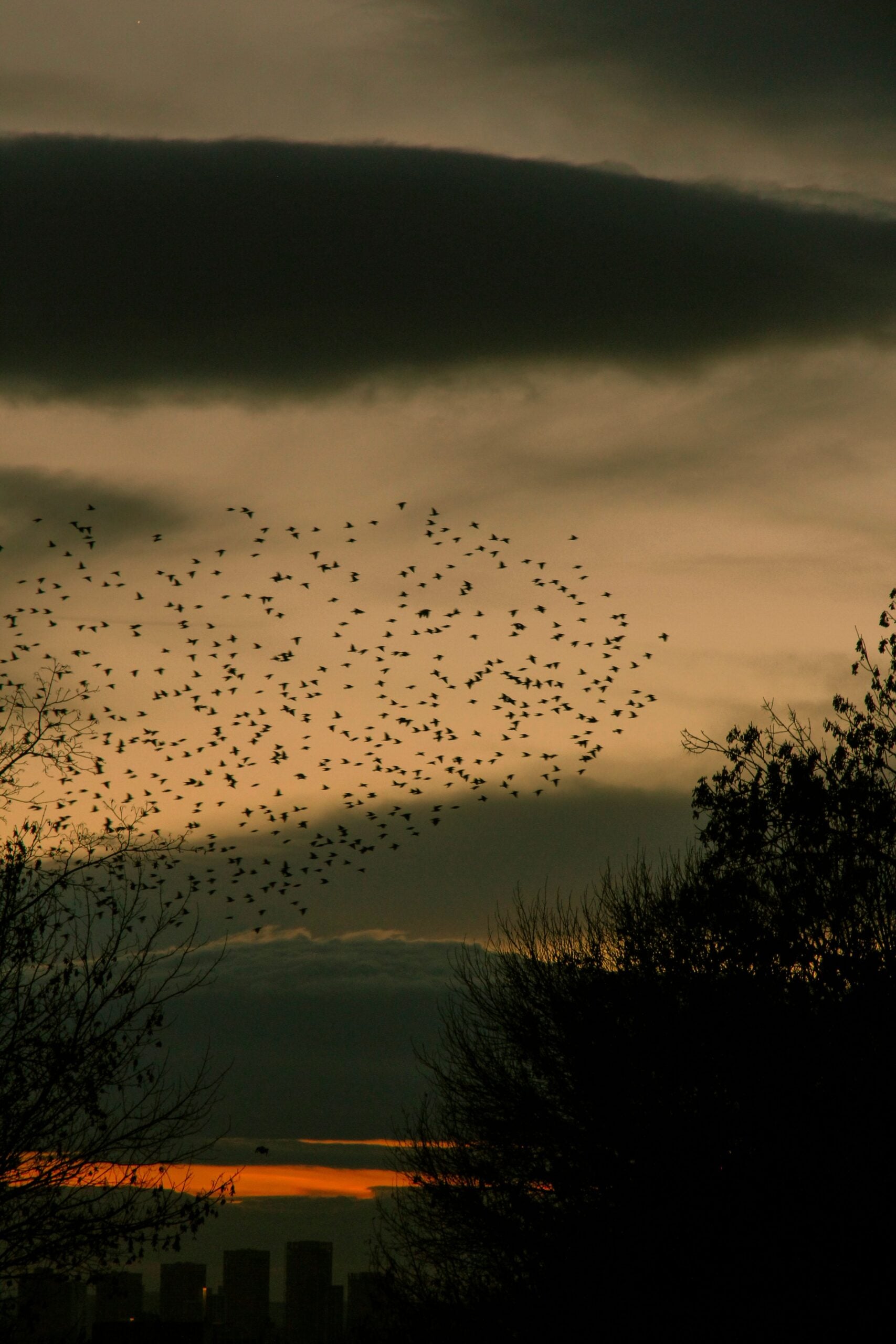
A night-migrating robin can choose a seasonally appropriate direction inside a featureless cage even when stars and landmarks are unavailable. Rotate the magnetic field around the bird and its preferred direction rotates with it. The behavioural fact is well established: many birds possess a magnetic compass. The unsolved part is how a field tens of thousands of times weaker than a refrigerator magnet enters the nervous system.
The leading proposal puts a chemical compass in the retina. Light excites proteins called cryptochromes, creating pairs of short-lived molecular fragments whose electron spins evolve quantum mechanically. Earth’s magnetic field may alter that spin evolution by a tiny amount, changing the chemical output of cells at different positions in the eye. If the brain combines that output with ordinary sight, magnetic direction could appear as a pattern laid over the visual scene.
Every part of that account requires a different confidence label. The magnetic behaviour is observed. Radical-pair chemistry is physically real. A robin protein has shown magnetic sensitivity in a test tube. The identity of the receptor in a living bird remains unconfirmed, and nobody knows what a magnetic signal feels or looks like to the animal.
The compass birds actually demonstrate
Experiments beginning in the twentieth century placed migratory songbirds in circular orientation cages and recorded the direction of their movements. Coils surrounding the apparatus allowed researchers to rotate the horizontal component of the local magnetic field without supplying a visible cue. The birds changed their headings in step with the manipulated field.
The avian compass differs from a pocket compass. Many tested birds respond to the inclination of field lines relative to gravity, not to magnetic polarity. Reversing magnetic north and south while preserving the inclination does not necessarily reverse their heading. Turning the field’s vertical component upside down does. The system therefore distinguishes poleward from equatorward through the angle at which field lines enter Earth.
Lighting matters, and certain weak radio-frequency fields can disrupt orientation. Those characteristics helped motivate the radical-pair hypothesis. Neural experiments also found that magnetic compass information in European robins depends on visual pathways; a 2009 Nature study reported visual, rather than trigeminal, mediation of compass orientation. That does not by itself identify a molecule or prove that the signal becomes a conscious picture.
A quantum reaction small enough to notice Earth
Cryptochromes are flavoproteins, meaning they bind a light-absorbing cofactor called flavin adenine dinucleotide, or FAD. When a photon excites FAD, an electron can transfer along a chain of tryptophan amino acids. The transfer leaves two radicals, each containing an unpaired electron.
The pair begins in a quantum spin configuration and can oscillate between states conventionally called singlet and triplet. Internal magnetic interactions within the molecules drive that evolution. An external field as weak as Earth’s can, under suitable conditions, alter the timing or balance. If singlet and triplet states proceed toward different products, the reaction yield becomes a possible compass readout.
The crucial quantity is direction as well as strength. A cryptochrome held at one angle to the field can produce a slightly different output from an identical molecule held at another angle. The standard biophysical review of the radical-pair mechanism explains how this anisotropy could convert electron-spin chemistry into orientation information.
Calling the process quantum does not require a bird to perform a calculation, nor does it establish macroscopic quantum entanglement across the brain. Electron spin and the rules governing radical-pair reactions are quantum phenomena at molecular scale. The biological challenge is amplifying a very small chemical difference into a reliable neural signal.
Why European-robin CRY4 drew attention
Bird retinas contain several cryptochromes. Cryptochrome 4, or CRY4, became a leading candidate because it occurs in photoreceptor cells and does not simply follow the daily expression cycle expected of a circadian clock protein. Work on European robins located CRY4 in outer segments of double cones and long-wavelength single cones, positions compatible with a light-dependent retinal sensor.
The strongest molecular result came in 2021. Researchers purified CRY4 from the night-migratory European robin and compared it with corresponding proteins from chickens and pigeons. Light initiated electron transfer through a chain of four tryptophans, and the robin protein’s photochemistry was magnetically sensitive in vitro. It showed a larger response than the two comparison proteins.
Site-specific mutations helped identify which electron-transfer steps created and stabilised the radicals. This was powerful evidence that robin CRY4 possesses molecular machinery suitable for a chemical compass. It was not a complete demonstration of magnetoreception. The protein had been removed from the retina, the experiment did not trace a signal into a bird’s brain, and domestic chickens and pigeons also use magnetic information despite their weaker CRY4 responses in that assay.
What a magnetic overlay might look like
The visual-overlay idea follows from geometry. If magnetically sensitive proteins are anchored in ordered orientations across the curved retina, each region will meet Earth’s field at a different angle. Radical-pair yields would vary spatially. As the bird turns its head, the pattern would shift relative to the landscape.
Models often render the result as changing light and dark bands, altered contrast or colour modulation with symmetry around the field axis. A bird could learn that a particular pattern corresponds to a useful migratory bearing, much as humans learn to interpret a compass face. Space Daily previously described laboratory work showing that a synthetic light-activated molecule could respond to Earth-strength fields, an important proof that chemical direction sensing is physically possible.
But simulated haze and glowing field lines should not be confused with avian experience. No researcher can ask a robin whether the signal resembles brightness, colour, texture or something that has no human visual analogue. The magnetic channel could also remain partly separate from ordinary image formation while using retinal cells and visual brain pathways. “Seeing” is a useful shorthand, not a measured account of conscious perception.
The hypothesis still has serious gaps
A major 2026 review of magnetosensation concludes that the cryptochrome hypothesis has substantial support but remains far from proven. Among its concerns, laboratory magnetic effects on cryptochromes have often been demonstrated at fields stronger than Earth’s. Direct evidence that a geomagnetic-strength field changes an intact candidate receptor in a living bird is still missing.
The chemical details are contested too. The simplest account emphasises radical pairs formed during light-driven reduction of FAD. Some behavioural experiments show birds orienting under green wavelengths that cannot initiate that step efficiently, or responding when meaningful magnetic information is present during dark intervals after illumination. Those results have shifted attention toward radicals produced during reoxidation, a later part of the cryptochrome cycle.
Even the receptor’s location is not closed. Experiments using broad radio-frequency fields have disoriented birds in ways consistent with radical-pair chemistry, yet one eye-localised radio-frequency test did not reproduce that disruption. Researchers disagree about which cryptochrome isoform, retinal cell and signalling partner would supply sufficient sensitivity and amplification.
A 2025 commentary went further, warning that radical-pair cryptochrome research risks becoming a “ruling hypothesis” whose popularity can cause contradictory evidence to be discounted. That criticism does not refute the mechanism. It is a reminder that consistency with a model is weaker than a selective causal test.
What would turn a compelling model into a sensory mechanism
The decisive experiment must connect molecules, cells, nerves and behaviour. Researchers would need to disable a specific cryptochrome or electron-transfer pathway in a migratory bird without damaging ordinary vision or its circadian clock. Loss of magnetic orientation should follow. Restoring the molecular function should restore the compass.
At the same time, instruments would need to detect a repeatable response to an Earth-strength field in the intact receptor cell and follow that signal into defined brain circuits. Rotating the field should rotate the cellular or neural response in the way the model predicts. Alternative magnetic sensors, including iron-containing structures and mechanosensory pathways, would have to be separated from the retinal compass rather than assumed away.
A widely cited review of the avian magnetic compass argues that radical pairs and cryptochromes provide a concrete framework for these tests. The framework has already joined animal behaviour, photochemistry, quantum spin physics and neuroscience in one unusually demanding problem.
For now, migrating birds may indeed carry a molecular heads-up display. The evidence supports a light-linked inclination compass and shows that retinal cryptochromes can perform relevant spin chemistry. It does not yet show magnetic scenery inside a bird’s mind. The most accurate wonder is not that scientists have solved how birds see Earth’s field, but that a chemically plausible quantum mechanism has survived increasingly precise attempts to explain one of biology’s most elusive senses.