
On the morning of 2 September 1859, telegraph operators along the Boston-to-Portland line unplugged their batteries, watched the acid-slick terminals go dark, and kept sending messages anyway. The wires were carrying a current the sky was pushing through them. For roughly two hours, the storm itself ran the telegraph.
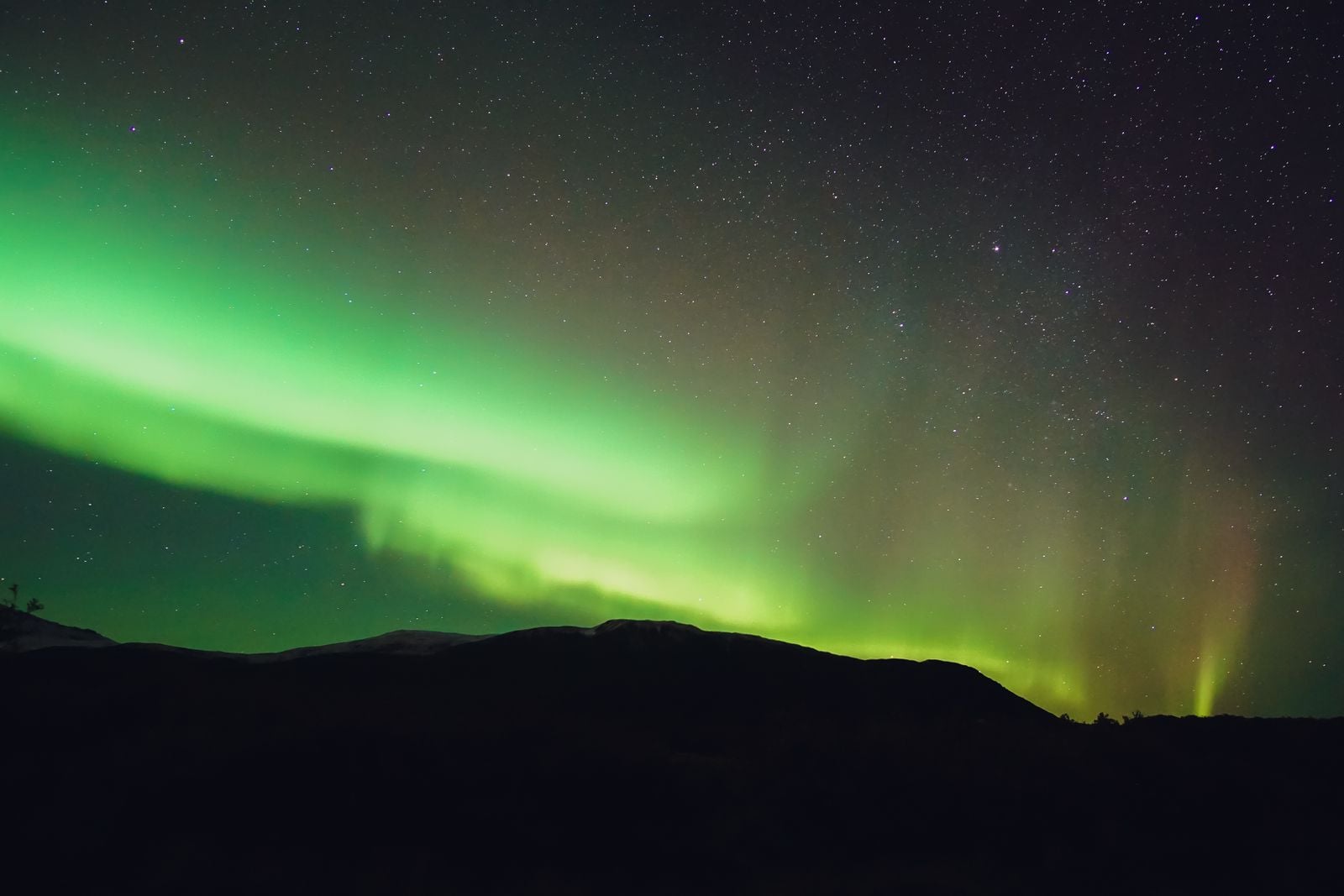
The event that made this possible had begun the previous day, when English amateur astronomer Richard Carrington, sketching sunspots through a filtered telescope at his private observatory in Redhill, saw two beads of intense white light flare above a complex sunspot group and fade within five minutes. Roughly seventeen and a half hours later, a coronal mass ejection slammed into Earth’s magnetic field. According to the National Environmental Satellite, Data, and Information Service, that night skies from the Rocky Mountains to Panama glowed brightly enough for people to read newsprint by aurora alone.
Auroras were reported over Cuba, over Jamaica, over Hawaii, over Colombia. Gold miners in the Rockies got up and cooked breakfast, thinking dawn had come early.
What the operators actually did
The telegraph network of 1859 was the most sophisticated communications system humans had ever built — tens of thousands of kilometres of copper strung on wooden poles across North America and Europe, powered by wet-cell batteries at every station. It was also, unintentionally, the world’s first planetary-scale antenna for geomagnetic current.
When the coronal mass ejection compressed Earth’s magnetic field, the rapid change induced voltages along any long conductor lying roughly east-west. The longer the wire, the bigger the induced current. Telegraph lines were exactly that: long, conductive, and grounded at both ends.
Contemporary accounts of the storm record what followed. Machines sparked. Paper caught fire. Some keys clacked out garbled text on their own. On the Boston-to-Portland line, the two operators on duty — never named in the surviving transcript, which was printed in the Boston Evening Traveller — realised their batteries were fighting the induced current rather than adding to it. They disconnected the batteries. The line kept working.
Space Daily has previously covered the Boston-Portland exchange in detail, including the transcript-style back-and-forth in which the two men agreed the auroral current was steadier than their own.
How big the storm actually was
The Carrington Event remains the most intense geomagnetic storm ever directly recorded. Estimates of its energy vary wildly depending on what is being measured — the flare itself, the coronal mass ejection, or the ground-level magnetic disturbance — but the Yahoo News summary of contemporary reconstructions puts the released energy on the order of 17 billion one-megaton nuclear bombs. That figure is a rhetorical benchmark rather than a measurement, but it points at the right order of magnitude.
More useful is the transit time. Most coronal mass ejections take three to four days to cross the 150 million kilometres between the Sun and Earth. The Carrington ejecta did it in roughly 17.6 hours. That implies a bulk speed above 2,000 kilometres per second, meaning the plasma cloud arrived while its magnetic field was still coherent and aggressive.
A 2024 paleomagnetic reanalysis suggests the storm was even more powerful than the nineteenth-century instruments could capture. IFLScience’s summary of that reanalysis notes that some of the magnetograph traces from 1859 were pinned against their stops — the needles had physically reached the end of their travel and could measure no further.
Why auroras reached Cuba and Hawaii
Auroras form when charged particles funnelled along Earth’s magnetic field lines slam into the upper atmosphere at roughly 100 kilometres altitude, exciting nitrogen and oxygen atoms. The colours — green from oxygen at lower altitudes, red from oxygen higher up, blue and purple from nitrogen — depend on which atoms are being hit and how hard.
Normally the field lines that carry these particles anchor near the magnetic poles, which is why the aurora borealis is a high-latitude phenomenon. During a severe geomagnetic storm, the entire auroral oval expands equatorward. The stronger the storm, the further south (or north, in the southern hemisphere) the glow reaches.
For the Carrington Event, the oval expanded so far that observers in Havana logged red auroras overhead. In Honolulu, the sky reportedly went blood-red. Ship captains in the Caribbean noted the phenomenon in their logs. This is the signature of an extreme storm: not just bright aurora at the usual latitudes, but aurora somewhere it has never been seen before.
The physics behind the wires is the same whether the conductor is a telegraph line in 1859 or a high-voltage transmission cable in 2026. A changing magnetic field induces a voltage in any conductor sitting inside it. Long, grounded conductors accumulate the biggest voltages because the induced electric field integrates over the length of the wire.
Solar storms, as Space Daily has explored elsewhere, do not attack people directly. They attack long metal. In 1859, the only long metal humans had strung across continents was telegraph wire, and there were only a few tens of thousands of kilometres of it. Today’s grid, pipelines, rail signalling systems and undersea cables constitute a target surface millions of times larger.
That is why the same physical event, replayed on modern infrastructure, would look nothing like sparking telegraph paper. It would look like transformers cooking themselves from the inside as DC-like induced currents saturate their iron cores.
What the same storm would do now
The most cited worst-case assessment comes from the US National Research Council’s 2008 report on severe space weather events. That report estimated recovery from a modern Carrington-class event could take four to ten years and cost trillions of dollars, with the damage concentrated in extra-high-voltage transformers that are custom-built, expensive, and made by only a handful of manufacturers worldwide.
Space physics researcher Vincent Ledvina, quoted in the All That’s Interesting piece, describes a Carrington-class event as potentially “one of the most economically devastating natural disasters to affect planet Earth”.
Not everyone agrees the picture is that bleak. Grid operators in the United States have been under FERC rules since 2014 requiring geomagnetic disturbance planning. Some transformer designs are more tolerant than others. And the geometry of the storm — which hemisphere gets hit at what local time — matters enormously. A hit at the wrong hour could be catastrophic; the same magnetic pulse a few hours earlier or later, geometrically misaligned with the major grids, would be far less destructive.
The best modern measurement of a Carrington-class event comes not from Earth but from a spacecraft that happened to be in the wrong place at the right time. In July 2012, a coronal mass ejection of comparable magnitude to the 1859 storm erupted from a region of the Sun that had rotated just past the Earth-facing line. The ejecta missed Earth. It hit NASA’s STEREO-A spacecraft squarely.
STEREO-A’s instruments were built to measure exactly this sort of plasma cloud. They survived the encounter and returned detailed data on the shock front, the magnetic field orientation, and the particle energies. Reconstructions suggest that had the eruption occurred a week earlier, with Earth in the firing line, the induced ground currents would have exceeded the 1859 event.
The May 2024 G5 storm — the strongest to hit Earth in more than two decades — was, on Ledvina’s assessment, roughly an order of magnitude weaker than Carrington. Auroras reached Florida and southern Europe. Some GPS-guided tractors in the American Midwest were knocked off-line during planting season. The grid held.
Proposed defences, from prosaic to exotic
Most of the practical mitigation work is unglamorous: adding neutral-current-blocking capacitors to transformer neutrals, hardening spare-transformer stockpiles, refining space-weather forecasts so operators can shed load or reconfigure grids before a storm arrives. The Space Weather Prediction Center at NOAA runs continuous monitoring and provides the alerts that grid operators act on.
Then there are the more ambitious proposals. A 2026 paper in the journal Space Weather, summarised on Hackaday’s coverage of the concept, proposes what its authors call StormWall: releasing a cloud of neutral alkali-metal gas at geosynchronous orbit ahead of an incoming coronal mass ejection. The gas gets ionised by the storm plasma, and in the process absorbs — the paper’s simulations suggest — up to fifty per cent of the storm’s coupling energy before it reaches the magnetosphere.
The mass required is not small. The simulation called for 384,048 kilograms of gas, which the authors estimate as roughly six Starship launches to GEO. Whether that is feasible depends on assumptions about Starship’s eventual payload capacity that remain, in 2026, unproven at scale.
What the 1859 record does and does not tell us
The Carrington Event is the calibration point for every modern space-weather risk model. It is also a single data point. Discover Magazine’s overview notes the estimated recurrence interval is roughly once every 500 years, but that figure comes from ice-core nitrate spikes and tree-ring carbon-14 anomalies with wide uncertainty bars. Some paleomagnetic studies suggest even more powerful storms may have occurred in 774 CE and 993 CE, both detected as radiocarbon spikes rather than direct observations.
What the 1859 record does not tell us is what happens when a storm of that magnitude hits a civilisation that runs on transformers, semiconductors and just-in-time logistics. The Boston-to-Portland operators had the option of unplugging their batteries and carrying on. A modern grid operator watching geomagnetically induced currents climb through a substation’s neutral does not have that option. The transformer either holds or it does not, and if it does not, the replacement is on a barge from South Korea.
NPR’s Short Wave segment on the current solar maximum notes that Cycle 25 has already produced stronger activity than forecasters expected, though nothing yet approaching 1859.
The Sun is currently near the peak of that cycle. Activity will decline over the next few years toward solar minimum around 2030, then climb again. A Carrington-class event is not tied to the peak — the 1859 storm actually occurred as Cycle 10 was descending — so the elevated risk window is not neatly bounded.
Somewhere on the visible disc of the Sun tonight, a sunspot group is being tracked by half a dozen space-weather forecasting centres. Most such groups produce nothing more than routine flares. Occasionally one produces a coronal mass ejection that misses Earth by a few degrees of solar longitude. The 1859 event happened because one group, at the right moment, pointed itself squarely at the third planet and let go. The wires were waiting.