
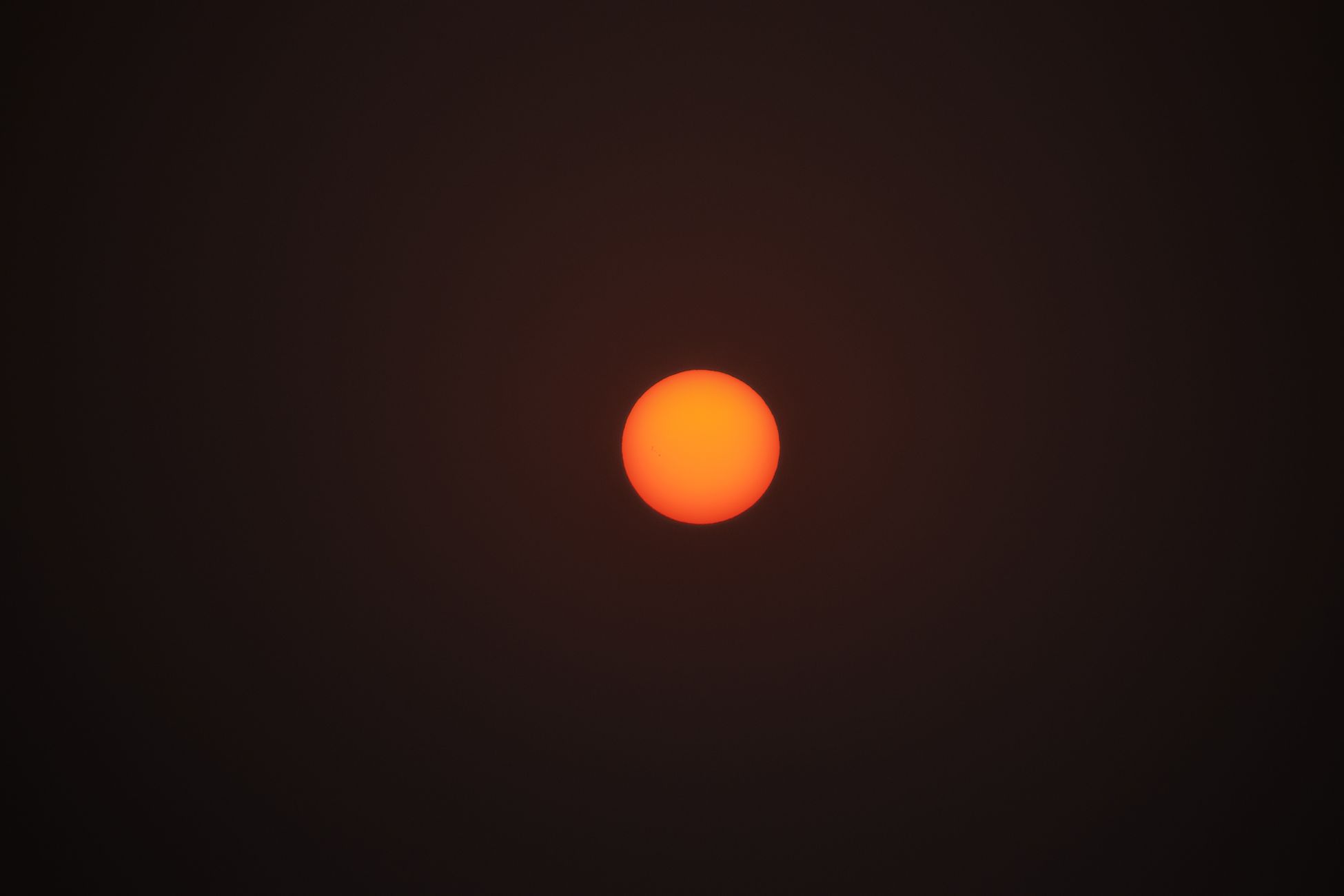
On July 23, 2012, NASA’s STEREO-A spacecraft was drifting ahead of Earth in its solar orbit when a coronal mass ejection tore off the Sun and slammed directly into its instruments — a blast that would later be measured at Carrington-class intensity, the same scale as the 1859 storm. STEREO-A felt it. Earth did not. The spacecraft was sitting in the path of the eruption, and because it kept recording through the impact, scientists now have the only detailed in-situ measurements ever taken from inside an extreme solar storm.
The probe survived. The data it sent back has shaped every serious estimate of what a direct Carrington-class strike on a modern, electrified Earth would actually look like.
A spacecraft in the wrong place at the right time
STEREO-A — the Solar Terrestrial Relations Observatory Ahead — launched in 2006 alongside its twin, STEREO-B. The pair were sent into heliocentric orbits, one drifting ahead of Earth and one trailing behind, so that for the first time the Sun could be watched in stereo. Their job was to track coronal mass ejections from launch to arrival, building three-dimensional reconstructions of solar storms that single-vantage observatories from Earth orbit could never produce.
By July 2012, STEREO-A had drifted well ahead of Earth along its orbit. That put it on the far side of the Sun from our perspective, looking back at the same patch of solar surface that had recently rotated past Earth’s view. The active region that produced the July 23 eruption had already crossed the visible disk and was firing off the Sun’s western limb — which, from STEREO-A’s position, meant straight at the spacecraft.
What 3,000 kilometers per second looks like
A typical coronal mass ejection travels at a few hundred kilometers per second and takes two to four days to reach Earth’s orbit. The July 2012 event covered the distance much faster. It was actually two CMEs in rapid succession, with the first plowing the solar wind ahead of it and clearing a low-density path for the second to accelerate through almost unimpeded.
When the shock front hit STEREO-A’s instruments, the magnetic field strength inside the cloud spiked to extreme levels — several times what a strong geomagnetic storm normally delivers at 1 AU. The plasma temperature, density, and velocity all pegged at the high end of anything previously observed near Earth’s orbit. Researchers later modeled what the storm would have done to Earth’s magnetosphere if the timing had been different, and the numbers landed squarely in Carrington-class territory: a Dst index estimated in the range of major historic storms, comparable to or exceeding the 1859 storm.
For context, the 1989 storm that collapsed Quebec’s power grid was one of the most intense geomagnetic events of the modern era. The G4 storm alert issued after a May 31, 2025 eruption was also severe. The July 2012 event would have eclipsed both.
Why Earth missed it
Solar active regions rotate with the Sun, completing a full turn in about 27 days as seen from Earth. The active region responsible for the July 23 event had been geoeffective — meaning aimed at Earth — during the preceding week, producing several M-class flares and at least one X-class flare that did cause moderate geomagnetic activity. By July 23, the region had rotated well past the central meridian and was pointed at empty space from Earth’s perspective.
Empty space, except that STEREO-A happened to be sitting in it. The spacecraft’s orbital position, set in motion years earlier for entirely unrelated scientific reasons, placed it in the bullseye of the most extreme CME of the modern space age. Analysts have noted that if the eruption had occurred earlier in the solar rotation, the storm would have hit Earth head-on.
The measurements that would not otherwise exist
Before July 2012, every estimate of what a Carrington-class storm would do to modern infrastructure relied on indirect evidence: auroral records from 1859, telegraph operator accounts, magnetometer traces from a handful of European observatories, and ice-core nitrate spikes. None of it included the actual plasma density, magnetic field topology, or shock structure of the storm itself, because no instrument capable of measuring those things existed in 1859.
STEREO-A’s instrument suites captured all of it. The magnetometer recorded the field rotation through the magnetic cloud. The plasma analyzers logged the proton density, the alpha particle ratio, the temperature anisotropy. The radio and energetic particle detectors traced the shock acceleration of ions to relativistic energies. Researchers finally had a ground truth dataset for what an extreme event actually contains — the kind of in-situ record now informing analyses of other extreme solar and stellar coronal mass ejections.
What it would have done
Analysis of the STEREO-A measurements using magnetohydrodynamic models of Earth’s magnetosphere estimated that the storm would have driven geomagnetically induced currents capable of damaging hundreds of high-voltage transformers across North America and Europe.
The probability of a Carrington-class event hitting Earth in any given decade has been estimated at around 10-15 percent based on the power-law distribution of CME magnitudes. The July 2012 measurements provided a crucial anchor point for these statistical models.
Economic impact assessments have estimated first-year damage from a Carrington-class strike at $1 to $2 trillion, with a four-to-ten-year recovery timeline. These estimates depend on knowing what the input actually looks like at the magnetopause. STEREO-A provided the input.
The probe that kept working
STEREO-A is still operating today, nearly two decades after launch, on a 22-month-cycle orbit that periodically brings it back into conjunction with Earth. Its twin, STEREO-B, was lost in 2014 during a planned hard reset, and although mission controllers re-established contact briefly in 2016, the spacecraft was never recovered. STEREO-A inherited the full burden of the mission’s far-side stereoscopic observations of the Sun.
In 2023, STEREO-A passed between Earth and the Sun for the first time since launch, briefly reuniting with the SOHO and Solar Dynamics Observatory fleet for coordinated three-dimensional imaging. During the recent G4-class geomagnetic storms, STEREO-A’s vantage from outside the Sun-Earth line provided observations that no Earth-orbiting spacecraft could replicate.
The asymmetry that defines space weather
The Sun fires CMEs in essentially every direction, all the time. Earth presents a target roughly 12,750 kilometers across, sitting in a sphere of possible CME trajectories with a radius of 150 million kilometers. The geometric odds of any given eruption hitting our planet are tiny — which is why most CMEs go entirely unmeasured by anything except remote-sensing coronagraphs that watch them disappear into empty space.
STEREO-A broke that asymmetry once. A spacecraft engineered for a different purpose, in a position chosen for different reasons, caught a once-in-a-century blast that would otherwise have left the historical record as a faint blip on a few coronagraphs and a footnote in a flare catalog.
Solar physicists have studied the July 23, 2012 solar storm extensively using data from the STEREO-A spacecraft, which happened to be positioned to capture the event, and treat the STEREO-A dataset the way climate scientists treat the Vostok ice core: as the canonical reference for an extreme that has not yet recurred. The next Carrington-class CME will eventually point at Earth. When it does, the difference between an inconvenience and a continental-scale disaster will turn on hours of warning — warning that exists, in part, because one spacecraft sat in the wrong place at the right time and kept its instruments running through a blow that nobody on Earth ever felt.
