
In 1974 two psychologists sent an attractive young woman to stand at the end of a bridge and stop men walking across. She asked each one to fill out a short questionnaire, then tore the corner off a sheet of paper, wrote down her name and phone number, and said he could call if he wanted to talk more about the study. The only thing that changed was which bridge the men had just crossed.
On a high, swaying footbridge, nine of the eighteen men who took her number later called. On a low, solid bridge nearby, only two of sixteen did. The men who had just been frightened were far more likely to phone a stranger, and Donald Dutton and Arthur Aron argued the reason was that they had felt their hearts pounding and read it, wrongly, as attraction.
Two bridges over the same river
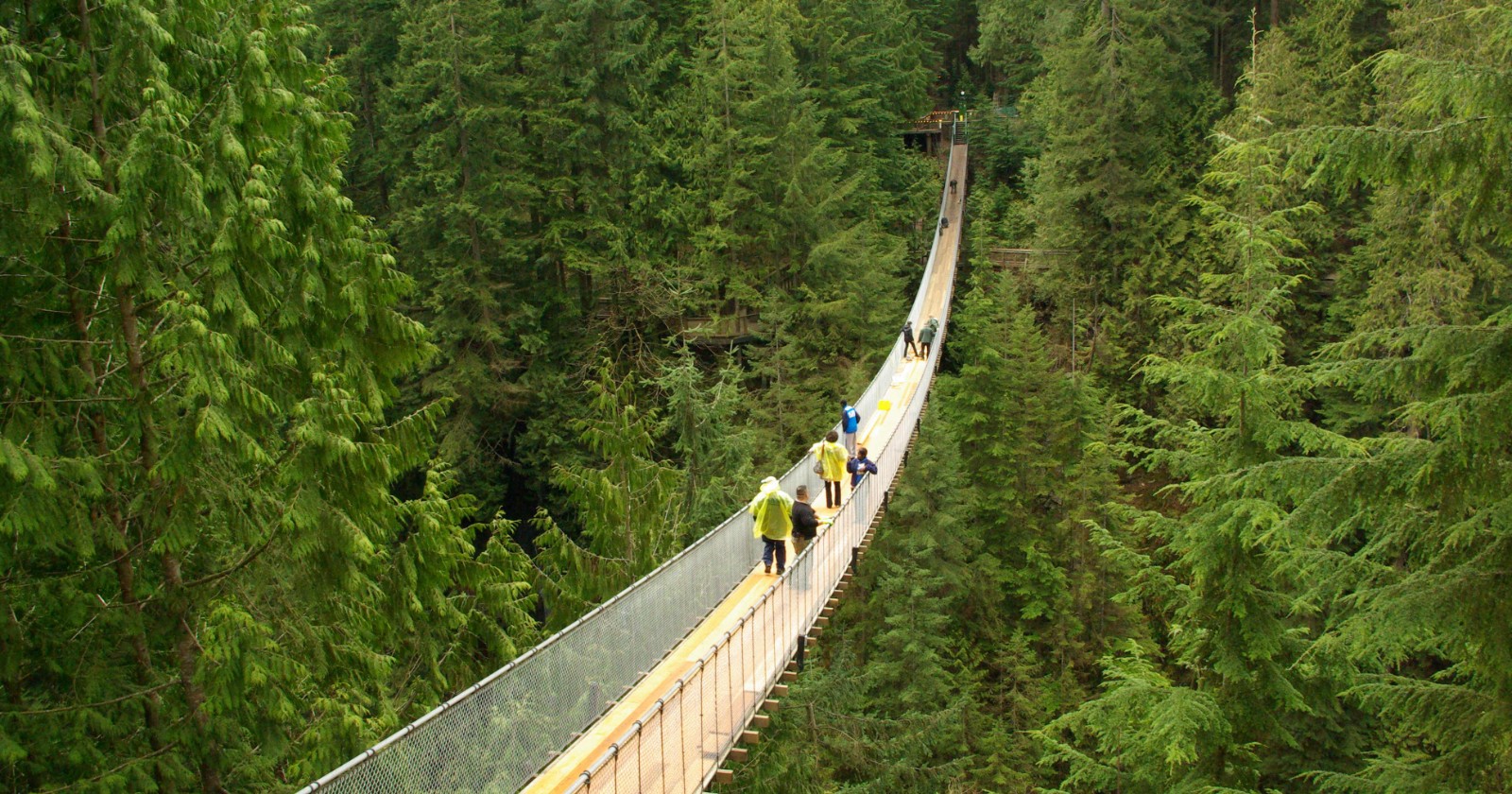
The study ran over the Capilano River in North Vancouver, British Columbia. The frightening bridge was the Capilano Canyon Suspension Bridge, a five-foot-wide walkway of wooden boards strung from wire cables and stretched 450 feet across the canyon. It tilted and wobbled underfoot, its handrails were low cable, and it hung about 230 feet above rocks and shallow rapids. Roughly four in ten people crossing it gripped the rail and inched along.
The calm bridge sat upriver: a heavy cedar structure, wider and firmer, only about ten feet above a small stream, with high handrails and no sway. When the researchers later asked a separate group of men how frightened they felt crossing each one, the suspension-bridge group rated their own fear at 65 on a 100-point scale. The men on the solid bridge rated theirs at 3.
So the two groups began in very different physical states. One had a body still humming with adrenaline. The other did not. Everything that came after was designed to see whether that difference leaked into how the men responded to a woman.
What the interviewer measured
The interviewer told the men she was studying how scenery affects creativity, then asked each to write a short, dramatic story about an ambiguous picture of a woman. The stories were scored from one to five for sexual content by raters who did not know which bridge each man had been on. Men from the suspension bridge wrote stories with noticeably more sexual imagery, averaging 2.47 against 1.41 for the solid bridge.
The phone number was the second, blunter measure. The researchers reasoned that curiosity about the study should be about equal across both groups, so a difference in who actually called back would reflect a difference in interest in the woman herself. That is where the gap was widest: half the men from the suspension bridge called, against roughly one in eight from the solid bridge.
One detail mattered to the interpretation. When a male interviewer ran the same routine, the effect vanished. Men leaving the scary bridge wrote no racier stories and were no more likely to call him back. The arousal only seemed to redirect toward someone the men might plausibly be attracted to.
The check the authors built for themselves
A skeptic could object that the two bridges drew different kinds of people. The suspension bridge is a tourist attraction, so its visitors might be bolder, more out-of-town, or simply in a different mood than someone strolling a quiet park. Dutton and Aron raised that objection themselves, and ran a second version to answer it.
This time they kept only suspension-bridge visitors, comparing men stopped right after crossing with men from the same crowd approached at least ten minutes later, once their nerves had settled. The freshly rattled men again wrote more sexual stories and called more often: thirteen of twenty, against seven of twenty-three for those who had cooled down.
A third study moved indoors, where the researchers could control more. Eighty male university students were told they would receive an electric shock, some led to expect a strong jolt and some a mild one. A woman they believed was another participant sat nearby. Men braced for the painful shock reported more attraction to her and again produced more sexual imagery. Crucially, the boost came from anticipating their own shock, not from worrying about hers, which argued against the idea that they were simply moved by a woman in distress.
How much can two bridges really tell us?
The studies are vivid, but they are small and old, and the famous bridge experiment carries the usual hazards of research done in the wild. The groups were not randomly assigned; they sorted themselves by which bridge they chose to cross. The phone-call measure rested on a few dozen men, the kind of sample where a handful of decisions swings the result. And the whole design worked in one narrow direction only: a female interviewer and unaccompanied young men. It says nothing about anyone outside that setup.
The interpretation is also more contested than the tidy version suggests. Dutton and Aron leaned on the idea, drawn from earlier work by Stanley Schachter, that the body produces a wash of generic arousal and the mind looks around for a label to pin on it. On a swaying bridge, the nearest available label is the woman. But the authors themselves listed other readings of their data. Perhaps fear did not get relabeled as desire so much as loosen the brakes on feelings that were already there. Perhaps the link between fear and attraction is its own phenomenon rather than a special case of some grand rule about arousal. They could not rule those out, and which of those mechanisms is at work, if any, is not something a single field study could settle.
What survives is narrower than the headline but still striking: under the right conditions, a body stirred up by one cause can color a judgment about something else entirely. The bridge did not manufacture attraction out of nothing. It seems to have nudged men who were already inclined to notice a woman into noticing her a little more, and into reading their own pounding hearts as a reason.
That is the quiet, unsettling part of the finding. We tend to trust the feeling in our chest as a verdict about whoever is standing in front of us. Sometimes it is only a verdict about how high up we are.