
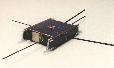
A Russian nuclear submarine has launched a German satellite using a ballistic missile in the first known commercial launch by the Russian Navy. The Tubsat-N communication and scientific research satellite was launched by the submarine Novomoskovsk from the Barents Sea, and has reached its planned orbit.
The launch was made using an RSM-54 intercontinental ballistic missile, lifting the 10 kilogram (22-pound) satellite into orbit. The missile is standard equipment on nuclear submarines in the Russian Northern Fleet.
The Russian Navy, which is facing a shortage of funds due to Russia’s
financial crisis, plans to continue with a commercial satellite launch
program.
The satellite contains three different experimental payloads provided by the Technical Univerity of Berlin:
- Reaction wheel performance
- Star sensor performance
- Store and forward communication:
The store and forward communication payload consists of four independent communication transceivers for store an forward communication with a baudrate of 1200 and 2400 baud. Two transceivers work in the 2m frequency band, the other two transceivers work in the 70 cm frequency band with FFSK (Fast Frequency Shift Keying) modulation. An additional downlink transmitter with 9600 Baud GMSK (Gaussian Minimum Shift Keying) modulation is available.
The attitude control of TUBSAT-N consists of two magnetic coils, a magnetometer, a reaction wheel and a star sensor. All attitude control devices are also developments of the Technical University of Berlin.
Electrical power is provided by 9 NiCd-battery cells of 5 Ah (SANYO). The battery cells are connected serially and provide an unregulated bus voltage from 9 to 13 V. The batteries are charged by two strings of solar cells with the dimensions 6×4 cm2. Each string consists of 34 cells.
It will be used for tracking medium-sized and large mammals, stolen cars and to collect data from autonomous buoys for earth environmental observation. These buoys are located in the northern atlantic ocean and near the canary islands.
— Copyright 1998 by United Press International. All rights reserved. —
