
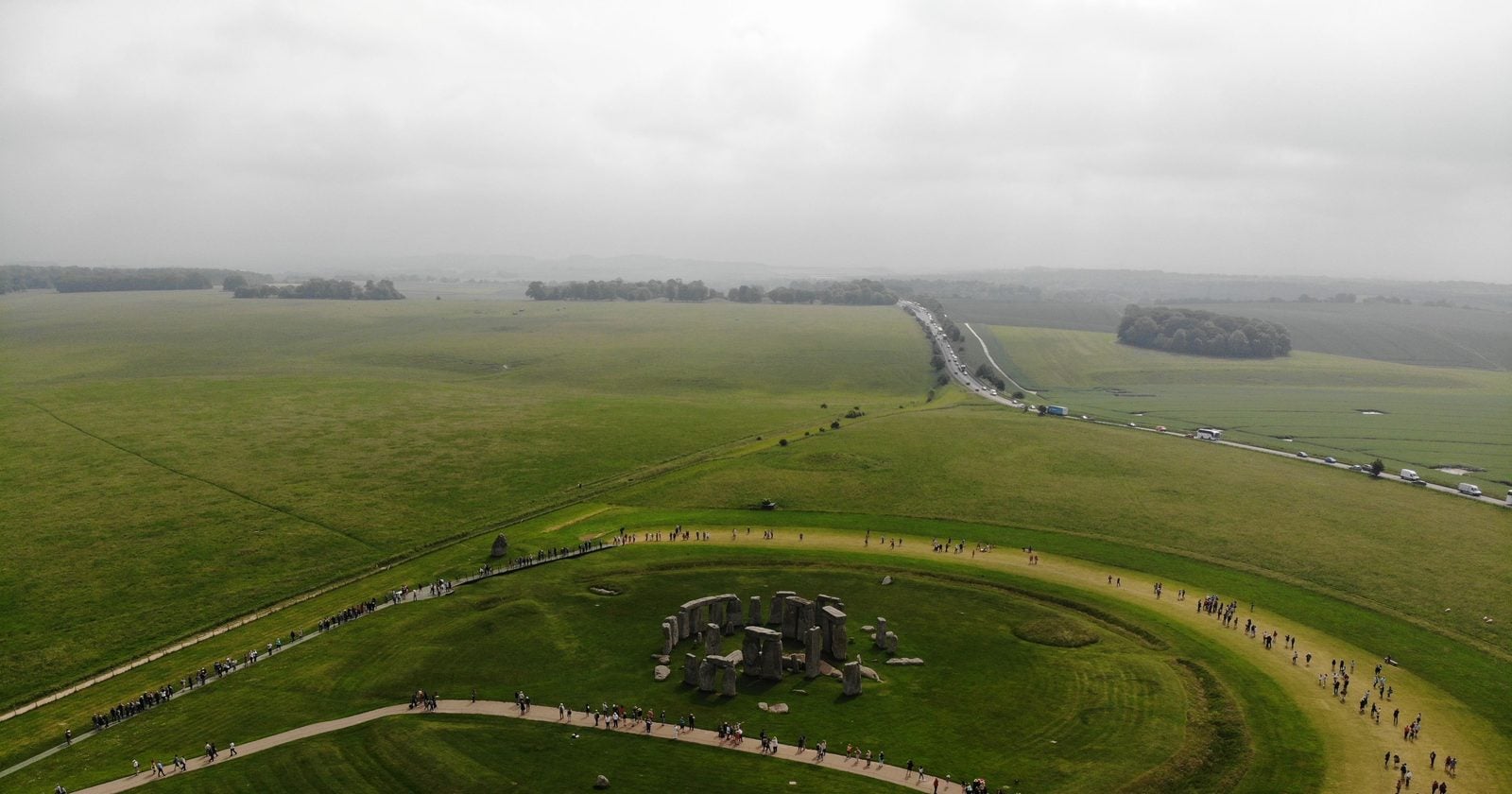
Why would anyone buy a stone circle at a country auction? Not the farmland around it, not a grand house, but the ruin itself, listed as a numbered lot on a printed catalogue.
That is roughly what happened at the Palace Theatre in Salisbury on 21 September 1915, and the man who did it seems to have surprised himself as much as anyone.
The buyer was Cecil Chubb, a barrister born in the nearby village of Shrewton. As English Heritage recounts, Stonehenge sold for £6,600. The reason he later gave for buying it is almost comically offhand. Legend has it he told a local reporter, in Chubb’s reported words, “but while I was in the room, I thought a Salisbury man ought to buy it, and that is how it was done.” That is a retold anecdote a century old, so treat it as flavor rather than sworn testimony. It still tells you something about how casually one of Britain’s most famous monuments changed hands.
What was actually being sold
Stonehenge had been in private hands for a very long time. It belonged to the Antrobus family, who had owned it since the early 1800s as part of the Amesbury Abbey estate in Wiltshire. The estate came onto the market after a run of deaths. The heir to the baronetcy was killed in action in 1914, and after Sir Edmund Antrobus died in February 1915, the estate passed to his younger brother Sir Cosmo Gordon Antrobus, who decided to sell it.
So Stonehenge went under the hammer as Lot 15, catalogued by the auctioneers as “Stonehenge with about 30 acres, 2 rods, 37 perches of adjoining downland.” The bidding, by English Heritage’s account, climbed in £100 steps, with a local farmer, Isaac Crook, pushing it to £6,500 before Chubb took it. In today’s money the £6,600 is somewhere around £475,000, though estimates vary depending on how the conversion is done.
It helps to remember what condition the place was in. This was not the tidied, roped, floodlit site of today. Stones had fallen, some were propped up, and decades of visitors chipping off souvenirs had left their mark. What Chubb bought was a neglected ruin on a patch of grass.
From private whim to national gift
He did not keep it long. In 1918, three years after the auction, Chubb handed Stonehenge to the nation by deed of gift, and was knighted for it. In the gift itself he wrote that “I became the owner of it with a deep sense of pleasure… [but] it has been pressed upon me that the nation would like to have it for its own.”
That line goes some way to explaining the arc. A man buys something almost by accident, grows attached to it, then decides the country has a better claim than he does. What strikes us is how short the private chapter was. Barely three years separate the impulse purchase from the moment it stopped being anyone’s personal property.
English Heritage, which now runs the site, treats the whole episode as a turning point. Its chief executive, Kate Mavor, said that “Cecil Chubb’s impulse buy marked a turning point in the story of how Stonehenge was transformed from neglected ruin to national treasure.”
The shilling clause
The deed of gift came with conditions, and the one most often quoted is the cap on admission. Chubb stipulated that the general public should get in for no more than a shilling a visit.
The shilling itself is almost beside the point now. A shilling in 1918 says nothing about the price of a modern ticket, and the surrounding land followed its own path anyway, with acres of downland bought for the nation and given to the National Trust in the years that followed. What lasts is the principle inside the clause.
Chubb could have kept Stonehenge, walled it off, charged what he liked, or sold it on at a profit. Instead the deed fixed a ceiling on what any future keeper could ask of a visitor, framed in the language of ordinary access rather than exclusive ownership. The number was small. The idea behind it, that a place like this belongs to the people who come to see it and should stay within reach of an ordinary purse, turned out to be the lasting thing.
That a monument this old spent so much of its history as somebody’s property, and passed into public hands on the strength of one man’s second thoughts, is easy to forget when you are standing in the queue. The deed is the paper trail of that change of mind.
