
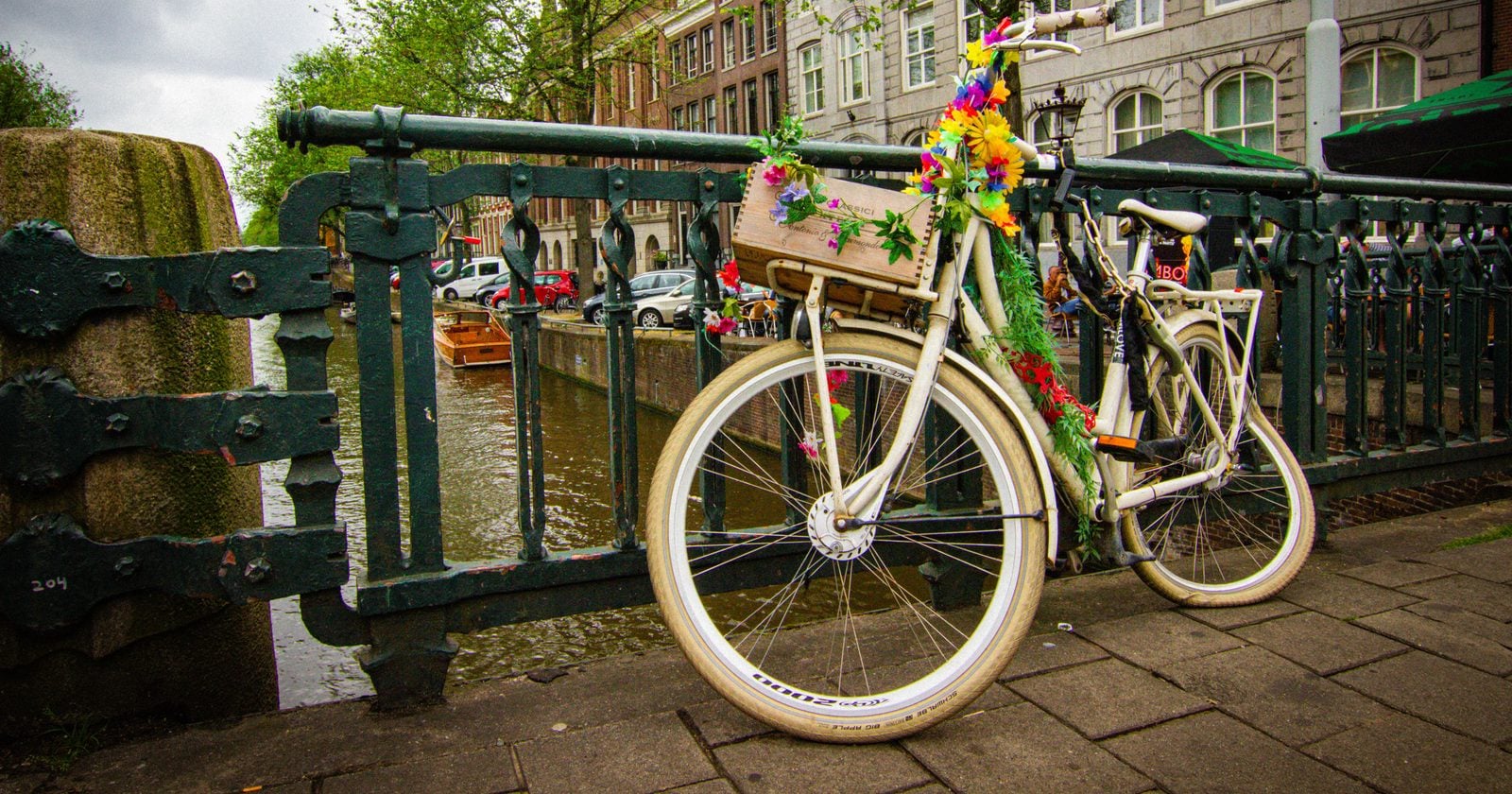
Guinness World Records keeps an entry for the most bicycles recovered from a city’s waterways, and perhaps unsurprisingly, it belongs to Amsterdam.
The figure it cites sits between 12,000 and 15,000 bikes a year. That is not a one-off haul from some historic clean-up. It is the ordinary yearly output of a crew that goes out on the water and does this on purpose, and has been doing it since the 1960s.
At one point, there were so many bicycles lying in the canals that they were reportedly scraping the bottoms of boats!
What we keep coming back to is how routine the whole thing is. A city famous for bicycles has a permanent job whose entire purpose is fishing bicycles back out of the water. Not a stunt, not a festival, not a viral clean-up dive. A crane on a boat, a claw, and a barge that fills up and goes to the scrap yard.
Why the bikes end up in the water
Amsterdam is close to a million bicycles deep. Guinness puts the count at roughly 847,000 in 2015, against a canal network running about 100 km through the city. Put that many bikes next to that much open water and some of them are always going to end up wet.
Waternet, the local water authority, thinks theft and vandalism account for the vast majority. Then there is the everyday hassle of parking in a crowded city. Local skipper Tido Anema gave one likely cause to NH Nieuws, via Men’s Journal: “There are people who arrive, they can’t park their bicycle and when they see one that is not locked to the rack, they throw it in.” Add wind, a car nudging a rack, and a night out gone sideways, and the water does the rest.
The canals have soaked up worse than bikes. Waternet’s Diane Kleinhout says they were once the city’s sewer. “The canals used to be an open sewer,” she told The World. “There was no sewer system in Amsterdam so this was the open toilet for the people of Amsterdam.” That is her account rather than a historian’s, but it fits the picture of water that has always doubled as the city’s dumping ground. Bicycles are just the current layer.
How the retrieval actually works
The tool is simple and effective: a hydraulic claw on a crane at the front of a boat. “That’s our equipment for fishing the bikes out of the canal,” Kleinhout told The World. The operator swings the claw down into the murky water, closes it around whatever is down there, and lifts the load up and over into a garbage barge trailing behind.
There is no map of where the bikes are. The crew works the canal by feel. Asked how he knows where to dig, bike fisherman Jan de Jonge put it plainly: “How do you know where the bikes are? We don’t know. We’re just searching.” You lower the claw, you close it, you see what comes up.
De Jonge does not seem to mind the work. “I love my job,” he said. “You’re standing outside with a lot of freedom around you. So it’s a nice job.”
Where 12,000 bikes a year go
Nothing romantic happens to a bike once it has spent a season underwater. The frames come up rusted, tangled, sometimes bent around each other. They drop into the trailing barge and head off to be recycled as scrap metal.
There is no lost-and-found reunion, no repair shop for the average catch. The water ruins them, and the claw just moves them from one place to another.
Bicycles are not even the only thing the water swallows. Amsterdam’s municipal diving unit reckons the canals also take in roughly 35 cars and 100 people each year, alongside the bikes. The bikes just happen to arrive in numbers big enough to justify a standing crew and a claw built for the job.
De Jonge puts the crew’s yearly catch at around 15,000, at the top of the range Guinness records. Whichever figure you take, the shape of it is the same: a barge-load, then another, then another, until the year is out and it starts again.
What the routine says about the city
Perhaps the striking thing here is not the number at all. It is how unremarkable the number has become. A city that runs on bicycles has decided that losing something like a barge-load a week to the canals is simply a cost of the arrangement, and it has built a permanent, unhurried job to manage that cost. No outrage, no campaign. Just a boat, a claw, and a schedule.
Cities that live on water tend to grow these small, invisible maintenance habits, the way a house near the coast learns to repaint the salt-worn side more often. Amsterdam’s version is a man on a barge lowering a claw into water he cannot see through, searching for bikes, filling a scrap barge because that is what the water demands of a place stitched together by canals and pedalled around by nearly everyone in it.
