
The Torajan people live in the mountainous highlands of South Sulawesi. There are roughly 1.1 million of them. They grow rice on terraced fields. They live in distinctive stilted houses called tongkonan with enormous curved roofs shaped like boats. Most are Christian following a century of Dutch missionary presence in the region. And they have a set of funeral practices unlike anything else in the modern world. When a Torajan dies at home the body is not immediately buried. It stays in the family house. It is treated as if sick rather than dead. It receives food four times a day. It is spoken to. It is included in family conversations. Guests entering the house are introduced to it. This continues for weeks or months. Sometimes it continues for years. The waiting period ends only when the family has saved enough money for the funeral the deceased is entitled to.
What it looks like to feed a dead relative every morning
The word Torajans use for a family member in this state is to makula’. It translates roughly as sick person. According to National Geographic’s detailed 2016 magazine feature by Amanda Bennett titled “When Death Doesn’t Mean Goodbye”, the term is not a euphemism. It reflects a genuine belief that the soul remains present in the household as long as the body is there. Bennett spent time with the Rante family in a town called Rantepao. The husband and father Petrus Sampe had been dead for nearly two weeks when she visited. His wife Elisabeth pulled back a golden curtain and led Bennett into the bedroom. Her son Jamie brought a tray. He set down rice and fish and chilies beside the bed. Elisabeth said softly to her husband that a guest had come from far away. Then she said it was time for his dinner. Petrus was lying under a red blanket. He had been embalmed with a mixture of formaldehyde and water shortly after his death. The room smelled of sandalwood. On the wall hung a picture of Jesus leading a lamb.
The eldest son Yokke explained the practice to Bennett in one sentence. “We do this because we love him and respect him so much.” His mother added something even simpler. “Before, we used to eat together. He’s still at home. We should feed him.” Petrus would remain in the bedroom for four more days. Then he would be moved into a coffin. He would stay in the coffin at home for another four months. The family was planning his funeral for December. Until then his wife would sleep in the same room. Some families follow an even stricter version of the old custom and never leave the dead person alone in the house at any hour of the day or night.
Why the funeral takes so long to organise
The delay is not about grief or reluctance. It is about money. A proper Torajan funeral is one of the most expensive social events anywhere in the world relative to the wealth of the people paying for it. The ceremony is called Rambu Solo. It lasts several days. It draws every extended relative of the deceased from wherever they now live in Indonesia or overseas. Hundreds of guests attend. The centrepiece of the event is the sacrifice of water buffalo. Elite funerals require a minimum of twenty-four buffalo. Some require more than a hundred. Each animal costs roughly 20 million rupiah at market rates. That is around 1,425 US dollars per buffalo. Pigs are also sacrificed by the dozen. Food and drink for hundreds of guests must be provided. Temporary bamboo housing must be built for visitors travelling from far away. On National Geographic’s own accounting an elite funeral can exceed 400,000 US dollars in buffalo costs alone. For most families the cost cannot be met from any single generation’s savings. The funeral obligation ripples across grandparents and grandchildren.
According to Huck Magazine’s 2017 profile of the Swiss documentary photographer Claudio Sieber, written by staff writer Alex Robert Ross, roughly half of Indonesia’s 1.1 million Torajans still live in the highlands where the traditional practices have been preserved. The other half live in the diaspora across Indonesia and beyond. Both groups return home for funerals. The Torajan phrase Sieber records is that the community “lives to die,” meaning that funerals are the most important events in a Torajan life and are treated as the culmination rather than the closure of it. Christianity coexists with the older animist tradition called Aluk To Dolo or Way of the Ancestors. Nearly every stage of a Torajan funeral is marked with Christian prayers and readings alongside the traditional rites. The two systems have merged into a single practice over the past century.
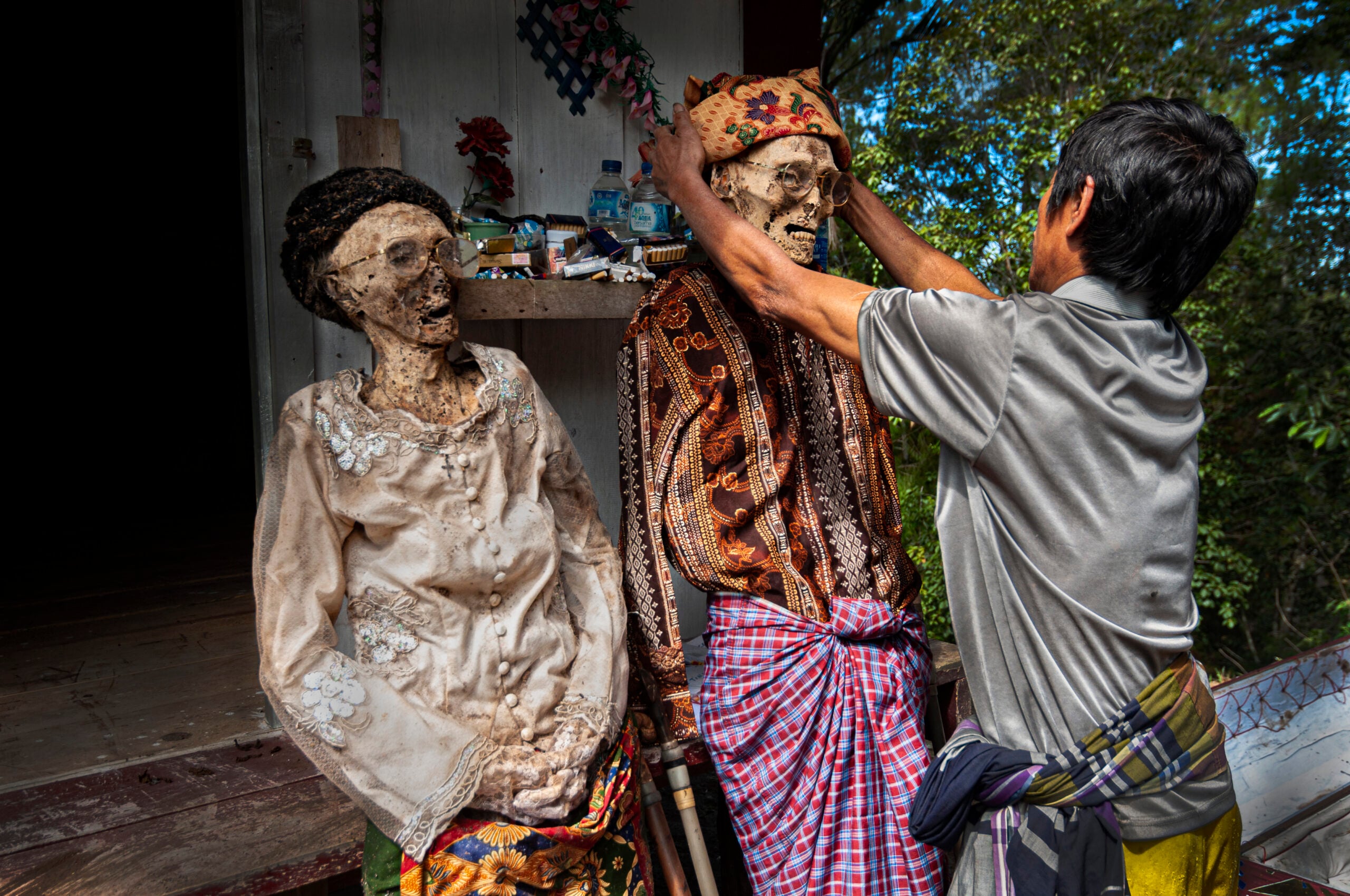
After the funeral itself the body is not left alone. It is placed in a rock crypt or cave in the cliff face. Wooden effigies called tau tau are carved to represent the deceased and placed on a balcony outside the tomb. Every few years the family returns to the crypt. They open it. They bring the body back out into the sunlight. They change its clothes. They clean it. They talk to it. They take photographs with it. They give it cigarettes. Then they put it back. This second ceremony is called ma’nene. It takes place in August. It is not a Halloween event or a tourist attraction. It is a family reunion that happens to include the family members who have died.
What the whole system represents is a fundamentally different theory of what death is. In Torajan understanding the moment of biological death is not the end of the person. It is the beginning of a long transition. The soul does not depart when the heart stops. It departs slowly over the following months and years as the ceremonies unfold. The person remains part of the household throughout. They remain part of the family after the funeral. They remain part of the family after the burial. What Westerners tend to treat as a single moment requiring immediate closure Torajans treat as a gradual process unfolding across generations. Neither approach is objectively correct. But the Torajan version, on the reflection of everyone who has spent extended time observing it, produces a form of family continuity across the boundary of death that most other cultures have long since lost.