
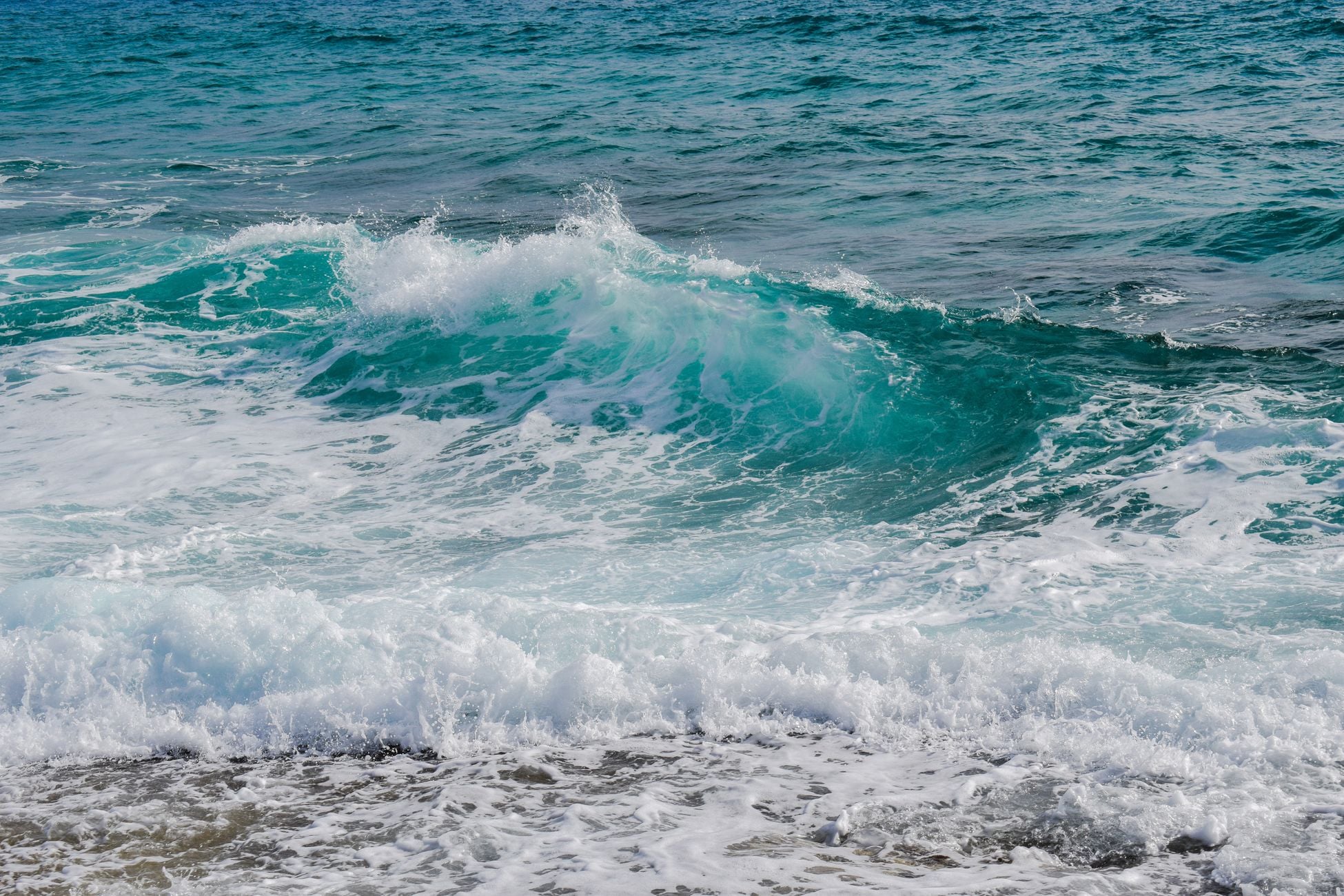
Twice a day, roughly every 12 hours and 25 minutes, the Atlantic climbs the pilings under Brighton Pier and then falls back again, and the reason it does this two times rather than once has puzzled anyone who has thought hard about it since Isaac Newton first worked out the answer in his Principia Mathematica of 1687. The Moon pulls the ocean toward itself. That much is intuitive. What is not intuitive is that the ocean also bulges outward on the opposite side of the planet, the side facing away from the Moon, producing a second high tide almost exactly halfway around the globe from the first.
The far-side bulge is the strange one. It looks, at first glance, like the ocean is being pushed away from the Moon rather than pulled toward it. And in a sense, that is exactly what is happening — not because of any repulsive force, but because the solid Earth beneath that far-side water is being tugged out from under it.
Two bulges, one planet
Gravity weakens with distance. The side of Earth facing the Moon is about 12,742 kilometers closer to it than the side facing away — one full Earth-diameter of separation. That difference is small compared with the roughly 384,000 kilometers between the two bodies, but it is enough to matter. The Moon pulls hardest on the near-side ocean, less hard on the solid body of the planet at its center, and least hard on the far-side ocean.
Think of it as three tugs of different strengths on three parts of the same object. The near ocean accelerates toward the Moon faster than the Earth’s core does. The Earth’s core, in turn, accelerates toward the Moon faster than the far ocean does. The result is that the near ocean pulls ahead, the far ocean falls behind, and the planet stretches into a slight football shape along the Earth-Moon line. Scientific American describes this as the tidal force being a differential gravitational effect — not the absolute pull of the Moon, but the difference in that pull across the width of the planet.
Two bulges. One near, one far. Earth rotates through both of them each day, which is why most coastlines see two high tides and two low tides in every 24-hour-and-50-minute lunar day.
Why the far side rises at all
The far-side bulge is the part that trips people up, and it has tripped up textbook writers for generations. The clearest way to picture it: imagine the Earth and everything on it in free fall toward the Moon. The whole planet is falling. But the near ocean is falling faster than the solid planet, because it is closer and feels a stronger pull. The far ocean is falling slower than the solid planet, because it is farther and feels a weaker pull.
From the perspective of someone standing on Earth, the near ocean rushes ahead — a bulge toward the Moon. The far ocean lags behind — a bulge away from the Moon. Neither ocean is being pushed. Both are simply responding to gravity at slightly different rates, and the solid Earth is caught in the middle, being tugged out from under the water on the far side. As meteorologists explaining tides often put it, the far-side bulge exists because the Earth itself is being pulled away from that water.

Newton did the math in 1687
Newton was the first to work all of this out mathematically. Before him, tides were understood as regular but mysterious — Galileo had proposed, incorrectly, that they were caused by the sloshing of oceans as Earth spun and orbited the Sun, and he had dismissed the Moon’s role as astrology. Newton showed that if gravity followed an inverse-square law, then the difference in the Moon’s pull across the Earth would produce exactly the tidal pattern observers saw: two highs, two lows, and a slow drift in timing that matched the Moon’s own orbital motion.
The Sun contributes too. It is vastly more massive than the Moon, but it is also about 390 times farther away, and the tidal effect scales with the cube of the distance rather than the square. The Sun’s tidal pull on Earth is roughly 46 percent of the Moon’s. When the Sun, Earth, and Moon line up — at new moon and full moon — the two tidal effects add together and produce the higher spring tides. When they sit at right angles, at the quarter moons, they partly cancel, producing the weaker neap tides. The stronger tides at new moon are a direct consequence of that alignment.
The bulges are not where you think
In an idealized ocean covering a perfectly smooth Earth with no continents, the two bulges would sit almost exactly on the Earth-Moon line, and high tide would arrive when the Moon was directly overhead or directly underfoot. Real coastlines do not behave that way. The Bay of Fundy in Nova Scotia sees tidal ranges of more than 16 meters — the height of a five-storey building — because the shape of the bay resonates with the tidal period, amplifying the wave. The Mediterranean, by contrast, is nearly tideless, with ranges under 30 centimeters in most places, because its narrow opening to the Atlantic chokes off the tidal flow.
Continents also drag the bulges out of alignment with the Moon. Friction between the ocean water and the rotating seafloor means the near-side bulge is carried slightly ahead of the Moon rather than sitting directly beneath it. This offset has a consequence that reaches far beyond the surf line.
The Moon is retreating because of this
The offset bulge exerts a small gravitational tug on the Moon in the direction of Earth’s rotation, nudging it forward in its orbit. That nudge lifts the Moon into a slightly higher orbit. Laser reflectors left on the lunar surface by Apollo 11, 14, and 15 astronauts have allowed scientists to measure the recession precisely: the Moon drifts away from Earth by about 3.8 centimeters per year, roughly the rate at which fingernails grow.
The same interaction, in reverse, is slowing Earth’s rotation. Days are getting longer by about 1.7 milliseconds per century. Run the clock backward and the consequences are dramatic: Ars Technica has reported on research suggesting that without certain resonances in the atmosphere, Earth’s day could have stretched to something like 60 hours by now. As it stands, when trilobites crawled the seafloor 500 million years ago, a day was closer to 21 hours long.
The Moon feels the tides too
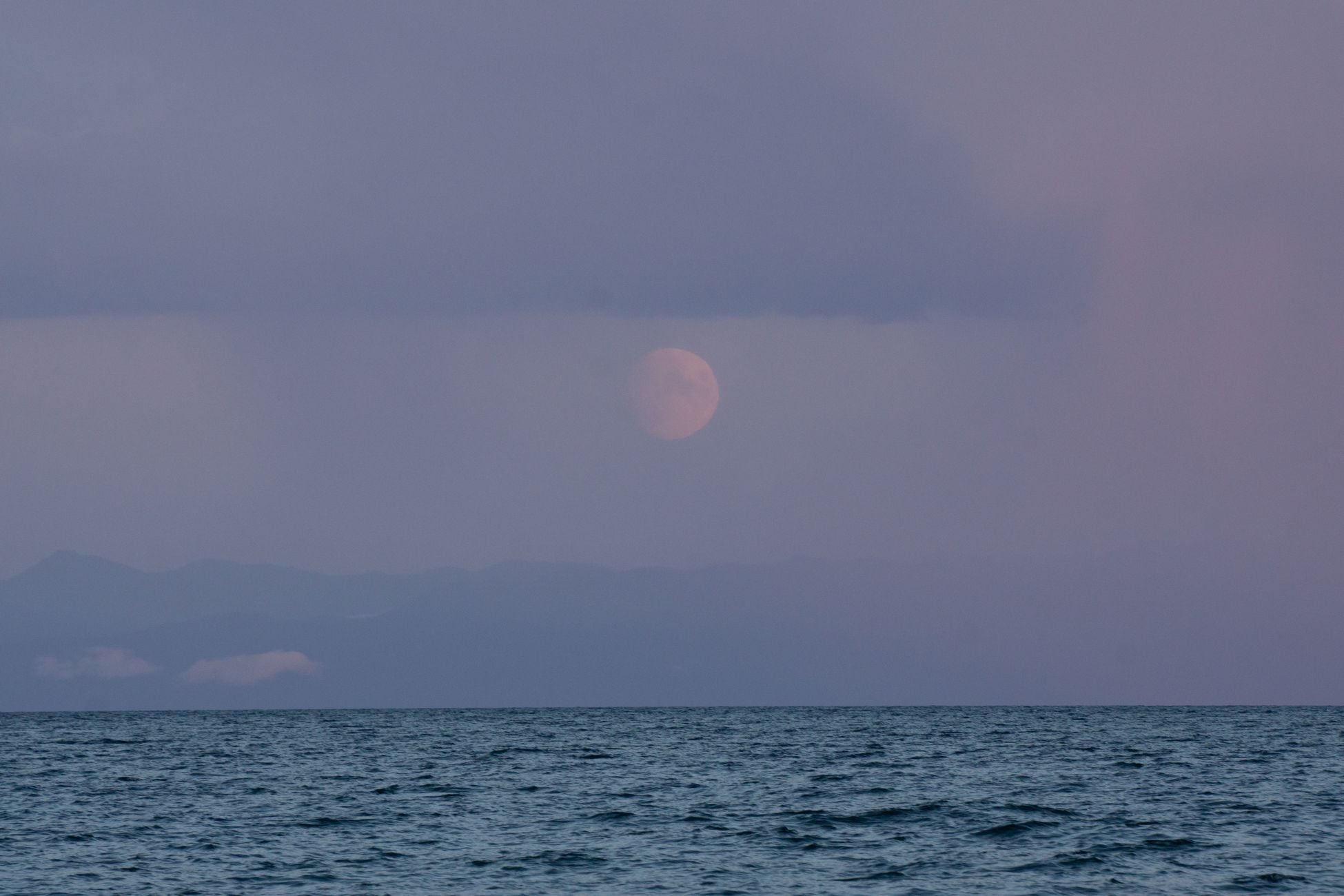
Earth pulls on the Moon far more strongly than the Moon pulls on Earth, because Earth is about 81 times more massive. Early in the Moon’s history, when it was closer and still partly molten, Earth’s tidal force squeezed and stretched the young Moon so severely that it deformed permanently. Astronomy magazine has described how Earth’s gravity gave the Moon an early facelift, freezing an asymmetric shape into its crust. The same tidal locking process eventually slowed the Moon’s rotation until it matched its orbital period — which is why the same face of the Moon always points toward us.
Solid ground rises and falls too
The tides are not just an ocean phenomenon. The solid crust of Earth also flexes under the Moon’s pull, rising and falling by about 30 centimeters twice a day. Standing on granite in the middle of a continent, a person is being lifted and lowered by roughly the height of a coffee cup with every tidal cycle, though the motion is far too slow and smooth to feel. Sensitive instruments at particle accelerators like CERN have to correct for tidal deformation, because the ring of the Large Hadron Collider stretches by about a millimeter as the Moon passes overhead.
The atmosphere tides as well, though the effect is subtle and mostly detectable in barometric pressure records. Every gas, every liquid, every solid on the planet is participating in the same slow stretching that raises the sea against the pilings under Brighton Pier.
What the timing tells you
The interval between successive high tides is not 12 hours but 12 hours and 25 minutes. That extra 25 minutes is the Moon’s own doing. In the time it takes Earth to complete one rotation, the Moon has moved a little farther along its orbit — about 13 degrees per day — and Earth has to spin a bit longer to catch up to it again. Over the course of a lunar month, high tides drift steadily later each day, arriving at a slightly different hour every time.
Coastal communities have known this rhythm for as long as they have kept records. The Egyptians tracked it along the Nile delta. Fishing villages in the Bay of Bengal time their departures by it. What Newton added, and what modern satellite altimetry has confirmed to millimeter precision, is the reason: two bulges, one on each side of a planet caught between the strong pull of a nearby ocean and the weaker pull of a distant one, spinning slowly through both.
Related reading on Space Daily: Venus and its 243-day rotation, and how the wind moves on Titan.
The next time the tide comes in twice in a single day, one of those bulges is the ocean reaching toward the Moon. The other is the ocean being left behind as Earth itself is pulled away — the far-side high tide, a piece of geometry hidden in plain sight on every beach on the planet.
