

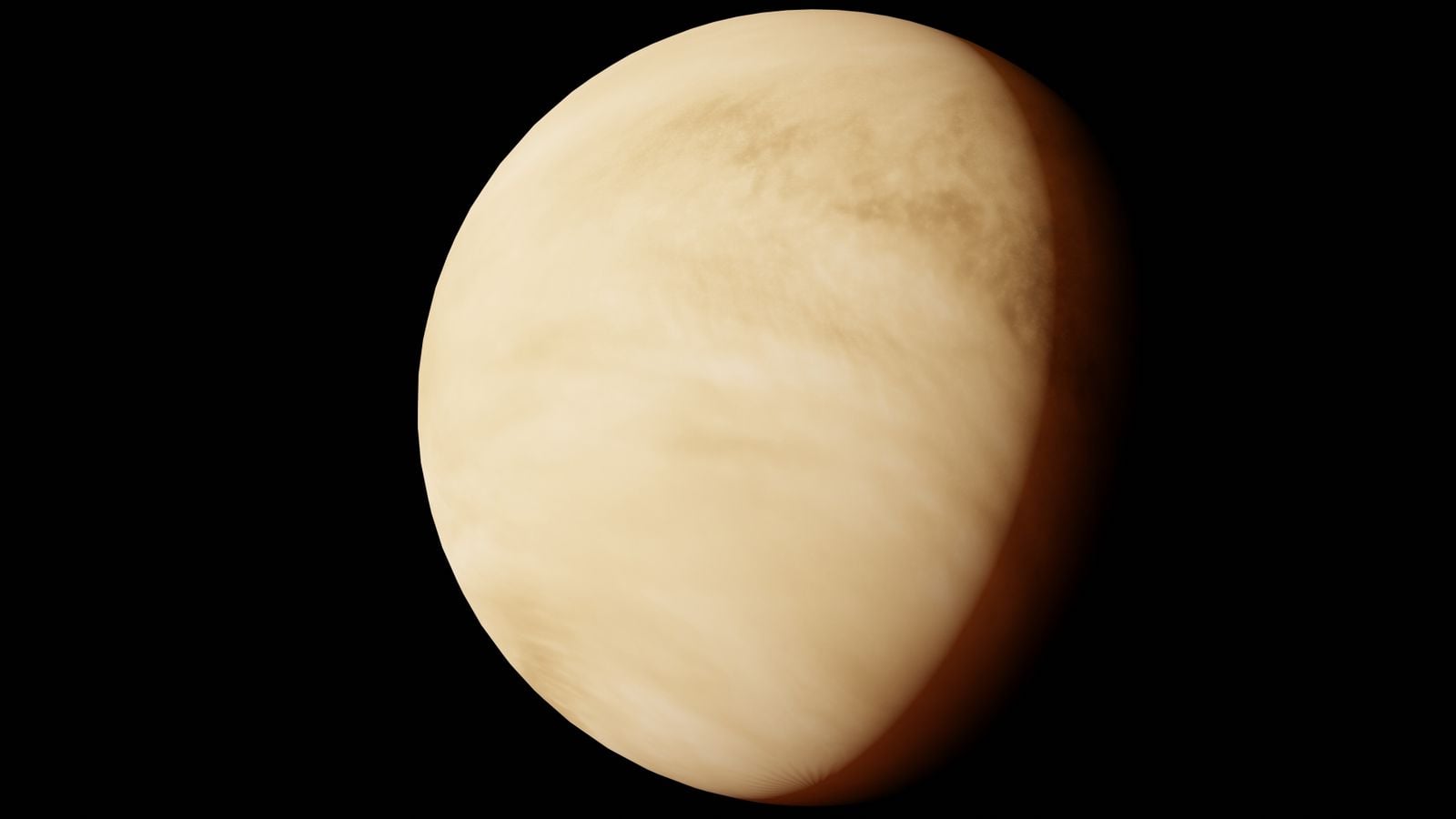
Venus keeps the strangest clock and calendar in the solar system. It takes about 243 Earth days to turn once on its axis, and only about 225 Earth days to travel all the way around the Sun. On Venus, in other words, the day is longer than the year. The planet finishes a lap of the Sun before it has finished a single rotation.
It gets stranger from there, and the figures are worth pulling apart, because two different “days” are hiding in this story.
Two kinds of day
The 243-day figure is the time Venus takes to spin once relative to the distant stars, what astronomers call a sidereal rotation. It is the true turn of the planet on its axis.
But a day in the everyday sense is the gap between one sunrise and the next, and on Venus that is a different and shorter span: about 117 Earth days. The two numbers disagree because Venus is moving around the Sun while it spins, and its spin is unusually slow, so the Sun’s position in the sky is set by a tug-of-war between the planet’s rotation and its orbit rather than by rotation alone. The result, according to NASA’s figures, is a solar day of roughly 117 Earth days. Sunrise to sunrise takes nearly four Earth months.
Rising in the west
There is one more oddity, and it is the one most people have heard. On Venus the Sun comes up in the west and goes down in the east, the reverse of what it does here.
This is because Venus rotates backwards. Nearly every planet, Earth included, spins in the same direction it orbits, which is why our Sun rises in the east. Venus turns the other way, a motion called retrograde rotation, effectively almost upside down compared with its neighbours, its axis tipped close to 180 degrees. It is also the slowest-spinning planet in the solar system, which is part of why its day runs so long. From the surface, the Sun’s daily path would run the opposite way across the sky.
Why it spins like this is not settled. The leading ideas involve either a colossal ancient impact that flipped or reversed the planet, or the slow grinding action of solar tides on its massive atmosphere over billions of years. Both remain hypotheses.
What you would actually see
Here the romantic image needs a caveat, because nobody on Venus would watch a crisp sun lift over a western horizon.
The planet is wrapped in a dense atmosphere of carbon dioxide topped with thick clouds of sulphuric acid, and almost no direct sunlight reaches the ground as a clear beam. A surface observer, if one could survive the 460-degree heat and crushing pressure, would experience a slow, dim brightening and fading of a uniformly glowing sky over those 117 days, rather than a disc rising at a point on the horizon. The direction of the Sun would be a smear of light, not a sunrise you could photograph.
That does not change the underlying mechanics. The Sun’s light still tracks east to west across that murky sky, just without a sharp Sun to mark it.
A planet out of step
Put together, Venus runs on a schedule that breaks every habit Earth has taught us. The day outlasts the year. The Sun, such as it is, rises in the wrong place. And the time from one dim dawn to the next is counted in months, not hours.
None of these are quirks of measurement or rounding. They follow directly from a planet that turns slowly, backwards, beneath a sky that never clears, which is a fair summary of how thoroughly Venus refuses to behave like home.