

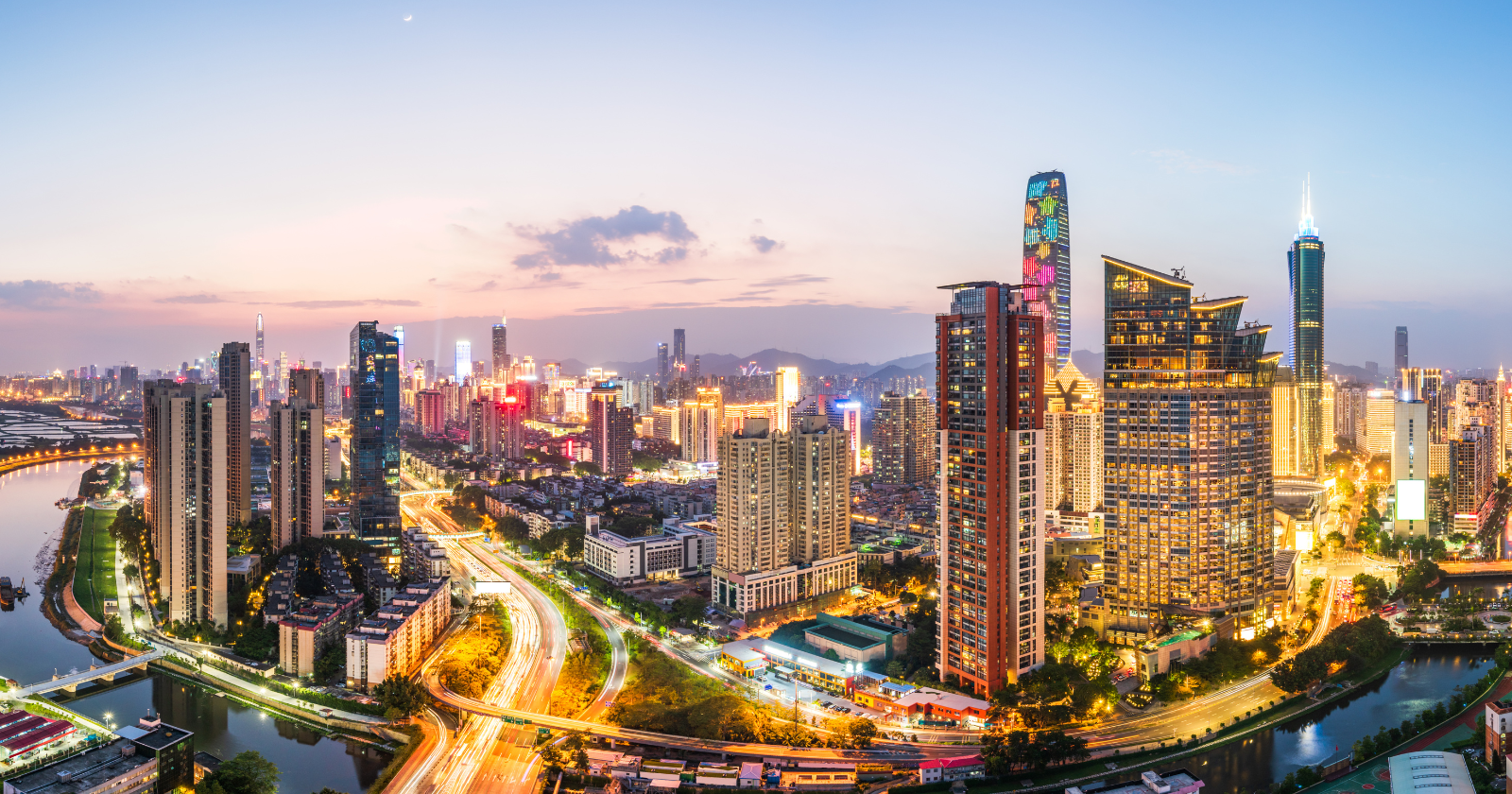
The largest and fastest urbanisation event in the recorded history of the human species happened in one Chinese city across the working career of one generation. Shenzhen in 1979 was not merely a small town. It was, by essentially every available development-economics metric, an unlikely candidate for large-scale urban expansion of any kind. The town of Shenzhen itself contained approximately 30,000 people, primarily engaged in rice cultivation, freshwater fishing, and small-scale trade with the neighboring Hong Kong. The broader Bao’an County — which was formally the administrative unit that would be renamed Shenzhen City — contained approximately 300,000 additional residents scattered across agricultural villages spanning approximately 2,000 square kilometres of undeveloped land. There was no substantial industrial infrastructure. There were no universities. There was no port capacity beyond small fishing docks. There was no rail connection to the rest of China of any consequence. The specific reason Deng and his advisors chose Shenzhen as the location for the first Special Economic Zone was, in essential respects, the same reason no substantial industrial development had occurred there in the previous three decades: the immediate adjacency to Hong Kong, which under British colonial administration had become one of the most substantial commercial ports and financial centres in East Asia, and which the Chinese government reasonably expected would serve as the source of the foreign capital, technical expertise, and export-market access that any successful Chinese SEZ would need.
According to the Hinrich Foundation’s analysis of foreign direct investment in China’s reform and opening-up process, the specific mechanism by which Shenzhen was expected to grow was foreign direct investment routed primarily through Hong Kong-based intermediaries. The Chinese central government contributed approximately 1.4 percent of the physical infrastructure investment that built Shenzhen across the 1980-1990 period. The Shenzhen municipal government contributed approximately 13.1 percent. The remaining approximately 85 percent came from foreign direct investment, primarily from Hong Kong-based Chinese entrepreneurs (many of whom had emigrated from mainland China across the preceding three decades) and secondarily from Taiwanese, Japanese, and Western multinational corporations attracted by the SEZ’s tax incentives, regulatory flexibility, and geographic access to both Hong Kong shipping infrastructure and the broader Chinese labour market. The city was, in essential respects, built by foreign capital operating under a specific Chinese governmental framework that had been designed to enable exactly this kind of externally-funded development while maintaining Chinese Communist Party political control over the broader economic transition.
The forty-five years of construction
The trajectory of Shenzhen’s growth across the subsequent four and a half decades is, by essentially every measurable metric of modern urbanisation, without precedent in the recorded history of the human species. As detailed in StudyCLI’s academic overview of Chinese Special Economic Zones and their broader economic impact, Shenzhen’s GDP grew from approximately 270 million yuan in 1980 (approximately $40 million in contemporary US dollars) to approximately 3,460 billion yuan in 2023 (approximately $490 billion) — a nominal expansion of approximately 12,800 times across 43 years. The city’s population grew from approximately 300,000 in 1979 to approximately 1 million in 1990, 7 million in 2000, 10 million in 2007, 13.5 million in 2010, and approximately 17.5-17.8 million in current permanent residents (with the metropolitan agglomeration including undocumented migrant workers reaching approximately 20 million). The built-up urban area expanded from approximately 3 square kilometres in 1980 to approximately 1,000 square kilometres in 2020. The urban skyline evolved from essentially no buildings taller than four storeys in 1980 to the current density of skyscrapers that includes the 599-metre Ping An Finance Centre (2017), currently among the ten tallest buildings in the world. The city constructed the International Trade Center in 1985 — 53 floors in 18 months — establishing the “Shenzhen speed” pattern of construction that has, across the subsequent four decades, essentially defined the pace of Chinese urban development.
The transformation from manufacturing base to technology hub happened primarily during the 1990s and 2000s. Deng Xiaoping’s Southern Tour in January-February 1992, in which the then-88-year-old former paramount leader visited Shenzhen and reaffirmed the continued commitment to market reforms in the face of post-Tiananmen political conservatism, provided the substantial political cover under which the city’s transition to higher-value-added industries was permitted. Per the CRA Global Development academic case study of Chinese Special Economic Zones’ developmental impact, the Shenzhen High-Tech Industrial Park was established in 1996, attracting substantial multinational technology investment from Intel, IBM, Toshiba, and Samsung across the subsequent decade. The Shenzhen Stock Exchange had opened in 1990, providing capital-raising infrastructure that no other Chinese SEZ possessed. The city’s transition from low-cost manufacturing (the “world’s factory floor” of the 1990s) to high-value technology production (the “Silicon Valley of China” of the 2010s and 2020s) was substantially completed across approximately two decades between 2000 and 2020.
The three companies
The specific corporate anchors of Shenzhen’s current technology sector are three companies that each founded in the city across the 1980s and 1990s and each subsequently grew into globally significant technology firms. As reported in HistoryRise’s summary of Shenzhen’s transformation from fishing village to tech metropolis, Huawei was founded in 1987 by the former People’s Liberation Army officer Ren Zhengfei with approximately 21,000 yuan (approximately $5,000) of starting capital, initially as a distributor of Hong Kong-manufactured private branch exchange telecom switches, and has subsequently grown into one of the world’s largest telecommunications equipment manufacturers with 2023 revenues of approximately $98 billion and a global workforce of approximately 207,000 employees. Tencent was founded in Shenzhen in 1998 by Ma Huateng (known internationally as “Pony Ma”) as an instant-messaging startup called QQ, and has subsequently grown into the operator of WeChat (the dominant Chinese social media and payment platform, with approximately 1.4 billion active users), the world’s largest gaming company by revenue, and a substantial investor in Western game studios including Riot Games (League of Legends) and Supercell (Clash of Clans). BYD (“Build Your Dreams”) was founded in Shenzhen in 1995 by the chemical engineer Wang Chuanfu, initially as a manufacturer of rechargeable batteries for mobile phones, and has subsequently — following a series of strategic pivots that included a substantial 2008 investment from Berkshire Hathaway — become the world’s largest manufacturer of electric vehicles, surpassing Tesla in 2023 with sales of approximately 4.27 million vehicles in 2024. The Chinese fishing village of approximately 30,000 people that Deng Xiaoping designated as a Special Economic Zone in August 1980 has, in essential respects, become one of the more consequential concentrations of technological and industrial capacity currently operating anywhere on the planet.