
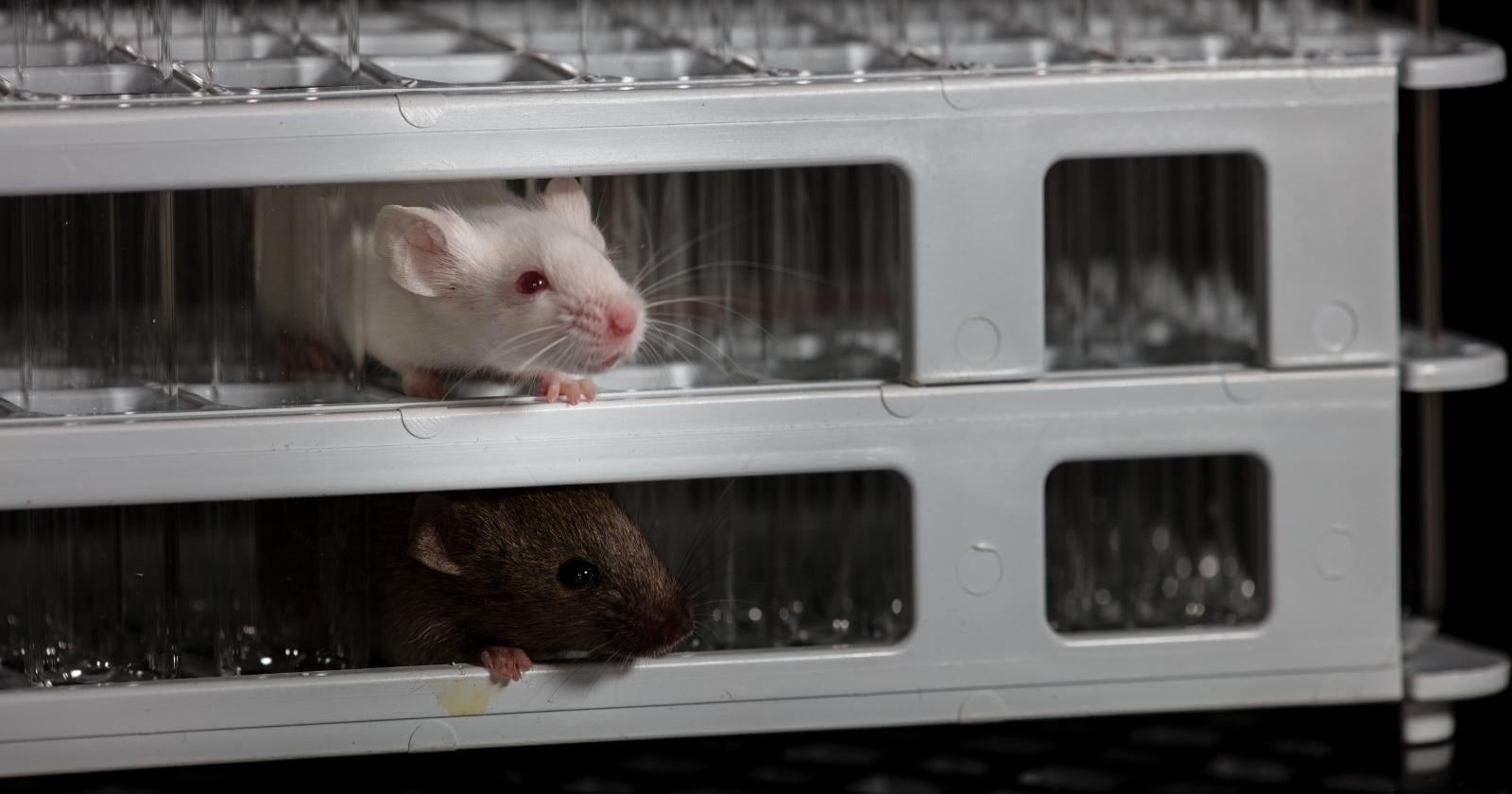
The closer a rat gets to the food at the end of a runway, the harder it pulls toward the reward. The closer it gets to a place where it once received a shock, the harder it pulls away. And when both forces act on the same animal at the same spot, the avoidance gradient rises more steeply than the approach gradient near the goal — meaning the urge to retreat grows fastest exactly when the prize is almost in the mouth. That gradient, sketched by Neal Miller in the 1940s and later threaded into a full neuroscience of behavior by the British psychologist Jeffrey Gray, is the cleanest physical picture of what people now call self-sabotage.
It is also, increasingly, a circuit diagram. In a 2026 intracranial EEG study published in Nature Communications, epilepsy patients played a stripped-down version of Pac-Man while electrodes inside their brains recorded the conflict in real time. The closer their on-screen avatar drifted to the ghost, the more violently a prefrontal-limbic network lit up. The pattern was old. The resolution was new.

The gradient Miller drew, and the system Gray named
Neal Miller’s runway experiments in the 1940s produced a graph that has outlived almost everything else in mid-century behaviorism. Hungry rats were trained to run toward food. Other rats were shocked at the goal box. A third group experienced both. By harnessing the animals and measuring how hard they pulled at different distances, Miller showed that both approach and avoidance strengthen as the goal gets closer — but avoidance climbs faster. The two lines cross. Where they cross, the animal stalls, oscillates, sometimes turns back.
Jeffrey Gray spent the 1970s and 1980s building a neural theory around that crossover. His Behavioural Inhibition System proposed that a septo-hippocampal circuit, modulated by serotonin and noradrenaline, was the brake — the structure that halts ongoing behavior when goals and threats compete. Gray’s work on the neuropsychology of anxiety placed the hippocampus at the center of conflict detection long before functional imaging could test the claim. The framework predicted that near-goal conflict should produce a measurable signature in limbic regions. It took roughly four decades to record it directly in a human brain.
What the Pac-Man electrodes saw
The Nature Communications team, led by researchers studying presurgical epilepsy patients, designed a task that compressed Miller’s runway into an arcade corridor. Pac-Man sat at one end. A ghost paced at the other. Between them lay dots worth 10 or 20 points. Players pushed the joystick to approach the rewards or retreat to the exit. The ghost’s probability of attacking rose as Pac-Man got closer — the digital equivalent of Miller’s steepening avoidance gradient.
During approach, theta-band power rose across the hippocampus, amygdala, orbitofrontal cortex, and anterior cingulate. The same regions associated with emotional processing. Theta synchrony between this limbic circuit and the lateral prefrontal cortex — specifically the middle frontal gyrus — also climbed. The longer a participant stayed on approach, the more tightly these regions oscillated in lockstep.
Then the ghost attacked. The theta circuit dropped out. High-frequency activity in the lateral prefrontal cortex surged. The brain switched modes. One network for deliberation under conflict, another for executing escape under direct threat.
The behavioral consequence matched Miller’s prediction with eerie fidelity. When the last available dot was large, players pushed closer to the ghost before turning around. When it was small, they turned earlier. The avoidance gradient was steeper near the goal — except when the reward was juicy enough to push the crossover point a little further in.
Dopamine in a place no one was looking
The Pac-Man study mapped where the conflict lives. A May 2025 paper from Mount Sinai, summarized by Science Daily, mapped what tunes it. Eric Nestler’s team found that D1 and D2 dopamine receptors in the ventral hippocampus of mice play opposite roles in approach-avoidance decisions. Activating D2-expressing cells made the mice noticeably less fearful. Activating D1 cells did the reverse.
The result mattered because dopamine signaling in the hippocampus had been treated as a footnote for decades. Reward and motivation belonged to the striatum. Memory belonged to the hippocampus. The Mount Sinai paper showed that the hippocampus is also running its own dopamine-gated approach-avoidance arithmetic — and that the receptor balance there could push the same animal toward the food bowl or away from it.
This is the molecular layer underneath Gray’s circuit. The septo-hippocampal brake he described in the 1980s now has named receptors, traceable projections, and a dopamine modulator that biases the calculation moment by moment.
Why the near-goal spike feels like self-sabotage
The phenomenology of quitting just before success is familiar to almost everyone: the manuscript abandoned at 90% completion, the relationship undermined the week it starts feeling real, the promotion conversation skipped after months of preparation. The pattern has been described in countless ways. Psychology Today recently catalogued the everyday signs of joy-sabotage. National Geographic has covered the brain basis of procrastination in similar terms.
What Miller’s gradient adds is geometry. The closer you get to a goal that carries any potential cost — exposure, judgment, the risk of finally finding out whether you’re good enough — the steeper the pull-away. Avoidance climbs faster than approach near the endpoint. A person who has been moving steadily toward something for months can find, in the final stretch, that the same situation suddenly feels unbearable. The situation has not changed. The gradient has.
Research on goal framing found that people who frame their pursuits in avoidance terms (such as focusing on not failing or not embarrassing themselves) report less progress and less subjective well-being than those who frame the same pursuits in approach terms (such as doing well or connecting with someone new). The framing shifts which gradient dominates the final stretch.
The anxiety dimension
Excessive avoidance is the cardinal feature of anxiety disorders. The Pac-Man paper notes this in its opening lines, and a separate 2026 study in Molecular Psychiatry tracked how two distinct dimensions — anxiety sensitivity and intolerance of uncertainty — produce different avoidance signatures in the brain. People high on anxiety sensitivity over-weight the bodily signals of fear. People high on intolerance of uncertainty over-weight the ambiguity of the outcome. Both push the crossover point of Miller’s gradient further from the goal. Both make the near-finish stall happen earlier and harder.
In generalized anxiety disorder, PTSD, and agoraphobia, the avoidance gradient does not just steepen near the goal — it dominates the entire field. The party becomes unattendable. The phone call becomes unmakeable. The runway shrinks until there is no approach side left.
The intracranial recordings hint at why traditional talk therapies for these conditions emphasize graded exposure. If the avoidance gradient is steepest near the goal, the most effective intervention is to extend the time spent near the goal without retreating. The theta synchrony rises. The high-frequency escape signal does not fire. The brain learns that the ghost was never going to attack at this distance.
What this changes about quitting
The standard story about self-sabotage is psychological: hidden fears of success, feelings of fraudulence, fear of visibility, family scripts about not outshining the parent. These narratives are not wrong. They describe what the conflict means. The Miller-Gray framework describes what the conflict is — a structural feature of how nervous systems weigh competing signals as distance to the outcome shrinks.
This is useful because it predicts the moment of failure with some precision. The risky drop-out point is not the start of a project, where motivation is novel and the cost is abstract. It is the final 10%, where the reward is concrete enough to be visible and the cost of failing is concrete enough to be felt in the body. The runway crossover sits near the food box, not near the start line.
Research on goal framing, including a recent piece in The Conversation on why fresh-start motivation fades, suggests that translating an avoidance frame like don’t blow this into an approach frame like make this thing exist flattens the near-goal spike. A December 2025 Psychology Today essay on effective goal-setting reaches a similar conclusion from a different direction: specificity and approach-language produce more completion than vague avoidance-language.
The mirror the rats held up
Miller’s apparatus was a wooden runway and a harness with a strain gauge. Gray’s tools were lesion studies and pharmacology. The 2026 Pac-Man patients had platinum electrodes threaded into their hippocampi and amygdalae for clinical reasons that had nothing to do with self-sabotage. Across eighty years and three orders of magnitude of technical change, the picture has stayed the same. Animals — including the human kind — approach what they want. They avoid what hurts. Near the goal, the two signals collide. The brain’s theta circuits oscillate in time. Sometimes the approach wins. Sometimes the avoidance does.
The pattern is so old it predates the language used to describe it. Long before anyone called the near-finish stall “self-sabotage,” before personal-development bookshelves existed, before the word procrastination entered everyday vocabulary, a rat in a harness was already showing the same shape. It pulled hardest toward the food when the food was close. It pulled hardest away from the shock when the shock was close. Where the two lines crossed, it stood still, trembling slightly, deciding nothing.
In the editorial team’s recent piece on how astronaut hearts reshape in orbit, the body’s quiet adaptations to changed conditions became visible only when measured directly. Approach-avoidance conflict works the same way. The pattern was always there, in every life. It took electrodes to see the trembling.
The runway was never about rats. It was a way of making a hidden gradient legible. The Pac-Man corridor inside an epilepsy patient’s brain is the same runway, drawn at higher resolution. The shape Miller sketched in pencil in 1944 turns out to be roughly what the hippocampus is doing on a Tuesday afternoon when someone almost sends the email and then closes the laptop instead.
