
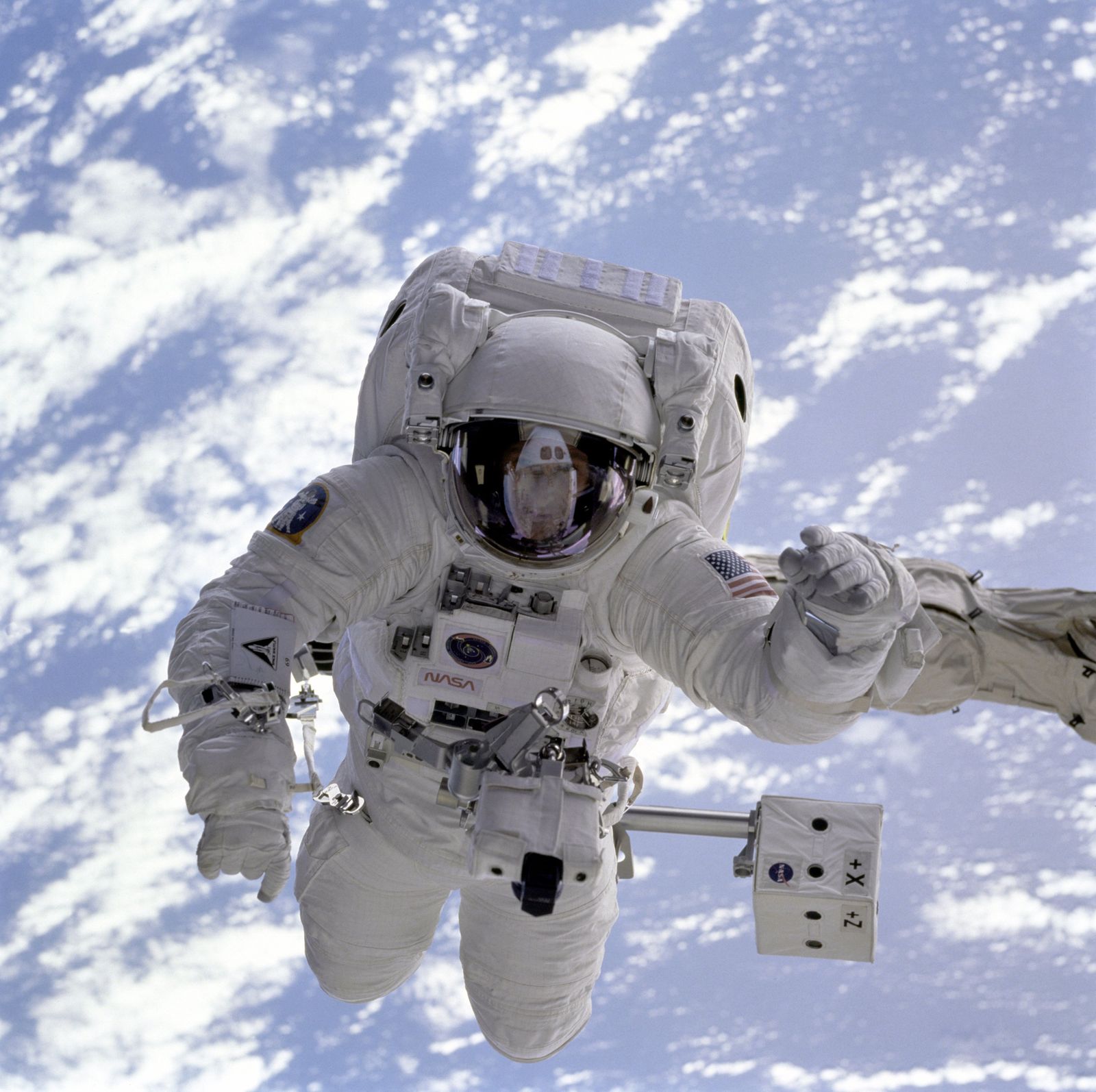
Spend long enough in orbit and your own body starts to change shape. With gravity no longer pulling on it in the usual way, an astronaut’s heart can grow slightly more spherical, and their spine can stretch enough that they return to Earth measurably taller than when they left. Both changes are real, both are temporary, and both come down to the same thing: a body built for gravity, briefly relieved of it.
Neither is dramatic on its own. Together they are a useful illustration of how much of our shape is simply the body bracing against a force we never notice.
The rounder heart
On Earth, the heart is a slightly elongated organ, its shape maintained in part by the constant work of pumping blood against gravity. Take that load away and it relaxes toward a rounder form.
A study presented at the American College of Cardiology in 2014, based on ultrasound images from 12 astronauts, found that the heart became more spherical by about 9.4 per cent during long spells in microgravity. The reading worth keeping is what that rounding signals rather than the shape itself. A heart that does less work tends to lose muscle, and the change is one visible sign of the cardiac deconditioning that comes with weightlessness.
It is a small study, and a preliminary one, and the effect reverses once an astronaut is back under gravity. What it points to is a longer question: what sustained low effort does to the heart over the length of a mission to somewhere like Mars.
The taller astronaut
The height change is more straightforward and, for a while, more noticeable. Astronauts can gain up to around three per cent in height in orbit, which for a tall person can mean a couple of extra centimetres.
This is not bone growth. The spine is a stack of vertebrae cushioned by soft discs, and on Earth gravity keeps those discs gently compressed all day, which is why people are fractionally taller in the morning than at night. In orbit there is nothing pressing down at all, so the discs expand and rehydrate and the whole column lengthens. The astronaut does measure taller, just not permanently.
The stretch comes at a price. Lengthened spines are linked to back pain in flight and to a raised risk of herniated discs after landing, as the spine recompresses. Height returns to normal over the weeks and months that follow.
A body unloaded
The two changes share a cause. Almost everything about the human body, from the thickness of bones to the tone of muscles to the set of the spine, is shaped by a lifetime of resisting gravity. Remove that resistance and tissues drift toward shapes and lengths the constant downward pull normally prevents.
The heart and the spine are only the most easily pictured examples. Weightlessness also sends fluid toward the head, thins the bones, and wastes the muscles, which is why astronauts on the International Space Station spend hours a day exercising to hold the worst of it off.
Why it is worth tracking
These effects are reversible on the timescales of current missions, but they stop being a curiosity the moment journeys get longer. A crew bound for Mars would spend months in this state on the way out, arrive with deconditioned hearts and altered spines, and then have to function on landing.
Understanding exactly how the body reshapes itself without gravity, and how to counter it, is part of the unglamorous groundwork of going anywhere far. It also runs the other way: the spherical-heart finding drew interest precisely because the shape resembles changes seen in certain heart conditions on Earth, which makes the orbiting body a strange but useful place to study the one down here.
