
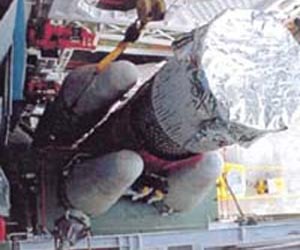
The test flight of a geo-synchronous satellite launch vehicle (GSLV-D3) powered by an Indian cryogenic engine with super-cooled fuel has been put on hold as it is undergoing final evaluation..
“We are undertaking a thorough review of the indigenously built cryogenic engine before finalising the launch date of GSLV-D3,” Indian Space Research Organisation (ISRO) chairman K Radhakrishnan said.
Clarifying that there was no delay as such in the rocket’s launch from the Sriharikota spaceport, about 80 km northeast of Chennai, Radhakrishnan said the launch schedule would be decided at a meeting later this month.
The successful test-firing of an indigenous cryogenic engine will take India into the elite space club of the US, Russia, China, France and Japan that can make such engines.
A GSLV-F04 at vehicle assembly building
A cryogenic engine uses liquid hydrogen as fuel at minus 265 degrees Celsius and liquid oxygen at minus 240 degrees Celsius as oxidiser in the upper stage of a rocket like the GSLV to deploy satellites in orbit. If the fuel mix is not in the exact proportion, the rocket can explode in the geo-synchronous orbit.
“We are planning to first launch Cartosat-2B in March using the PSLV (polar satellite launch vehicle) and follow it up with the GSLV-D3 later this year,” Radhakrishnan said.
The GSLV-D3 is set to carry GSAT-4 communication satellite into the geo-stationary orbit, around 36,000 km above the earth.
ISRO took up the development of cryogenic stage in 1996 to achieve self-reliance in cryogenic propulsion technology. ISRO so far used Russian-made cryo-engines for the GSLVs.
Besides Cartosat-2B, the polar rocket will carry on board Alsat, a small Algerian satellite, two Canadian nano-satellites and Studsat, another nano-satellite built by students of Indian universities.
