

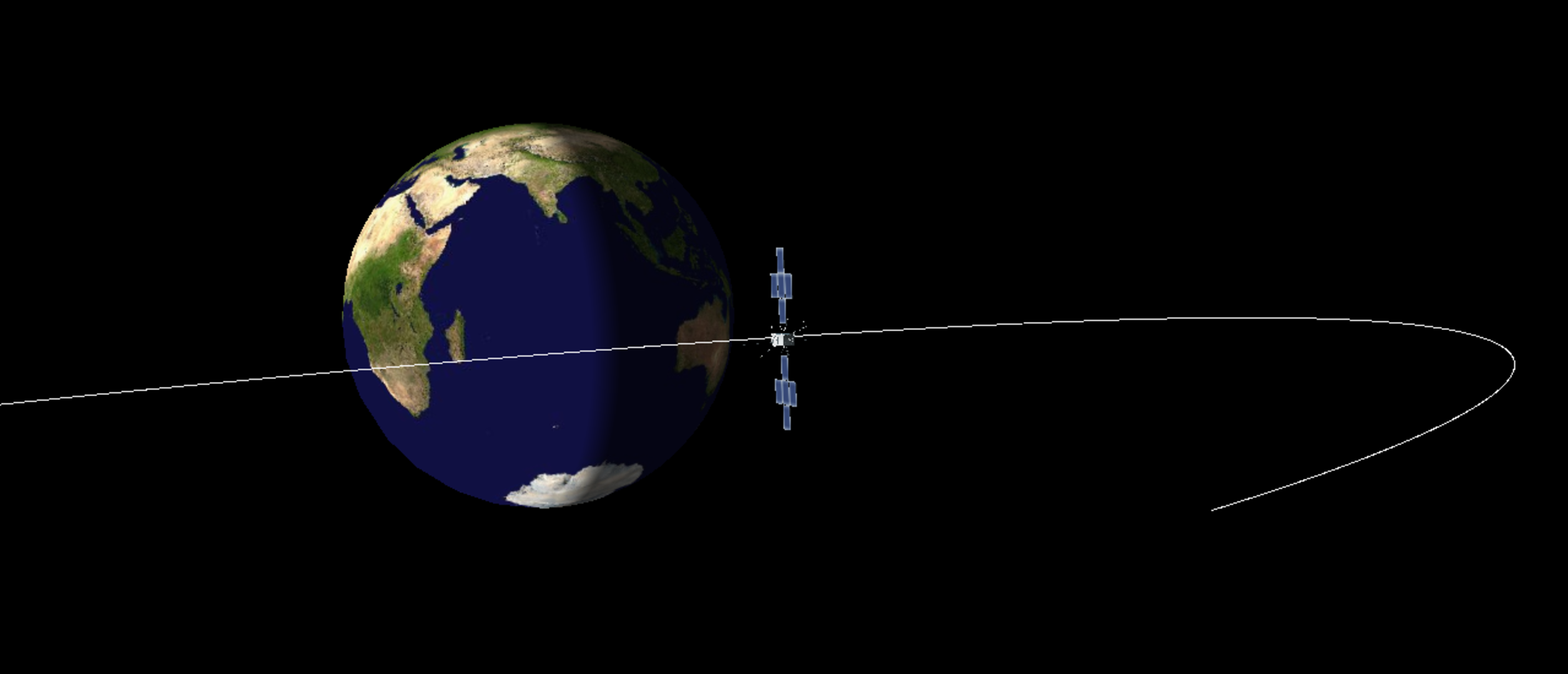
ESA’s Jupiter Icy Moons Explorer is approaching Earth again, but home is only a waypoint. On 28 September 2026, Juice will skim about 8,640 kilometres above the planet, letting Earth’s motion and gravity bend its path and increase its speed relative to the Sun by about 3.5 kilometres per second.
The encounter is the third of four planned gravity assists. It follows the first lunar-Earth double flyby in 2024 and a Venus flyby in August 2025. One more Earth pass in January 2029 will finally place Juice on its transfer towards Jupiter, where it is due to arrive in July 2031.
The mission is turning this return into more than a trajectory correction. Juice’s navigation camera will point at the Moon’s horizon to test a technique intended to improve optical navigation during selected encounters in a sequence of 35 future flybys of Ganymede, Callisto and Europa.
The Moon is not part of the gravity assist this time. It is a known target on which engineers can rehearse the image geometry they will later need around worlds hundreds of millions of kilometres away.
The detour through Venus began with a slowdown
The route looks inefficient only if distance is the sole measure. A direct flight would require a much more energetic launch and an enormous propellant load, first to reach Jupiter and then to prevent a nearly 6,000-kilogram spacecraft from flying straight past it.
A gravity assist avoids carrying most of that fuel. In the Sun’s frame, a spacecraft exchanges a minute amount of momentum with a moving planet as gravity curves its trajectory. The result can be a gain or loss of heliocentric speed, depending on the direction of approach. The planet’s own motion is what makes the encounter more than a simple U-turn.
Juice’s first assist in August 2024 deliberately removed energy. The Moon increased its speed by 0.9 kilometres per second relative to the Sun, positioning it for Earth one day later. Earth then reduced its heliocentric speed by 4.8 kilometres per second; overall, the lunar-Earth sequence turned the path by about 100 degrees.
That world-first lunar-Earth sequence sent Juice inward towards Venus while saving an estimated 100 to 150 kilograms of propellant. SpaceDaily’s account of the completed trajectory reset described how the two encounters worked together.
Venus supplied the next turn on 31 August 2025, bending the solar orbit back towards Earth and adding speed. The flyby had no sightseeing component. Juice was built for the cold outer Solar System, so it pointed its 2.5-metre high-gain antenna towards the Sun as a heat shield and kept its remote-sensing instruments inactive.
The operation followed a communications failure caused by a software timing bug that left a signal amplifier switched off. SpaceDaily covered the recovery and final preparation for the Venus encounter. ESA subsequently described the spacecraft as successfully through that flyby and on course for Earth.
Earth supplies a precisely aimed bend
According to ESA’s current flyby plan, closest approach will occur over the Indian Ocean at 11:45 UTC on 28 September. Earth should deflect Juice’s trajectory by about 20 degrees while increasing its speed relative to the Sun by roughly 3.5 kilometres per second.
Those numbers are not produced by an engine burn at perigee. They are the consequence of entering Earth’s moving gravitational field along a carefully chosen line and leaving it in a new direction. A mistimed arrival would change both the size and direction of the result.
The navigation campaign therefore began on 17 August. Six correction opportunities were reserved at intervals including four weeks, two weeks, one week and three days before the encounter. As of ESA’s 21 September update, only the first small manoeuvre had been required.
Controllers will be ready at 06:00 UTC on flyby day for a final emergency manoeuvre if they detect a critical navigation error or a collision risk involving another satellite. Under the nominal plan, they will not use it. Juice will pass above Australia 15 to 30 minutes before closest approach and then sweep over the Indian Ocean.
This boost still does not send Juice straight to Jupiter. Jupiter will not yet be in the right place. The 2026 encounter shapes another solar orbit, returning Juice to Earth in January 2029 for the final push onto a path that intercepts Jupiter in July 2031.
Earth’s shadow turns geometry into a power problem
Before closest approach, Juice will spend eight hours and 39 minutes in Earth’s shadow, from 19:24 UTC on 27 September until 04:03 UTC on 28 September. With no sunlight reaching its solar arrays, the spacecraft will operate from batteries alone.
That eclipse does not threaten the planned flyby, but it limits how freely the payload can be used. Teams are prioritising the most valuable observations during the battery-powered interval rather than switching on every instrument continuously.
Across a wider window from 23 September to 3 October, all ten science instruments are scheduled to gather data on Earth and the Moon, though not continuously or all at once. Both bodies are useful calibration targets because their shapes, surfaces and surrounding environment are already measured far better than the Jovian system.
Juice will also spend several days inside Earth’s magnetotail, the long nightside extension of the magnetic field shaped by the solar wind. The measurements can test particle and field instruments in a complex but comparatively familiar plasma environment before they face Jupiter’s larger, faster-rotating and more intense magnetosphere.
Two small monitoring cameras will photograph the passage as well. They should not be confused with NavCam or the JANUS science camera. The monitoring cameras provide engineering views of the spacecraft and its surroundings; NavCam extracts geometry; JANUS is designed for scientific imaging.
The Moon stands in for three icy worlds
During this Earth approach, the navigation camera will point towards the lunar horizon, also called the limb. An image of that curved boundary contains information about the apparent centre and angular size of the Moon. Compared with a predicted view, it can sharpen the estimate of the spacecraft’s position relative to the target.
ESA has said the new lunar observations will test a technique for improving optical-navigation accuracy, but has not published a full operational description of the new method. The careful claim is therefore that Moon-limb images will test it, not that the September campaign has already proved a specific performance gain.
NavCam first operated on a real world during the 2024 lunar-Earth encounter. In its account of that first in-space test, ESA showed raw, uncalibrated lunar images and explained that the camera would later use the shapes of Jupiter’s moons to support navigation.
The 2026 geometry is different. Juice is not flying close to the Moon, and lunar gravity is not the manoeuvre. The Moon is being observed from the Earth-approach trajectory as a reference object. Calling it a rehearsal is accurate; calling this another lunar gravity assist would not be.
Why a camera must share the navigation load
Ground-based radio tracking remains essential, but a complete Earth communications loop is too slow for fresh local relative-position updates during a close Jovian flyby. Near Jupiter, a radio message can take roughly 50 minutes each way. The location of the moon relative to the approaching spacecraft also matters more than an absolute position measured in isolation.
SpaceDaily’s earlier account of Juice’s image-based navigation system described onboard software that detects the edges of a moon in NavCam images. Those edge measurements allow the system to refine relative geometry without waiting through the complete Earth communications loop.
The underlying system is called Enhanced Attitude Guidance through Limb Extraction, or EAGLE. It is intended for use on the inbound leg of selected moon encounters, with mission planners deciding case by case when the technique should support guidance and pointing.
This does not mean Juice will improvise a tour or replace its flight-dynamics team. Ground controllers design and command the encounters. Optical navigation supplies a timely local measurement during sequences in which a small targeting error could move an instrument footprint by many kilometres or turn a planned close pass into a miss.
NavCam is also not a substitute for the science payload. It is a wide-field engineering camera optimised to tell the spacecraft where a world is. Scientific cameras and spectrometers ask what that world is made of and how its surface changes. A blurred-looking limb can still be excellent navigation data.
Earth is a rehearsal, not the destination
After Jupiter arrival, Juice will make 35 flybys of Ganymede, Callisto and Europa before entering orbit around Ganymede in 2034. Each encounter must satisfy navigation, power, communications, radiation and instrument-pointing constraints at the same time.
SpaceDaily has also reported an engineering-model rehearsal of a Callisto flyby, in which simulated images were projected into a navigation camera to exercise the flight software. That laboratory test supplied a synthetic moon; September’s observation supplies a real horizon to the flight camera in space.
Earth and the Moon offer known targets, stronger communications and time to improve procedures. At Jupiter, the encounters will be distant, fast and scientifically scarce. The apparent detour through Venus is preserving the fuel needed to conduct that tour, while the lunar images are buying something equally valuable: a navigation method tested before the real icy moons fill the camera.