

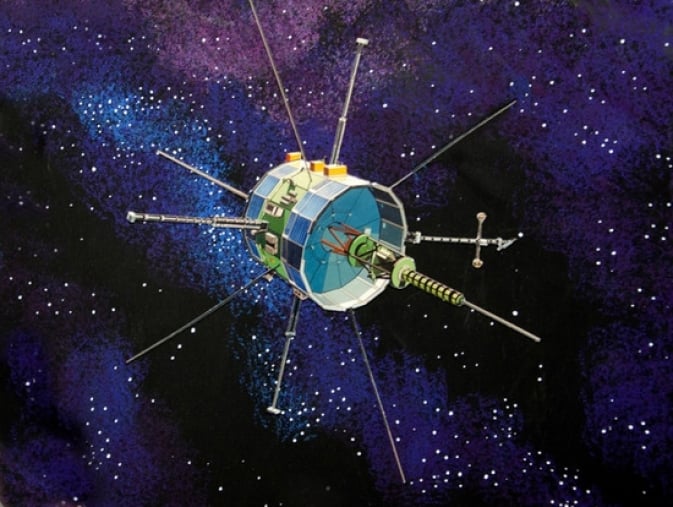
In 2014, a spacecraft launched before the first Space Shuttle flight was approaching Earth for the first time in decades. NASA had ended support for ISEE-3 in 1997. The specialised ground equipment once used to command it had been discarded, and no funded agency mission was waiting to take control.
A publicly financed group of independent engineers, scientists, programmers and radio specialists decided to rebuild that capability. The ISEE-3 Reboot Project secured NASA’s permission, assembled a modern command system around software-defined radio hardware and reached the spacecraft through some of the world’s largest radio telescopes.
On 2 July 2014, the probe fired its hydrazine thrusters for the first time since 1987. Eleven short pulses returned its spin almost exactly to the original operating range. Six days later, the team attempted the much larger manoeuvre needed to reshape its path through the Earth-Moon system. That burn quickly faded.
The failure was probably not an empty hydrazine tank. Telemetry indicated that the spacecraft had lost the nitrogen gas used to pressurise the propulsion system. Fuel could remain aboard, but without pressure to push it through the plumbing, it could not reach the thrusters.
ISEE-3 had already completed two pioneering missions
NASA launched the International Sun-Earth Explorer 3 on 12 August 1978 as part of a joint programme with the European Space Agency. Its first destination was the Earth-Sun L1 region, about 1.5 million kilometres sunward of Earth.
ISEE-3 became the first spacecraft placed in a halo orbit around a Lagrange point. From that position, it sampled the solar wind before the flow reached Earth’s magnetic environment. The geometry later became standard for solar observatories because it offers a continuous view upstream from the planet.
The probe’s working life then took an unusual turn. After the primary mission, NASA redirected it through Earth’s long magnetic tail and used five lunar flybys to send it toward Comet 21P/Giacobini-Zinner.
Renamed the International Cometary Explorer, or ICE, it passed about 7,862 kilometres from the comet’s nucleus on 11 September 1985. It was the first spacecraft to encounter a comet, crossing the tail and returning measurements of particles, fields and plasma.
NASA’s ISEE-3/ICE mission history also records its contribution to observations of Halley’s Comet in 1986. Daily data return ended in 1995, and NASA formally terminated operations and support on 5 May 1997, although the transmitter was left active for tracking.
The spacecraft returned to an Earth that could no longer command it
ISEE-3 continued in heliocentric orbit. Its path eventually carried it back toward the Earth-Moon system, creating a narrow opportunity in 2014. With a carefully timed velocity change, the probe could approach the Moon on a trajectory that opened routes back to the L1 or L2 regions and other useful orbits.
The spacecraft was transmitting, but hearing a carrier was not the same as commanding it. Its communication design belonged to the 1970s. The compatible Deep Space Network hardware had been removed after the mission ended, and NASA had neither a funded project nor the old equipment required for a conventional recovery.
The reboot effort was led by Keith Cowing and Dennis Wingo through Skycorp and the Space College Foundation, with help from specialists and observatories in several countries. Public crowdfunding paid for the attempt.
On 21 May 2014, NASA announced a non-reimbursable Space Act Agreement with Skycorp. It allowed the team to contact and potentially command the defunct spacecraft while defining legal, technical and safety responsibilities. NASA supplied permission and coordination, not project financing.
The arrangement was unusual. NASA described it as the first agreement of its kind for a spacecraft the agency no longer used and did not plan to use again. It did not transfer ownership of ISEE-3. It authorised a private team to operate a government spacecraft under agreed conditions.
Arecibo and software replaced a vanished control room
The team used software-defined radio technology to recreate functions once performed by specialised hardware. Instead of restoring a 1978 control centre component by component, modern software generated and interpreted the old signal formats.
Commanding was carried out through the 300-metre Arecibo radio telescope in Puerto Rico. Other facilities, including the 20-metre dish at Bochum in Germany and NASA antennas, contributed tracking and reception. The work combined institutional infrastructure with an independently organised mission team.
Two-way communication was re-established in late May. The spacecraft entered engineering mode and returned telemetry, allowing the team to inspect power, temperature, communications and propulsion data. Five scientific instruments were believed to remain usable.
This was the first major success of the project. ISEE-3 had not merely been detected. It had received authenticated commands built by a team that did not possess the original ground system and responded across millions of kilometres.
The achievement also exposed a distinction often lost in stories about dormant spacecraft. A probe can remain electrically alive while its mission is institutionally dead. ISEE-3 still generated power and transmitted, but the staff, budgets, procedures and machines that once made those signals useful had dispersed.
Eleven pulses restored a 1970s spin rate
ISEE-3 was spin-stabilised. Rotating the spacecraft helped maintain its orientation, but the rate had drifted to 19.16 revolutions per minute. The planned trajectory manoeuvre required it to return to the original operating specification of 19.75 revolutions per minute, with a tolerance of 0.2.
On 2 July, controllers commanded 11 brief pulses from the spin thrusters. The measured rate rose to about 19.75 revolutions per minute. The peer-reviewed account of the 2014 return, published in Acta Astronautica, describes it as the first manoeuvre since 1987.
The firing was modest, but its success carried a long chain of implications. The command had been received correctly. Heaters had brought the propulsion system into an operable state. Valves opened. Hydrazine reached the catalyst beds. The relevant thrusters produced measurable torque.
Restoring the spin did not itself redirect ISEE-3 toward L1. It prepared the probe for the larger burn and placed its rotation within the range assumed by the manoeuvre design.
The recovery burn achieved only a fraction of its target
On 8 July, the team attempted a trajectory correction of about 7.3 metres per second. The plan called for more than 500 pulses from the radial jets. That change would retarget the 10 August lunar flyby, using the Moon’s gravity as part of a longer path toward a useful Earth-Sun orbit.
The burn was therefore a necessary first step toward returning ISEE-3 to an observation point, not a direct insertion at L1. The distinction matters because the spacecraft still needed the planned lunar geometry and later orbital adjustments.
Telemetry showed that the manoeuvre produced only about 0.15 metres per second before thrust decayed. Further attempts could not restore useful propulsion. The available evidence pointed to depletion of the nitrogen pressurant.
ISEE-3 used hydrazine as propellant and compressed nitrogen to force that liquid from its tank toward the thrusters. When a valve opened, the pressurised system was supposed to deliver hydrazine to a catalyst, where it decomposed into hot gas and generated thrust.
If the nitrogen had leaked away during the 27-year interval, opening the valves would not provide sustained fuel flow. This explains how the short spin-up could work while the long burn failed: a small residual pressure or local supply could support 11 pulses, then collapse under the demand of hundreds.
The diagnosis remains phrased as probable because nobody could inspect the hardware. NASA’s HEASARC mission record likewise says the longer firing failed likely because the nitrogen pressurant had been depleted.
Failure to capture the probe did not end the reboot
Without the required velocity change, ISEE-3 passed about 15,600 kilometres from the Moon on 10 August and continued in heliocentric orbit. The carefully modelled capture opportunity was gone.
The team changed the mission rather than shutting it down immediately. Working scientific instruments were activated, data were received, and the project made those observations available online. The Planetary Society described the resulting public home for ISEE-3 data in August 2014.
Communication became increasingly difficult as the spacecraft receded. Contact was lost in September. The probe itself continued around the Sun, but it again became operationally unreachable.
The failed capture should not be rewritten as a complete rescue. The team regained command, changed the spin, operated instruments and returned data. It did not place ISEE-3 into the intended long-term observing orbit.
A rescue defined by both durability and obsolescence
ISEE-3 survived decades of radiation, thermal cycling and vacuum with functioning electronics, a working radio and several usable instruments. SpaceDaily has examined the same kind of endurance in the Voyager probes, although Voyager retained its institutional mission, command systems and engineering teams.
A different comparison is AO-7’s unexpected return after 21 silent years. That amateur-radio satellite resumed transmitting when an electrical fault changed state. ISEE-3’s revival was deliberate: people on Earth reconstructed the ability to speak its obsolete language.
The reboot exposed two kinds of spacecraft mortality. Hardware can fail because components degrade or consumables disappear. A mission can also end because knowledge, budgets and ground equipment vanish while the machine in space remains capable.
ISEE-3 survived the second kind long enough for outsiders to reverse it temporarily. The pressurant failure then imposed the first kind. The thrusters had not forgotten how to fire, and the hydrazine may not have been exhausted, but the gas that made the fuel system usable was apparently gone.
That is why the project remains more interesting than either a triumph or a failure. Eleven pulses proved that a retired interplanetary spacecraft could answer a new control room assembled by citizen scientists. The next several hundred proved that even an extraordinary recovery still answers to one depleted tank.