
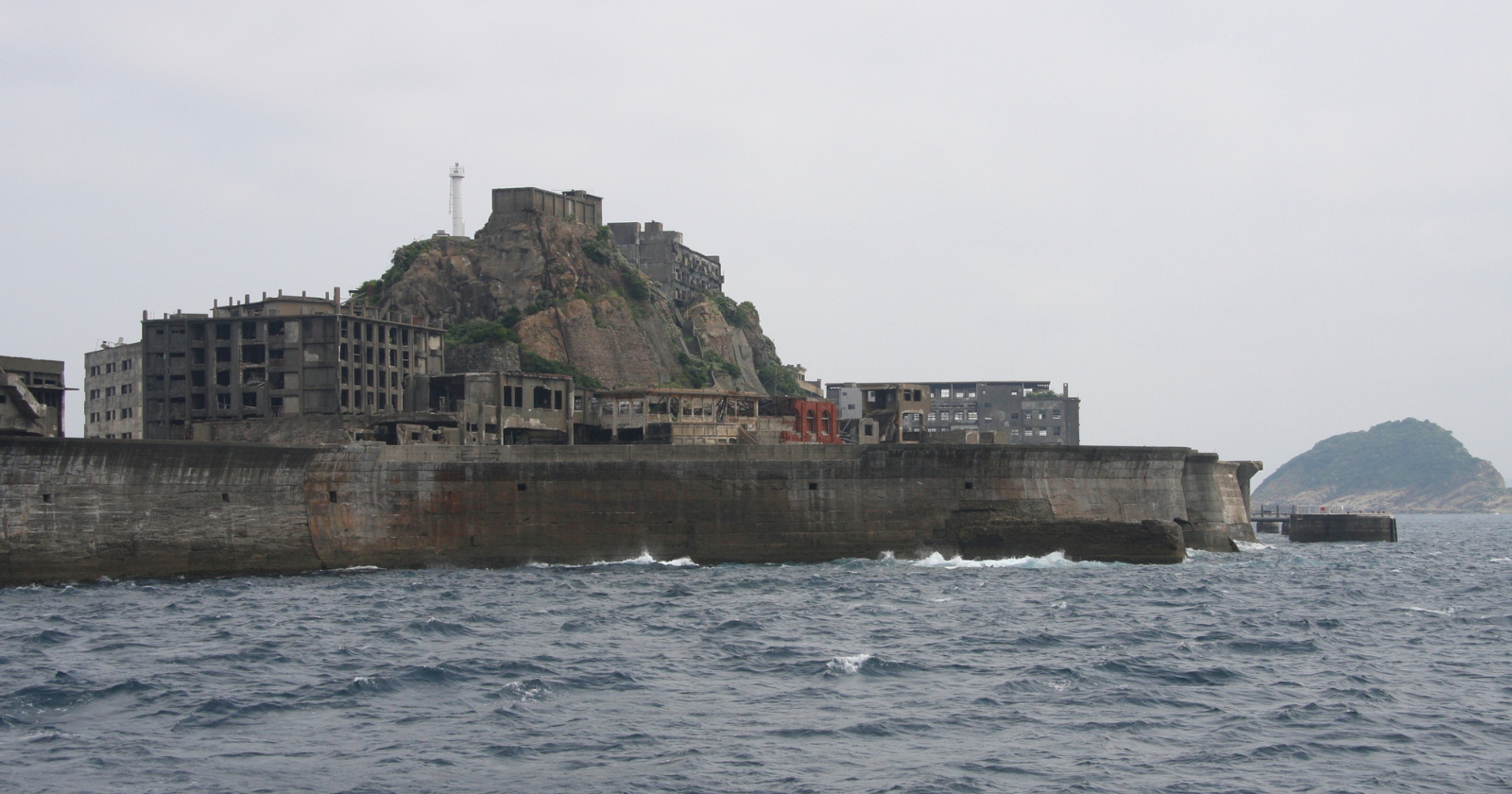
Somewhere off the coast of Nagasaki sits a slab of rock about the size of nine football pitches. In 1959, 5,259 people lived on it.
That rock is Hashima, better known as Gunkanjima, or Battleship Island, because from a passing boat it looks like a warship that ran aground and never got up again. Mitsubishi bought the place in 1890 for the coal running under the seabed, then kept building upwards, on the grounds that sideways was the ocean.
Run the numbers on that and it still reads like a typo. Historian Brian Burke-Gaffney, writing in Cabinet, put the island at 835 people per hectare overall and 1,391 per hectare across the residential blocks. It’s widely cited as the highest population density ever recorded anywhere. Warabi, the most crowded city in Japan today, manages 141.
Everything a town needs, stacked
Sixteen acres held two schools, a hospital, a cinema, a pinball parlour, twenty-five shops, bars, a Buddhist temple, a Shinto shrine and a brothel.
Housing went vertical early. In 1916 Mitsubishi put up a six-storey reinforced concrete apartment block, now known as Building No. 30, the first structure of its kind at any real scale in Japan. It was designed to shrug off typhoons as much as to house miners. Rooftops turned into gardens. Corridors turned into streets. Children grew up somewhere with no soil, no cars and no exit except the ferry.
Then the coal stopped mattering
Oil got cheap through the 1960s. Japanese coal did not, and the seams were thinning anyway. Mitsubishi shut the mine in January 1974. By April the last residents had gone.
Nobody boarded anything up on the way out.
Fridges, televisions, school desks and shrine fittings stayed exactly where they were. Wooden structures went first. Everything else was left to the salt.
An argument that never went away
Hashima carries a second history that Japan and South Korea have argued over for years. Hundreds of Koreans, along with Chinese labourers, were put to work in the mine during the war. When the island was inscribed by UNESCO in 2015 as one of 23 Sites of Japan’s Meiji Industrial Revolution, Tokyo publicly conceded that many had been “brought against their will and forced to work under harsh conditions”. It promised to say so properly at the site itself.
Seoul says that still has not happened. Its foreign ministry criticised Japan’s most recent progress report, in coverage by the Korea Times, for keeping exhibition materials that dispute the forced labour account and for parking survivor testimony on a bookshelf instead of putting it on display.
Concrete has a use-by date
Reinforced concrete and seawater are a poor long-term match. Steel bars buried in the slabs rust, rust expands, the slabs crack, and salt spray gets in faster through the cracks. Takafumi Noguchi, an architecture professor at the University of Tokyo who has spent years surveying the ruins, argues the island should be stabilised rather than restored. “So it needs to be preserved as ruins,” he says. He has told National Geographic that nothing else on earth makes a useful comparison, since Roman concrete at least had no steel inside it to corrode.
A survey reported by News On Japan in March 2025 found at least 17 of the island’s 30 major buildings had lost more than half their original seismic resistance. Building No. 30 has been quietly shedding walls and beams for years.
Who pays for a ruin
Nagasaki city does, mostly, and nowhere near enough. UNESCO flagged the problem at inscription, noting the absence of a conservation plan for Hashima and prompting Japan to commit to a thirty-year programme to stabilise the retaining walls and keep that battleship silhouette intact.
A decade on, a Kyodo News survey of all 23 Meiji sites found 14 of them worried about preservation, with money the most common complaint. Nagasaki officials described Hashima as a “heritage site with concrete structures that are deteriorating day by day”, and said holding it together needs specialist expertise and a great deal of funding.
Tour boats still run when the weather allows, and visitors are kept to a short walkway well clear of anything likely to land on them.
Mitsubishi spent eighty years building a city on a rock. The sea has had fifty to take it apart, and it is comfortably ahead on points.
