
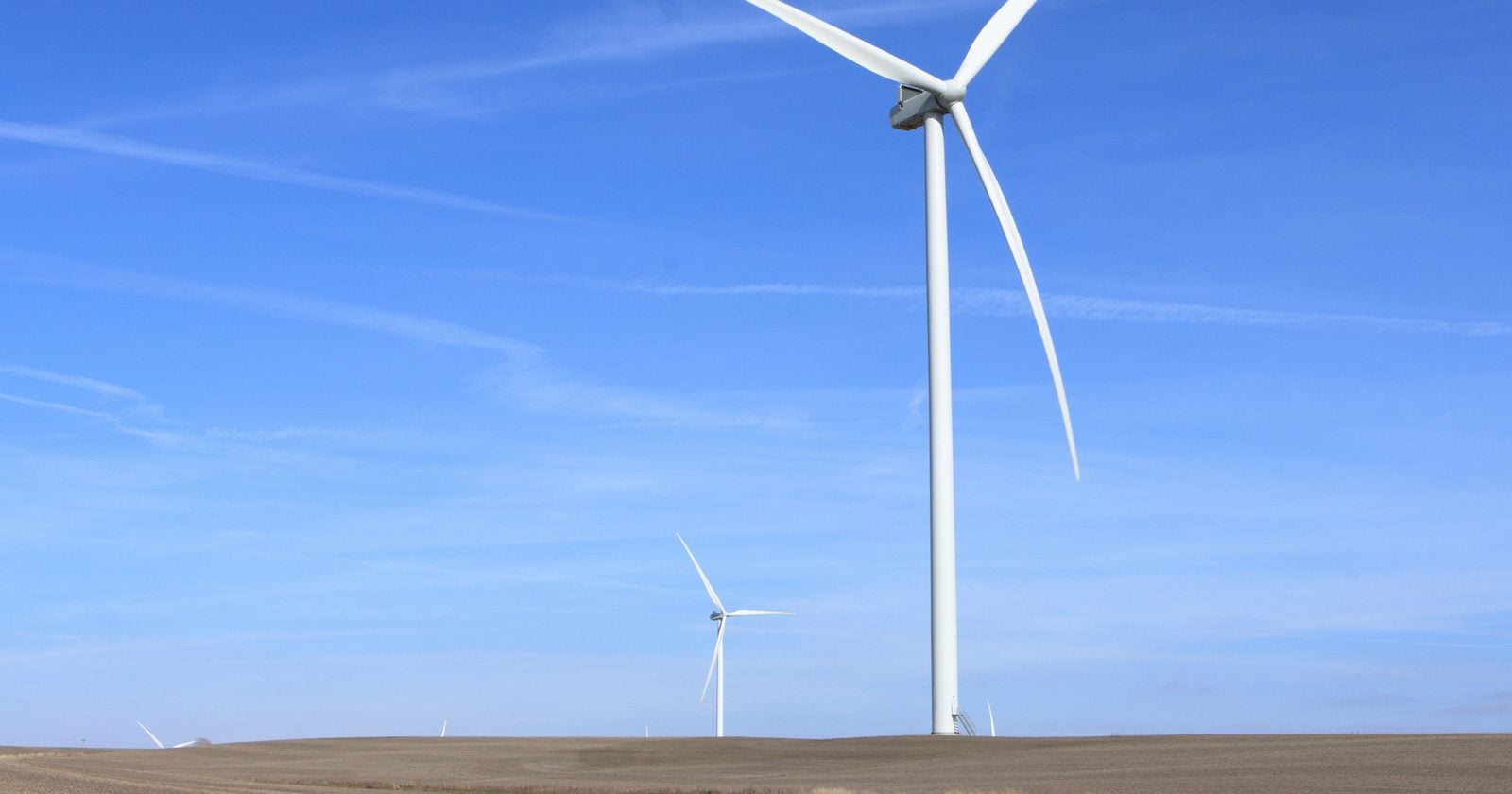
A wind turbine blade is basically glass fibre set in hardened resin. The fibres give it strength, the resin holds them in place, and the two are bonded so tightly that a blade can survive wind, rain and stress.
That same toughness is the problem once the blade comes down. Thermoset epoxy does not melt back into a workable liquid, and its stable chemical bonds are difficult to break. So retired blades are typically cut into sections and sent to landfill.
That is the waste a group of researchers decided to work with. In a 2026 study published in ACS Applied Engineering Materials, a team at Xi’an Shiyou University, with collaborators at the Beijing Institute of Technology and Monash University, ground old blade material into powder and turned it into a lightweight, sponge-like insulation.
Here is what came out of the lab, and how it stacks up against the size of the problem.
It squashes to a fifth of its thickness and springs back
The most surprising thing about the material is how far you can crush it without wrecking it. The team reports it took a squeeze of over 80 percent and recovered, meaning you can press it down to roughly a fifth of its height and it bounces back. That matters because conventional silica aerogels are famously fragile. They insulate well but can be brittle. A material that can take a squeeze and spring back is far easier to handle and install.
The trick is in the structure. Instead of a solid block, the composite is a network full of tiny connected pores, with the blade powder stiffening a soft, springy scaffold.
It combined low density with unusually high compressibility
Weight is where the main result sits. The material reached a density of 0.184 grams per cubic centimetre while sustaining more than 80 percent compressive strain. The authors say the composite showed “a superior combination of low bulk density (0.184 g cm–3) and high compressive strain (>80%), outperforming a wide range of reported silica-based or organic aerogels and composites.”
A caution is warranted: that line is the researchers describing their own work, not an outside verdict. “Outperforming” is their framing, and the comparison is against numbers from other published papers rather than a head-to-head test by a neutral lab. The figures themselves are measurable; whether the material performs as well in practice is the kind of thing other labs and larger-scale testing would need to settle.
It holds heat in about as well as ordinary insulation
Being light and squishy would not count for much if heat poured straight through it. It doesn’t. The composite measured a thermal conductivity of 0.068 watts per metre-kelvin, and lower is better here because it means less heat gets across. For comparison, ordinary glass wool building insulation sits around 0.04. So the blade composite is not a record-setting insulator, but it is in a sensible range for the job while remaining highly compressible.
It self-extinguishes instead of feeding a flame
Insulation lives inside walls and roofs, so how it behaves near fire matters. The team reports enhanced flame self-extinguishing capability, meaning it tended to stop burning once the flame source was removed rather than carrying the fire along. Again, this is one lab result on lab samples, though, and real fire-safety ratings require standardised testing. Read it as promising, not certified.
It turns a landfill problem into the raw material
The reason any of this is interesting is the sheer number of blades headed for the ground. Worldwide, the mass of blades expected to be discarded by 2050 may reach about 43 million tonnes. Right now, around 12,000 blades are retired across Europe and the US each year, and they are typically cut up and sent to landfill. A process that takes that same material and makes something useful flips the equation.
As the authors put it, reusing the blade waste “not only helps to reduce environmental burdens and resource waste but also opens up avenues for generating high-performing, useful materials.”
Where this actually sits
This is one study and one set of lab measurements. The chemistry is clever and the numbers look good, but the gap between a lab composite and a pallet of insulation shipped to a building site is wide. The paper doesn’t answer the questions that fill that gap: cost, batch-to-batch consistency, how the material holds up over years inside a wall, and whether grinding and processing old blades at scale actually makes economic sense.
That last question is the real hinge. Something has to make the recycled route cheaper or required before a lab result becomes a real supply chain.
None of that takes away from what the team built. This is a good answer to a narrow question, which is whether hard-to-recycle blade waste can be turned into a useful, light, tough insulating material at all. The evidence here says yes. The bigger question, whether it can be done by the tonne cheaply enough to matter, is still open.
