
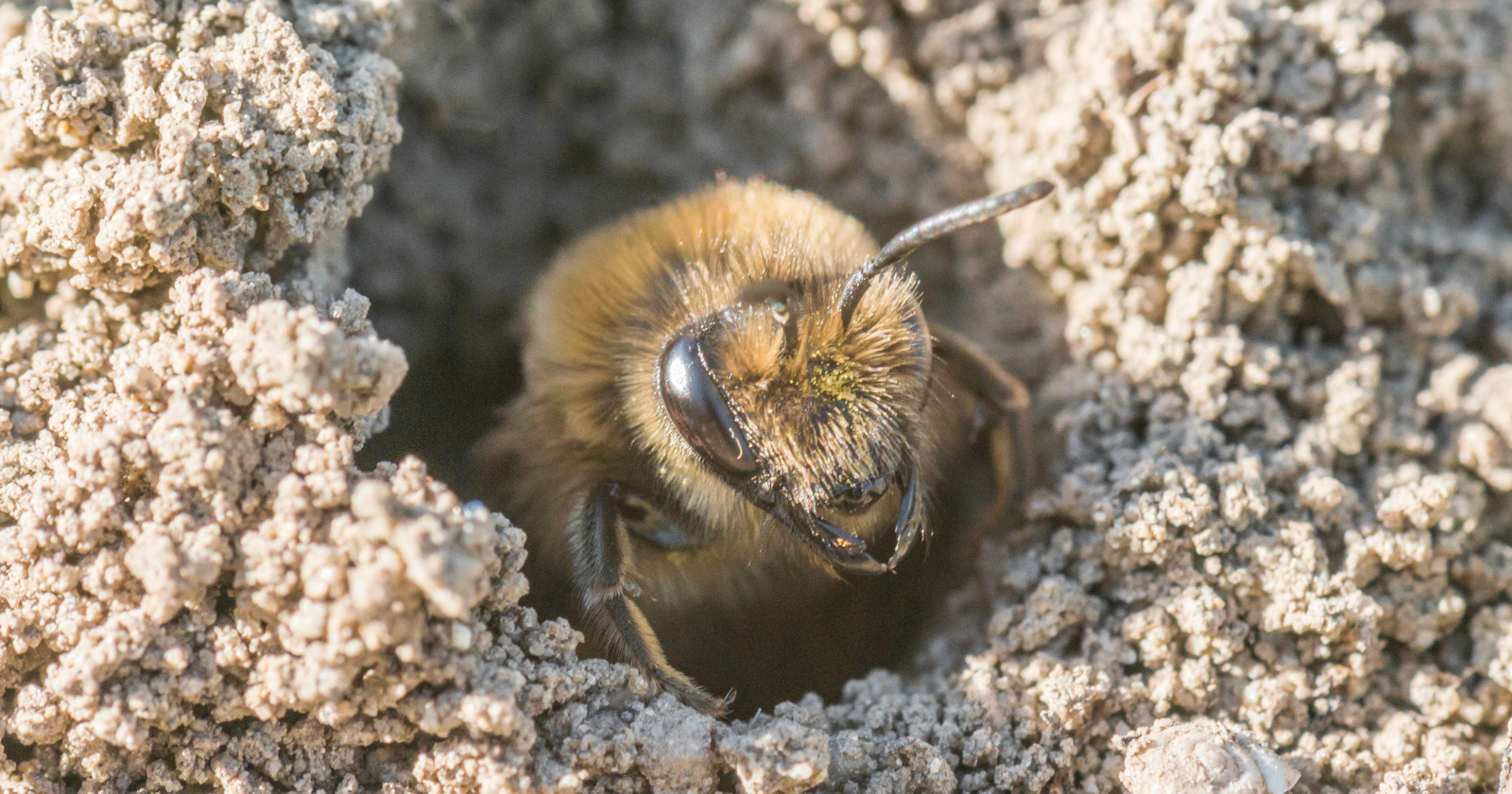
Rachel Fordyce used to save on parking. A technician in a Cornell University entomology lab in Ithaca, New York, she left her car at a plaza and cut across East Lawn Cemetery to work — and one spring morning in 2022, walking over the graves, she noticed the ground was alive with bees.
She scooped a jarful and carried them to her supervisor. What that jar started, once the lab did the arithmetic, was the discovery of one of the largest aggregations of ground-nesting bees ever recorded on Earth — hiding, in plain sight, under a small-town cemetery.
Five and a half million tenants
The bees are Andrena regularis, the regular mining bee, and they are not the honeybees most people picture. They belong to the vast, overlooked majority: roughly 70 percent of North America’s bee species nest in the ground, and most are solitary — no hive, no queen, no workers, no honey. Each female digs her own burrow, provisions it with pollen, lays her eggs and dies; the next generation overwinters underground and climbs out the following spring.
At East Lawn, they do this in almost unimaginable density. Cornell entomologists, led by Bryan Danforth with first author Steven Hoge, set mesh emergence traps across the cemetery through the spring of 2023 and counted what came up. The soil averaged 853 nesting bees per square meter — and scaled across the site, the estimate landed at around 5.56 million bees emerging in a single season, published in the journal Apidologie in 2026. It is one of the largest and, at nearly a century of records, one of the oldest known such aggregations anywhere.
The word for the arrangement is the key to it: aggregation, not colony. Millions of individual solitary females, each running her own single-parent household, packed side by side into the same good real estate — a suburb of five and a half million homes with no town hall, no shared roof, and nothing resembling a hive mind. They gather because the dirt is right, not because they cooperate.
Why a graveyard
The cemetery is not incidental to the story; it is the reason there is a story.
Mining bees need bare or thinly vegetated, well-drained soil they can tunnel — and East Lawn, founded in 1878, sits on sandy loam of exactly the right texture. More importantly, it offers the one thing modern landscapes almost never do: a century and a half of being left alone. Nobody plows a cemetery, sprays it with heavy pesticide, paves it, or digs it up, aside from the occasional grave. The ground stays undisturbed, undisturbed, undisturbed, year after year — the precise condition an underground bee city needs to persist across generations. A. regularis has been recorded on this plot since at least 1935, and probably far longer.
It helps that the neighborhood has a grocery. Cornell’s apple orchards sit a few hundred meters away, and the timing is no accident: A. regularis overwinters as an adult — relatively rare among bees — which lets it emerge unusually early, right as the apple blossom opens. A decade ago, Danforth’s team had found regular mining bees were the single most common pollinator in that orchard, without ever knowing where the multitude came from. The cemetery was the answer. The graveyard has been quietly running the orchard’s pollination the whole time.
The point about the little bees
There is a scale comparison that reframes the whole find. Solitary mining bees are prodigious pollinators — by many measures, individually more effective than honeybees — and 5.5 million of them working the same few acres delivers pollinating power on the order of hundreds of honeybee hives, an agricultural asset a farmer would pay dearly to install, sitting for free under a cemetery lawn.
And that is the researchers’ actual message, more than the eye-popping headcount. Honeybees get the attention, the branding and the worry, but they are a managed, semi-domesticated species — livestock, essentially. The wild solitary bees that do so much of the planet’s real pollinating are, in Danforth’s word, underappreciated: unbranded, unhoused, easy to overlook, and easy to destroy without noticing, because their entire civilization is invisibly underground until a few weeks each spring. The study elevates the humble graveyard — and the mown, undisturbed, unglamorous green spaces like it — into what they quietly are: some of the best pollinator habitat left in a paved landscape.
The tidy irony writes itself, and the entomologists have not resisted it. A place set aside for the human dead turns out to be one of the most intensely alive patches of ground in the region, five and a half million private lives running their single seasons beneath the headstones. Nobody planted it, funded it or planned it. It simply went undisturbed for 150 years — which, for the creatures that matter most and get noticed least, turned out to be the only thing they ever needed.
