
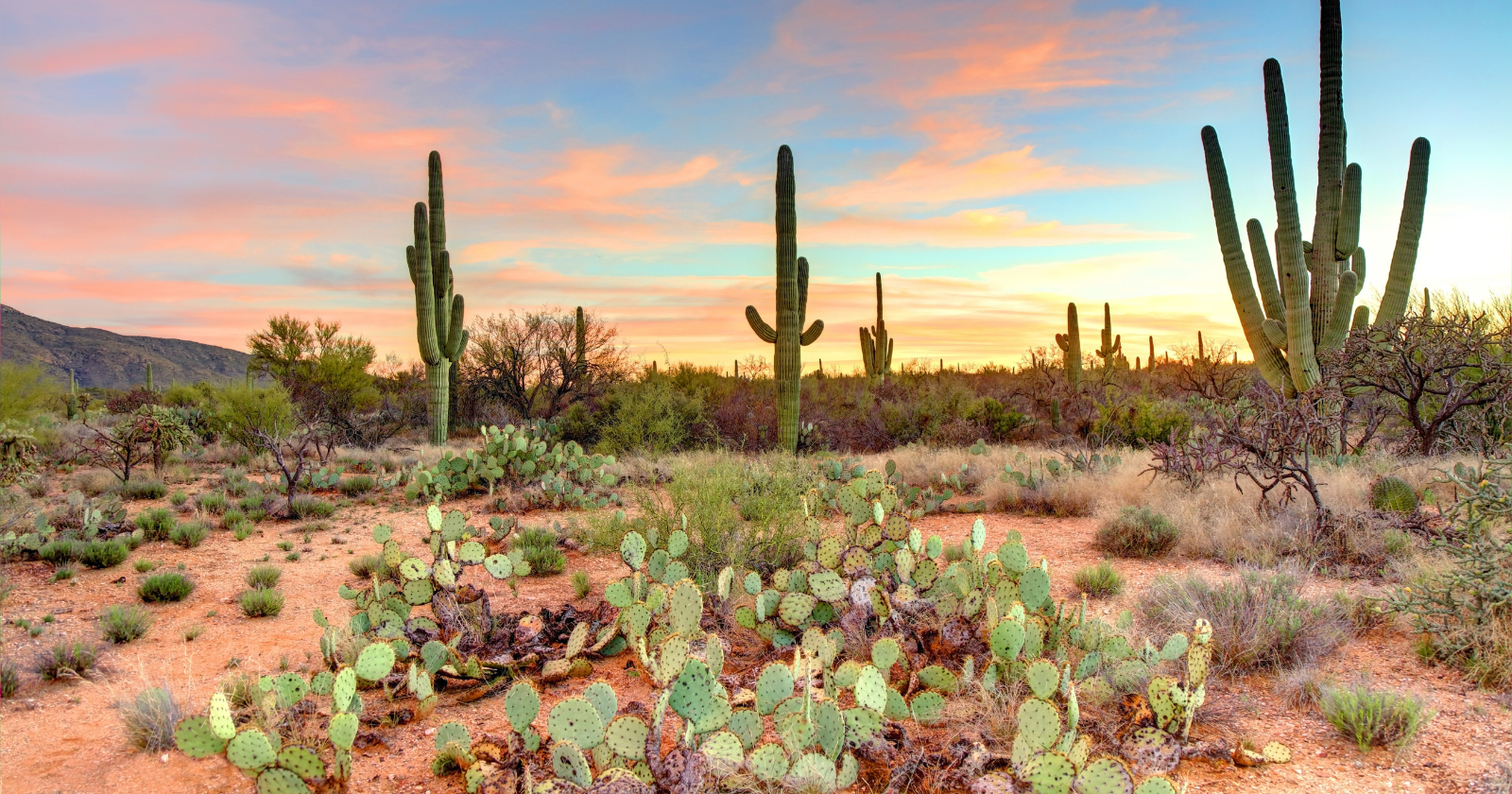
Evicting the tenants turned out to be the fastest way to grow a lawn in the Chihuahuan Desert.
In 1977, three ecologists fenced off a twenty-hectare stretch of scrub about six kilometres northeast of Portal, Arizona, laid out twenty-four quarter-hectare plots inside it, and started removing animals to see what the ground would do without them. James H. Brown, Diane W. Davidson and O. James Reichman were testing competition between seed-eating rodents. Nearly fifty years later, the Portal Project is still running, has produced more than a hundred scientific papers, and some of those plots stopped looking like desert a long time ago.
How to keep a kangaroo rat out
Each plot is ringed with hardware cloth, and most are worked through sixteen gates cut into the mesh, sized to decide which rodents get in. Control plots get openings of 3.7 by 5.7 centimetres, roomy enough for any rodent in the neighbourhood. Kangaroo rat exclosures have openings of 1.9 by 1.9 centimetres, and that difference does all the work.
Kangaroo rats cannot fit. Their skulls carry inflated auditory bullae, the bony chambers housing the inner ear, swollen to a size that makes faint desert sounds audible and small doorways impossible. Field protocols archived with the project data say so plainly: the gate is sized to the skull. Pocket mice and grasshopper mice stroll through unbothered. Anything that finds a way in gets picked up on the monthly trapping census and released outside the fence.
A kangaroo rat, in engineering terms, is defeated by its own ears.
Twelve years later, three times the grass
How much can removing one rodent change a landscape? Brown and Edward Heske put a number on it in Science in 1990. Twelve years after three species of Dipodomys were shut out, density of tall annual and perennial grasses on those plots had climbed roughly threefold, and rodents that belong to arid grassland rather than shrubland had moved in and stayed. Shrub habitat had quietly become something else while nobody changed the rainfall, the soil or the fence.
That is a strong result, from one experiment at one site, and it is still a single system rather than a law of deserts everywhere.
Grazing does not explain it either. A cattle fence went up around the whole site in 1977, and no livestock has grazed there since. That leaves control and exclosure plots under identical weather, identical soil and identical cows: zero, on both sides, with nothing different between them but the size of their doorways.
Why seed hoarders hold a grassland down
Picture one kangaroo rat on a single night: cheek pouches full of seeds, a fresh cache tucked into turned soil by sunrise. Multiply that by dozens of animals over years, and two habits help explain the grass problem. Kangaroo rats harvest and cache seeds, with a strong preference for the largest ones, and grass seeds are among the largest around. They also dig constantly, churning the topsoil into a surface no seedling wants to commit to.
Writing in Oecologia, Heske and his co-authors linked the vegetation shift to that combination of less soil disturbance and less predation on large seeds. They were careful to flag, though, that it is hard to tell whether the kangaroo rats caused the change directly, or indirectly, by simply letting the first grasses get established. Brown and Heske called the animals a keystone guild, meaning a few species whose removal reorganises everything around them. Take away a few dozen fist-sized mammals doing their nightly rounds, and the cumulative result is something you can see from the road.
Some of the new grass came from Africa
Among the winners was Eragrostis lehmanniana, Lehmann lovegrass, a perennial bunchgrass from southern Africa. It reached Arizona in the 1930s, sown on purpose to patch up rangeland that cattle had chewed back to dirt. By 1988, as documented by the US Forest Service, it counted as a major species across about 140,000 hectares of the state, most of that in the southeastern corner.
So the lush plots were partly an African import moving into a gap kangaroo rats had been holding shut.
Everything outside the plots went the other way
What good is one fenced site against a shift remaking an entire region? When this one was established in 1977, the habitat was best described as desert grassland. Across the following decades it slid into mixed shrubland, in step with a regional shift that has been reshaping the southwest since heavy grazing arrived in the nineteenth century. The project’s living data paper records the conversion alongside every trapping record, plant quadrat and rain gauge reading, all of it public and updated as it accumulates.
That leaves a genuinely odd picture. A patch of southeastern Arizona drifts steadily towards shrubland, while inside it, a handful of fenced squares stayed grass, held there by nothing more elaborate than a hole too small for a particular skull.
Brown and his colleagues went out there to settle an argument about which seed-eating rodents were outcompeting the others. They ended up showing that a few animals you would need a torch and some patience to find had been shaping the landscape the whole time.
