
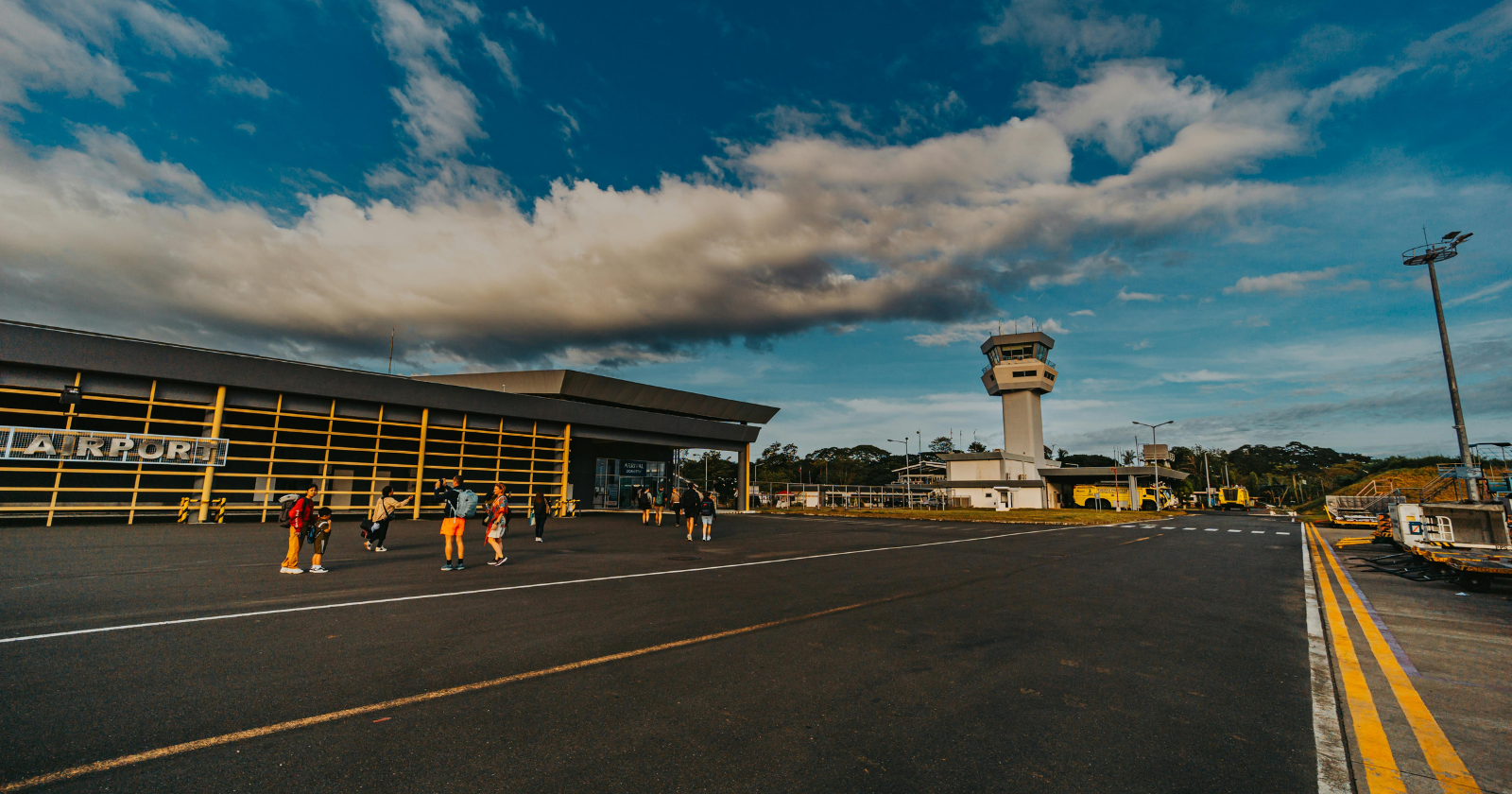
An entire airport pavement, thick enough to take a fully loaded jumbo jet, poured without a single gram of ordinary cement. That is what happened at Brisbane West Wellcamp Airport near Toowoomba, Queensland.
The company behind it, Wagners, supplied its own product, Earth Friendly Concrete, for the job. Australia’s CSIRO says the airport used 40,000 cubic metres of this concrete in 2014, showing the material works at full commercial scale. At the time, that made it the largest use of this kind of concrete anywhere in the world.
Why does this matter beyond one Australian runway? Because of what the concrete left out.
Making ordinary cement is one of the biggest sources of carbon in construction, and Wellcamp is the rare case where someone built something huge and load-bearing without it. So it is worth asking a few plain questions: what actually went into the ground, has it held up, and why, more than a decade later, has the approach still not spread?
So what replaced the cement?
The short answer is industrial leftovers. In normal concrete, cement is the glue that holds everything together. Here, that glue is made from two industrial waste materials instead, mixed with a concentrated alkaline solution that reacts with them and forms the geopolymer binder. One is blast furnace slag, a by-product of iron production. The other is fly ash, the fine material left over from coal-fired power generation. Wagners says the opening of Wellcamp Airport marked the largest modern geopolymer concrete project containing absolutely no Portland cement.
Take that with the usual caution, since it comes from the company selling the product rather than an independent lab. But the basic chemistry isn’t in dispute. Making ordinary cement means firing raw materials in a kiln at very high heat, and that is what makes it so carbon-heavy. This kind of glue skips the kiln step entirely. A widely cited review by Van Deventer, Provis and colleagues estimates it produces roughly 80 percent less CO2 than traditional cement. The stakes are large: cement production causes about 8 percent of the world’s CO2 emissions, putting out roughly 1.6 billion tonnes of it in 2022.
Why an airport apron was the place to try it
An aircraft pavement is a punishing place to prove a new material, which is exactly the point. The turning node, apron and taxiway at Wellcamp were built 435 millimetres thick, because they carry loaded Boeing 747 cargo planes, not family cars. These are the sections that take the full weight of a jet as it turns and holds position.
Wagners also reports that this method was quicker: construction was 30 per cent faster than usual concrete methods, which matters to a client watching a schedule as much as a carbon figure.
Does it hold up?
The pavements went into service when Wellcamp’s first commercial flight took off in November 2014. Since then they have done the ordinary work of an airport apron, carrying scheduled 747 freighters. That real-world record is the most useful thing about the project. The material isn’t sitting in a test slab in a lab. It is carrying regular jumbo traffic out in the open weather of the Darling Downs.
On emissions, Wagners also reports a saving of 6,600 tonnes of carbon across the project compared with conventional concrete.
Why it still isn’t everywhere
If it performs and cuts emissions, why aren’t airports and highways routinely poured this way?
The barriers are less about the chemistry and more about everything built around cement. A 2021 analysis of this technology in Australia calls it still in its infancy. The review by Van Deventer and colleagues points to the deeper snag: almost all the rules and design standards for concrete were written around ordinary cement. A glue that isn’t cement has to fight against the entire supply chain and rulebook built for the old material. Add in the fact that the raw materials vary, and that the chemical activators cost money and need careful handling, and the pull toward the familiar option stays strong.
There is also a supply problem hidden in the recipe. Both key ingredients are by-products of heavy industry, and one of them depends on burning coal. That is a real tension: a low-carbon material that leans partly on the output of a high-carbon industry the world is trying to shut down. As coal-fired power stations close in many countries, the long-term supply of fly ash is itself in doubt, which is perhaps one reason researchers keep hunting for other ingredients.
Wellcamp is still a genuine landmark, and more than a decade of jumbo traffic on that apron is the kind of evidence a lab can’t produce. The open question is whether a showcase like this becomes normal practice. For that to change, the codes would need rewriting for glues that aren’t cement, testing standards would need to catch up, and the industry would need a reliable ingredient that doesn’t depend on coal.
