
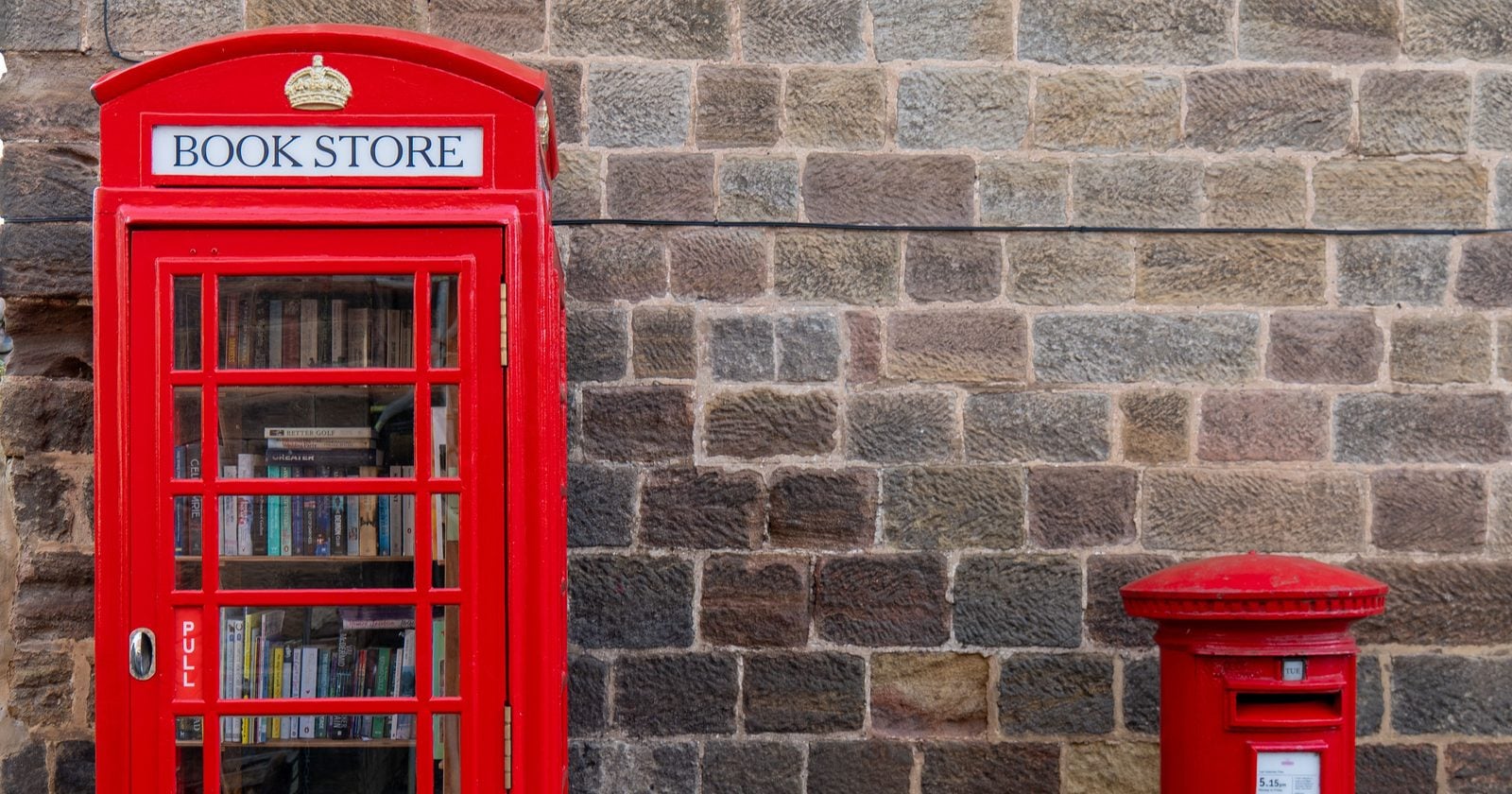
A pound will not buy much. A single bus fare, roughly, or half a coffee. But it will, it turns out, buy you a red phone box.
Since 2008, when BT launched its Adopt a Kiosk scheme, communities across the UK have taken on old kiosks for £1 each. By the company’s March 2021 count, the total was more than 6,600. By August 2023 it had passed 7,200.
The interesting part of this story is not nostalgia for the phone box, though. It is what a village does with one once it owns it.
The £1 that turned red boxes from liabilities into assets
The scheme exists because the payphone all but died. BT’s network of phone boxes peaked in the 1990s at around 100,000. Then mobile phones arrived and the calls stopped coming. The time people spent on payphone calls fell from around 800 million minutes in 2002 to just 7 million in 2020, and as 2021 96% of UK adults owned a mobile.
That trend left BT with a lot of little steel-and-glass boxes that no longer paid their way. The rules for adopting one are simple. A parish or community council, a registered charity, or a recognised public body can take over a decommissioned box for £1, keep it where it stands, and give it a new job. BT even keeps supplying the electricity for the light for free. A cost to the company becomes, in one step, a piece of community kit that already sits somewhere people know how to find.
What communities actually put inside them
The uses are more varied than you might expect. Adopted kiosks now hold book exchanges and mini libraries, small art galleries, local museums, food banks, and, increasingly, defibrillators.
The common thread is that the box is already where people are. As Chris Sharples, a parish councillor in Compton, Surrey, who adopted a kiosk, put it: “Phone boxes are generally located in the heart of communities, so I’d urge others to adopt redundant kiosks in their area and turn them into a community asset.”
That location advantage explains most of the appeal. A defibrillator or a lending library is only useful if people know where it is and can reach it quickly. A phone box has been a fixed, familiar landmark on the village map for decades. You do not have to teach anyone where it is.
Westray’s sixth defibrillator
On Westray, the Westray Development Trust spent the past couple of years building an island-wide network of public defibrillators, the machines that can restart a heart during cardiac arrest. Five went in first, at the airfield, the Gill Pier ferry terminal, the parish kirk, a local shop and the Rapness ferry terminal. The sixth and last one went inside an adopted red phone box at Midbea, on the island’s Westside.
The Trust had the box adopted through the Community Heartbeat Trust, a charity that specialises in exactly this kind of conversion. The Westray kiosk’s adoption was approved in October 2019, and the renovation and defibrillator install were finished by July 2020, part-funded by a local grant.
Isobel Thompson, the Trust’s operations manager, was clear about why the site made sense. She said: “The red telephone box on the Westside of Westray was an ideal location to install a public access defibrillator as the telephone box was both memorable and already strategically placed.” The scheme, she added, let them “expand our defibrillator network and improve access to life-saving equipment in an emergency for our isolated island community.”
We are not clinicians, and we would not want to overstate what a single machine can do for the odds in a rural cardiac arrest. What the Westray story shows is narrower and, we think, more solid: an island with limited access to emergency equipment used a scheme meant for surplus phone boxes to put the last piece of a safety network somewhere everyone could already picture. If any of this touches something you are dealing with, it is worth speaking to a doctor or a local first-aid group about defibrillator access where you live.
Why the reuse story beats the nostalgia one
It is easy to file the red phone box under heritage. Around 3,000 of the traditional red kiosks are still on the streets, and they are undeniably part of the national furniture. Martin Fagan of the Community Heartbeat Trust leaned into that framing, calling them “iconic British structures” whose repurposing “has given them a new lease of life.”
He is not wrong about the affection. But the affection is not what makes this work. Plenty of loved objects get preserved as museum pieces and then do nothing. What the scheme did was find the second job hiding inside the first. The thing that made a phone box useful in 1960, that it stood in a spot everyone knew, in the middle of where people lived, turns out to be exactly what makes it useful for a defibrillator or a lending library now. The function changed. The location logic did not.
There is also a reasonable case for keeping some payphones as payphones. Ofcom noted that almost 150,000 calls to emergency services came from phone boxes in the year to May 2020, a reminder that a fixed public phone still matters where signal is thin. The aim is not to strip every box out. It is that when a box has genuinely gone quiet, £1 turns dead kit back into something a village actually uses.
On Westray, a red box that once carried calls now holds a machine that might restart a heart. Not preservation, exactly, but a small structure being asked to do a different, useful thing in the same spot it always stood, which is a more interesting fate for old infrastructure than being admired and left alone.
