
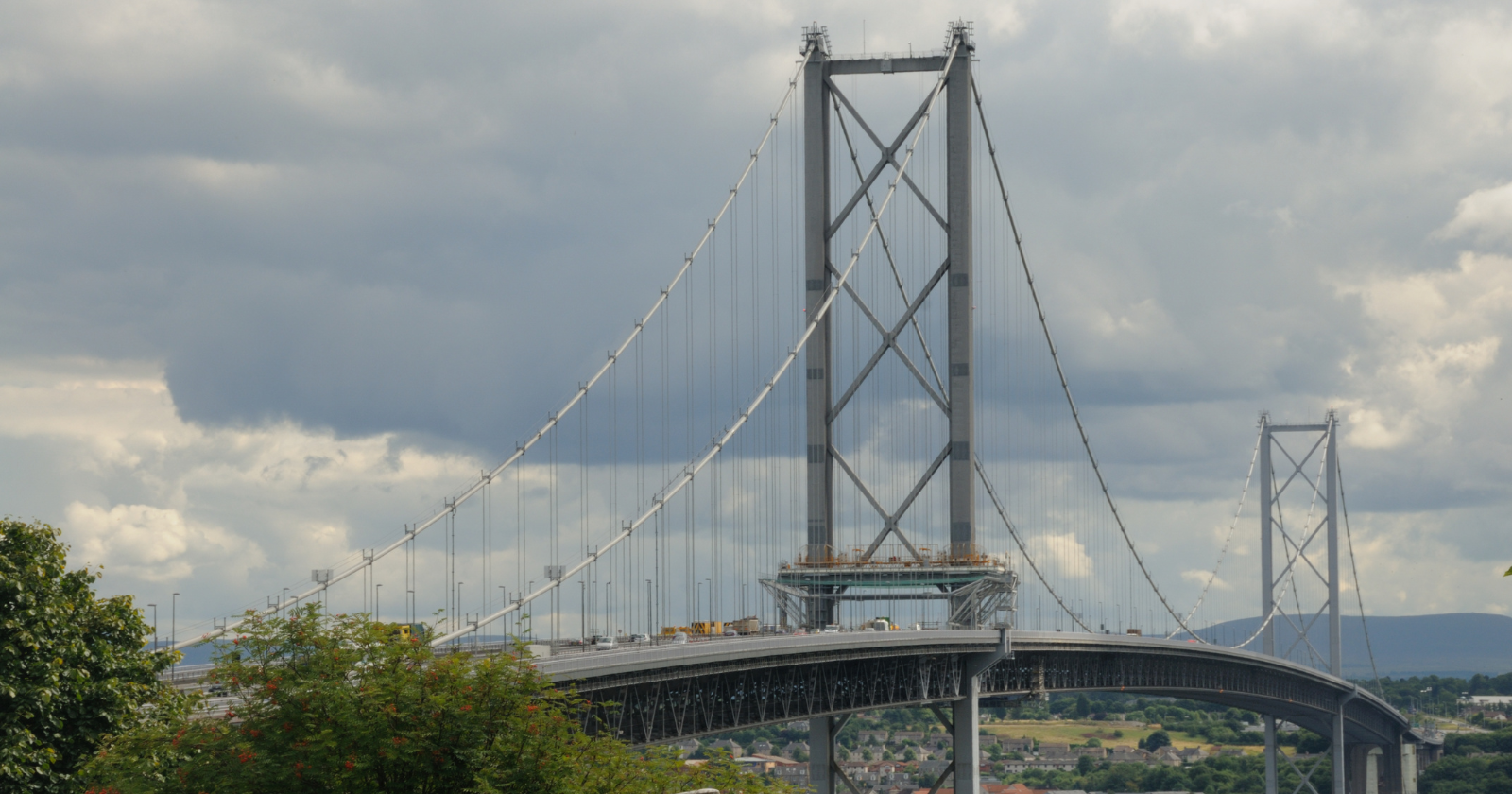
Somewhere inside a steel rope 60 centimetres thick, a wire no fatter than a pencil lead lets go. A microphone strapped to the outside hears it, software works out roughly where along the span it happened, and a running tally ticks over by one.
This is a normal week on Scotland’s Forth Road Bridge.
Opened in 1964, the bridge hangs from two main cables. Each one holds 11,618 high-tensile steel wires, five millimetres across, compacted into a bundle. The bundle was sheathed in red lead paste, wrapped in galvanised wire, painted, and finally covered in a protective membrane. According to Scottish Government records, that combination was standard practice for suspension bridge cables worldwide when the bridge opened. It was also, as things turned out, not watertight.
What happened when somebody finally looked inside
Nobody in Europe had ever unwrapped a suspension cable to check. Owners in the United States had already started doing it after finding trouble on bridges of similar vintage, part of a wider push that produced landmark American guidelines on cable inspection that same year. In 2004, the Forth Estuary Transport Authority decided to follow suit.
Barry Colford, then the authority’s depute general manager, gave New Civil Engineer the short version: from the outside the cables looked dry, and inside there was rust. Water had found its way in through cracks in the paintwork and around clamps. Some of it, engineers suspected, had been sealed inside since the original cable-spinning process four decades earlier. It had reached the centre.
Engineers put the loss of cable strength at 8 to 10 per cent. More alarming was the trajectory. Projections from that period had the crossing closing to lorries by 2017 and restricting cars by 2021, a timetable that pushed ministers towards commissioning a replacement bridge.
Why a five millimetre wire snaps
Corrosion here does not politely thin a wire down like a bar of soap.
A study in Engineering Failure Analysis examined wires recovered from the Forth cables and found that fractures traced back to extremely localised attack, with cracks driving inwards at right angles to the wire. Some specimens failed after corrosion had penetrated as little as 150 micrometres, roughly twice the width of a human hair. That is a single paper on one bridge’s wires rather than settled consensus, but its central finding is uncomfortable for inspectors: the industry’s visual severity grading was a poor guide to how much load a wire could still take.
The numbers bear that out. In the single worst-affected section inspectors opened, only 31 of the 11,618 wires were actually broken; plenty of the rest looked fine and still failed their ductility tests.
The fix is essentially a very large hairdryer
So how do you dry out something already wrapped in steel, paint and rubber? You seal it tighter, then blow dry air through the middle of it.
Contractors sealed the cables in an airtight elastomeric wrap, fitted injection ports along their length, and pumped dehumidified air in at one end of each section so it could work its way between the wires and carry the moisture out the other end. Spencer Group, which designed a bespoke crawling gantry to install the equipment at height, treats that final seal as central to the whole process. Relative humidity inside both cables fell from saturated to below 40 per cent.
None of this was cheap. Roughly £10.3 million went on dehumidification, set against an estimate of up to £122 million had the cables needed replacing or augmenting outright. It worked. Corrosion of the main cables slowed markedly in the years that followed, New Civil Engineer reported, easing fears that the crossing would need weight restrictions by 2021.
Microphones on a bridge
“Continuous monitoring gives us the comfort of an ongoing health check,” Alastair Andrew, bridgemaster at the time, told LocalGov in 2006, soon after acoustic sensors went into both main cables. Drying halts fresh corrosion. It does nothing for wires that were already damaged before anyone started listening, which is what the microphones are for.
The system runs continuously, tuned to the distinctive sound of a wire letting go and able to place each event somewhere along the cable’s length. It cost just under £1 million.
By early 2015 it had logged 93 breaks across the two cables, spread fairly evenly. Then, as reported by the Edinburgh Evening News, engineers recorded 24 breaks on one cable alone in a matter of months, clustered near the top of a tower. The system was upgraded the following year.
None of that converts neatly into a strength number. A tally of broken wires says how many broke. It says very little about what the surviving wires can still bear.
Living with a number nobody has
Everything known about the strength of those cables comes from opening a few panels every several years and extrapolating outward. Inspections in 2006, 2009, 2012 and 2015 all suggested the drying was working and further corrosion had largely stopped, which is genuinely good news, arrived at by unwrapping a small fraction of a bridge spanning 1,006 metres and doing statistics on the rest.
Traffic moved to the Queensferry Crossing in 2017. The old bridge now carries buses, taxis, cyclists and pedestrians, and Transport Scotland commissioned another programme of strengthening work for 2025 and 2026, covering tower bearings, deck concrete and viaduct girders.
Dozens of long suspension bridges around the world were built to the same design over the better part of a century, wrapped in equally confident paint. Most have never had a cable unwrapped. Those that have were nearly always prompted by somebody elsewhere getting a fright first.
