

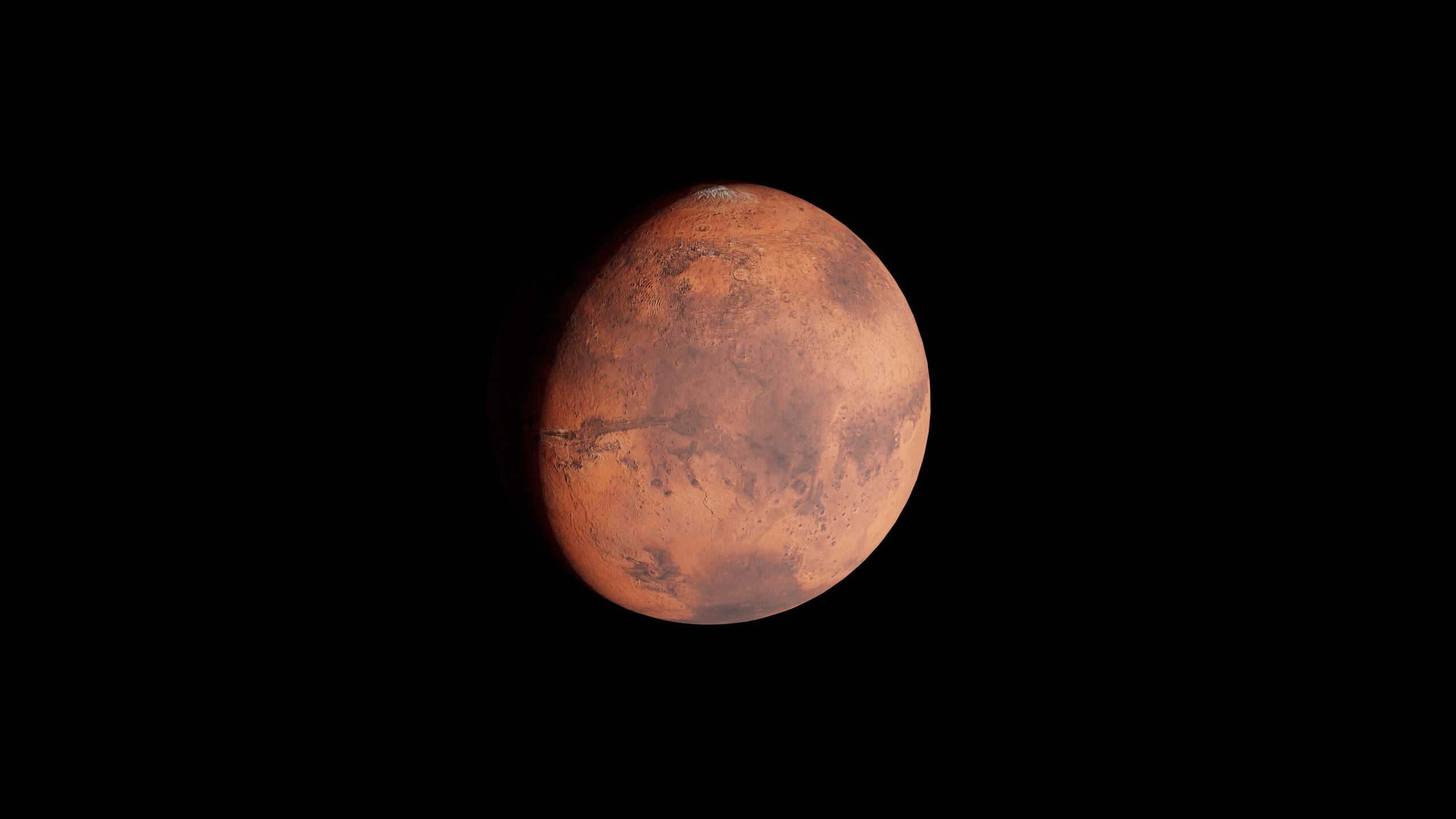
A proposed aerosol intervention could warm Mars quickly in a climate model, but the water cycle would keep changing long after the engineered particles reached a steady concentration. That distinction is central to a March 2026 preprint examining what happens when water vapour, clouds and surface ice are added to simulations of a deliberately warmed Mars.
Ashwin Braude, Edwin Kite and colleagues used the three-dimensional MarsWRF global climate model. Their manuscript reports that each 20-kelvin rise in global-average surface temperature produced roughly a tenfold increase in atmospheric water vapour during the first two Mars years. A difference of 20 kelvin is numerically the same as 20 Celsius degrees.
This is one modelling study, not a field experiment or an agreed forecast. The manuscript is a preprint and has not yet completed peer review. Its contribution is to add a missing system to earlier work: polar water ice can sublime, travel through the atmosphere, form clouds and settle elsewhere as the planet warms.
The earlier studies supplied the heat, not the water cycle
The chain begins with a 2024 study in Science Advances. It calculated that conductive rods made from aluminium or iron and shaped to interact strongly with thermal infrared radiation could warm Mars far more efficiently per unit mass than proposed greenhouse gases. The particles would allow much sunlight through while redirecting some heat leaving the surface.
A follow-up study tested atmospheric transport. Its three-dimensional MarsWRF simulations indicated that infrared-active particles released near the surface could self-loft, strengthen circulation and spread globally. That paper deliberately used a dry Martian atmosphere to establish a reference case. It named water-cycle feedbacks among the open questions.
SpaceDaily’s earlier examination of the nanorod warming proposal focused on the scale of manufacture, uncertain particle lifetime and the fact that warmer air would still be extremely thin. The new work is a continuation rather than a repeat. It asks where Mars’s existing ice would go once the surface warmed, and how the resulting clouds would alter the temperature pattern.
Twenty degrees meant ten times more vapour
The model began with a representation of present-day Mars, including a perennial northern polar water-ice cap, the seasonal carbon-dioxide cycle and a prescribed background dust pattern. The team ran cases with continuous release of an idealised warming aerosol for 20 Mars years. Separate shut-off experiments ended release after five Mars years and followed the response for another 15.
The warming agent was not a claim about a finished particle. Its optical properties were constructed to resemble the useful traits of aluminium rods and graphene disks studied previously, while producing about 12 times more warming per unit mass than the aluminium particles in the transport paper. Release rates of 1.25, 2.5 and 3.75 litres per second generated modelled global-average warming of about 15, 25 and 35 kelvin respectively.
Engineered aerosol abundance settled into equilibrium in fewer than three Mars years, as deposition came to balance continuous release. Atmospheric water did not stabilise with it. Warmer northern summers drove faster sublimation around the edge of the north polar cap, producing the tenfold increase in global water vapour for each 20 kelvin of warming during the first two Mars years. Vapour and cloud cover then continued building for decades.
The direct greenhouse contribution of that extra water vapour was less than 0.1 kelvin in the global average. Mars remained very dry by terrestrial standards. The larger response came after vapour condensed into water-ice clouds, which can affect both incoming sunlight and thermal radiation rising from the ground.
The same clouds warmed nights and cooled days
At night, clouds above about 10 kilometres absorbed and returned infrared energy towards the surface. The preprint’s abstract summarises low-latitude nighttime warming of roughly 5 to 10 kelvin. Its detailed results include warming as high as 20 kelvin across some low- and midlatitude regions and seasons.
During daylight, the sign reversed in the winter midlatitudes. Thick clouds reflected enough sunlight to reduce surface temperatures by as much as 40 kelvin relative to an otherwise similar simulation in which clouds had no radiative effect. In Hellas Basin, the modelled winter day-to-night temperature range could contract to less than five kelvin.
The 40-kelvin result should not be read as a global cooling forecast. It is a regional, seasonal and time-of-day difference between two versions of the same simulated warmed Mars. Engineered aerosol still supplied the underlying planetary warming. Summer cloud effects in Hellas could also lengthen the period with daily-average temperatures above the freezing point.
Clouds are known to matter on present-day Mars. A reanalysis of Mars Climate Sounder data found that water-ice clouds alter atmospheric temperature and circulation. That observational work supports the mechanism, not the precise magnitudes predicted for a hypothetical aerosol-warmed climate.
The altered climate retained a memory
The additional water did not remain evenly distributed. In the simulation, 15 to 20 gigatonnes of ice sublimated each Mars year from a band near the north polar cap’s edge. The net transfer between hemispheres was smaller, about 5 to 10 gigatonnes per Mars year, but it was enough to build a new perennial water-ice cap around the south pole and thicken seasonal frost across the midlatitudes.
This redistribution changed the seasonal engine. The south polar deposit began supplying vapour during southern summer, while winter clouds encouraged frost to reach lower latitudes. The paper also found limited destabilisation of shallow subsurface ice in the northern midlatitudes. In most places, modelled warming penetrated a few metres after ten Mars years, although soil properties made the depth vary widely.
When aerosol release stopped, the particles declined with an e-folding time of about 0.6 Mars years. Their direct warming disappeared within four Mars years. The water system recovered far more slowly. Winter midlatitude cloud cooling above 20 kelvin persisted 15 Mars years after shut-off, and the changed ice distribution kept the atmosphere moister than its initial state.
That persistence matters because Mars holds water mainly as ice and its atmosphere is too thin for exposed liquid water to remain stable for long. NASA’s overview of Mars describes polar and subsurface ice alongside the pressure constraint. Moving ice can erase part of a climate record and relocate a possible exploration resource without producing an Earthlike environment.
The largest uncertainties sit inside the model
The model fixed all cloud particles at an effective radius of five micrometres. It omitted interactions among engineered aerosol, natural dust and cloud formation, including whether the new particles would serve as cloud nuclei. It also excluded particle clumping, re-lofting after deposition, degradation and changes in surface brightness caused by settled material.
Those omissions can change both how long the warming agent remains airborne and how the clouds behave. The dry deposition rate of very small particles under Mars-like conditions is not measured well. Doubling the assumed rate halved the warming obtained from a given aerosol flow in the simulations. Runs above 2.5 litres per second with radiatively active clouds also became numerically unstable over long periods.
There is a wider model-dependence problem. A 2014 study of high-obliquity Mars also produced much more vapour and cloud after polar warming, yet it found strong warming in some winter regions where the new simulation produces net cooling. The physical scenarios were different, but the disagreement shows why cloud microphysics and cross-model comparisons are central rather than technical footnotes.
The preprint therefore does not establish that warming Mars would certainly cool winter days by 40 degrees. It establishes that a dry-atmosphere calculation leaves out a slow and consequential response. An engineered aerosol could be switched off, while the redistributed ice and clouds it created might retain a climatic memory for decades or longer.