

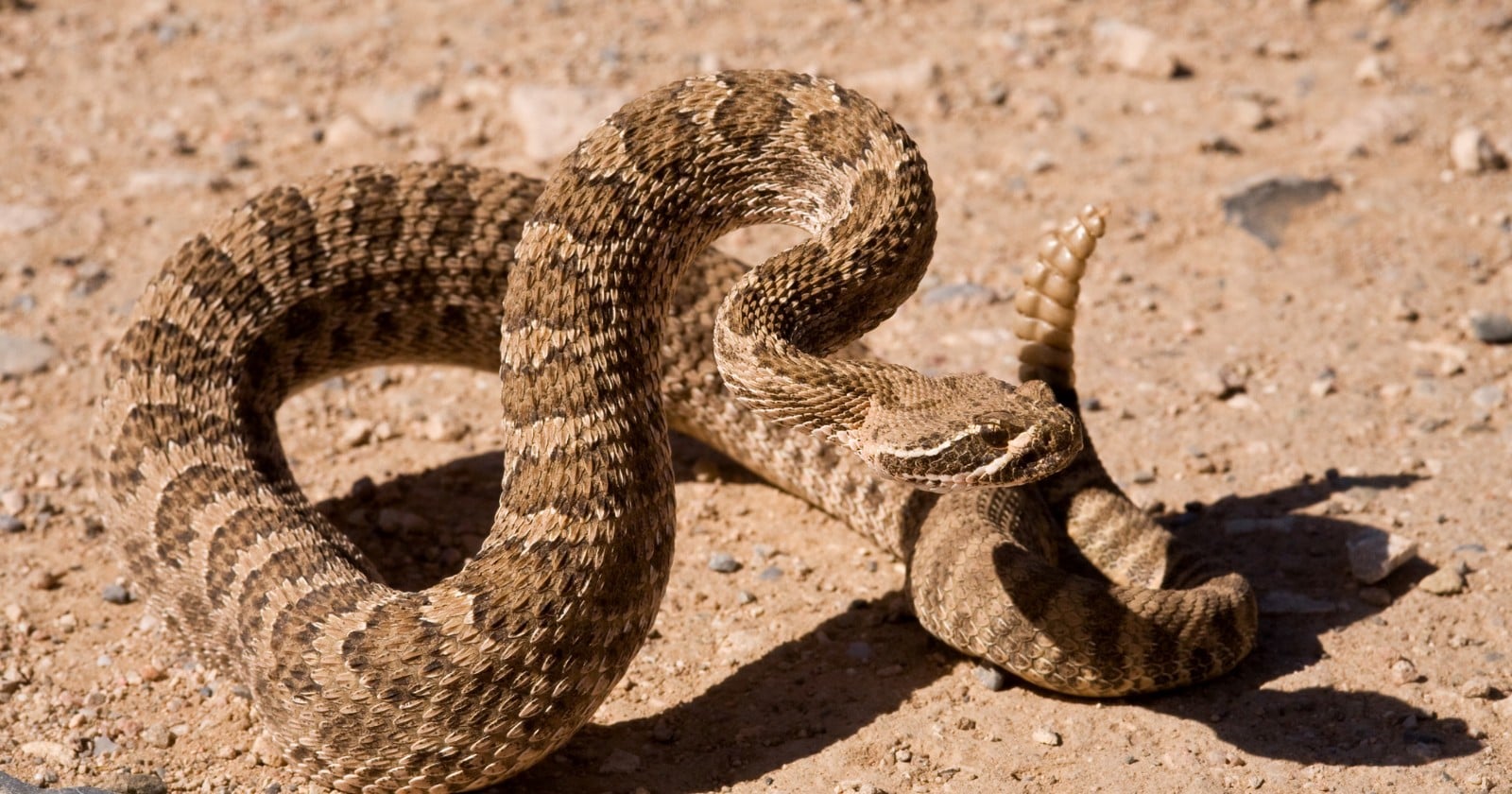
At nine minutes past nine on the morning of 8 September, the first timber rattlesnake pups of the season came into frame on Project RattleCam’s newest livestream. The Pennsylvania camera had gone live only in May.
That morning completed a set. Project RattleCam has this year recorded newborn rattlesnakes on all three of its livestreams, on 30 July in California, on 11 August in Colorado and on 8 September in Pennsylvania, Cal Poly said in a press release on 10 September. More than 60 newborn rattlesnakes have been observed in Colorado. The release also reports that a five-year-old snake called Iris, first seen as a baby in California in 2021, has now given birth to offspring of her own.
Emily Taylor, a Cal Poly biological sciences professor and a co-director of the project, put the Pennsylvania footage in plain terms. “After witnessing the first days of life of two other rattlesnake species on our cams, I can say that seeing brand new Timber Rattlesnake babies basking in the sun and exploring their new world is a huge privilege and endlessly fascinating,” she said in the release.
How a wild snake ends up with a name
Some of the snakes on these cameras were named by the people watching them. In 2024, on the Colorado stream, Project RattleCam ran a “Name a Snake” campaign in which viewers submitted livestream screenshots showing a snake’s unique scale pattern. Community scientists successfully named 23 snakes that way, and the project displayed individual snake profiles on its website. The release does not say how or when Iris was named.
Being able to tell individuals apart is what makes any long arc legible at all. A snake that can be told apart by her markings can be found again the following spring, and the spring after that, which is what turns a wild animal into a character with a history rather than a specimen in a photograph. Cal Poly says Iris was first seen in 2021 as a baby in California, and now describes her as five years old and a mother.
What a rattlesnake rookery actually is
The word the researchers use for the California and Colorado sites is rookery, a communal birthing site. Rattlesnakes bear live young rather than laying eggs, and pregnant females of some species gather at shared sites through the summer and give birth there in late summer and autumn.
The three sites are not equivalent. The original California camera, switched on in 2021, watches a small Western rattlesnake rookery, and the researchers themselves have written that its impact was limited: the stream ran only from 07:00 to 21:00 between June and October, and the site held zero to eight snakes on a given day.
The Colorado site is a different proposition. It is a combined hibernaculum and rookery of prairie rattlesnakes on a private ranch, and the team estimates that several hundred individuals overwinter there each year. Snakes emerge and bask near the entrance in April, most leave to hunt the surrounding prairie in May and June, and the pregnant females stay behind all summer. The paper describes births at that den as beginning in late August, which makes this year’s first Colorado newborns, seen on 11 August, ahead of the pattern the researchers published, a comparison the release does not itself draw. Western terrestrial gartersnakes live in the same den. The Pennsylvania camera, the newest of the three, watches timber rattlesnakes and went live in May of this year.
Who the pups curl up with, and who has seen a birth
The behaviour the cameras keep catching, and the one that seems to do most of the work on viewers, is what the project calls cuddling: pups pressed against an adult rather than dispersing. Anthony DiMeglio, a Cal Poly biological sciences graduate student, is studying whether newborns settle with their own mother or with whichever adult is available.
His stated reason for caring is defensive rather than sentimental. “Cuddling is a common rattlesnake behavior, which provides baby snakes protection,” DiMeglio said in the release. “King snakes are a predator of rattlesnakes, but in general they wouldn’t eat an adult because that’s too big. King snakes do target babies though.”
The release says viewers on the California and Colorado cameras have watched females deliver pups live; it does not say whether Iris’s delivery was among them. Scott Boback, a Dickinson College biology professor and the project’s other co-director, said seeing a rattlesnake deliver pups is something almost nobody has witnessed directly. “There is literally a handful of people in the world that have seen rattlesnake pups being born from their mother,” he said. Zoe Aksim, a Dickinson student, made the methodological version of the same point: behaviour only yields to long observation, and an observer who has not watched an animal day after day misses the nuances and has trouble telling the normal from the slightly unusual.
Where the evidence stops being a number
The version of this story that travels, Cal Poly’s own publicity included, has hardened into a claim the peer-reviewed paper stops short of: that the livestreams have been shown to change how people feel about rattlesnakes. The paper is careful about the gap. It offers a small selected set of live-chat comments as illustration, says plainly that a systematic analysis was not possible because viewers could not give informed consent, and states in its discussion that the authors have no quantitative evidence that watching caused any change. The promotional version keeps the illustration and drops the caveat.
The project counted attention carefully. Over the 2024 Colorado season, the project’s YouTube channel went from 813 subscribers in early May to 14,576 on 5 November. Across both that stream and the quieter California one, the livestreams were viewed 1,616,398 times by people in 122 countries, for 175,306 watch hours. The team counted 83 media articles about the project that year, 44 of them from local outlets and 39 from wider popular media, and before that coverage appeared there were no more than 30 viewers at one time.
What has not been measured is the thing the project is most often credited with. The authors say so plainly. Their paper states that the manuscript “was not designed a priori to collect data from viewers on how the livestream impacted their perception of rattlesnakes, so we cannot attempt to quantify its impact,” and that they do not currently have quantitative evidence that watching caused a change in how people see snakes. The quotations that circulate, including the viewer who wrote “I used to think it was ok to hurt these snakes,” come from a subset of live-chat comments pulled from 14 days in July and August and selected because they suggested a change of mind. The authors note that most other comments were positive but reported no change, which they suggest may mean those viewers already liked snakes.
The figures themselves need a boundary marked. The channel totals Cal Poly published in October 2025, of more than 21,300 subscribers, more than 4.4 million views and 350,000 hours of watch time, are cumulative YouTube channel totals as of that date, and are not the same quantity as the 2024 figures above. And the camera is fixed. It sees one patch of ground, it cannot follow a snake that leaves, and its zoom has to be driven by a human. Anything that happens off frame is not in the record. When no operator is on duty the camera can be left zoomed out, and the paper warns that fine visual details, such as the body markings used to identify individuals, may then not be captured.
What it costs to point a camera at a snake for a season
The unglamorous half of the project is the reason the footage exists at all, and the team published it deliberately because they could not find anyone else who had. The Colorado rig runs on three deep-cycle batteries charged by two bifacial solar panels, sized to survive five sunless days, with the electronics sealed in an insulated marine deck box behind an electric fence that keeps cattle off the hardware.
The camera itself is a weatherproof pan-tilt-zoom unit with a wiper blade and a heated lens. Its night vision uses 850-nanometre infrared, which the authors point out sits well below the 3,000 to 12,000 nanometre range detected by infrared-sensing snakes. Video went out over a cellular modem wired to a directional antenna aimed by hand at a single cell tower, burning roughly 38 gigabytes a day. The hardware and materials alone came to about 12,000 US dollars, which the authors say may be a barrier for many researchers and makes comparing several sites at once impractical in most cases.
It is less passive than a trail camera. From 18 June to 30 October 2024, 18 volunteers and undergraduates took shifts between 08:00 and 19:45 mountain time, operating the camera and moderating the chat, panning every few minutes and cycling through four preset positions every half hour to get a less biased sense of what the snakes were doing. Overnight the stream stayed up with the chat unmoderated and the camera panned less often.
What is still open
The rest is waiting. DiMeglio is still studying whether baby snakes cuddle with their own mother or find whichever adult is available, and the release reports the question, not an answer. The Pennsylvania camera has been live only since May, so it has a single partial season on the record. And the claim the project is most often credited with, that watching changes minds, is one the authors have said they are interested in testing in future studies, which means designing a study that collects from viewers what a live chat cannot. Iris, meanwhile, is five years old. Taylor told KCLU in August that Iris was herself born on camera and that this is her first litter. The release says only that she was first seen in 2021, as a baby, in California.