
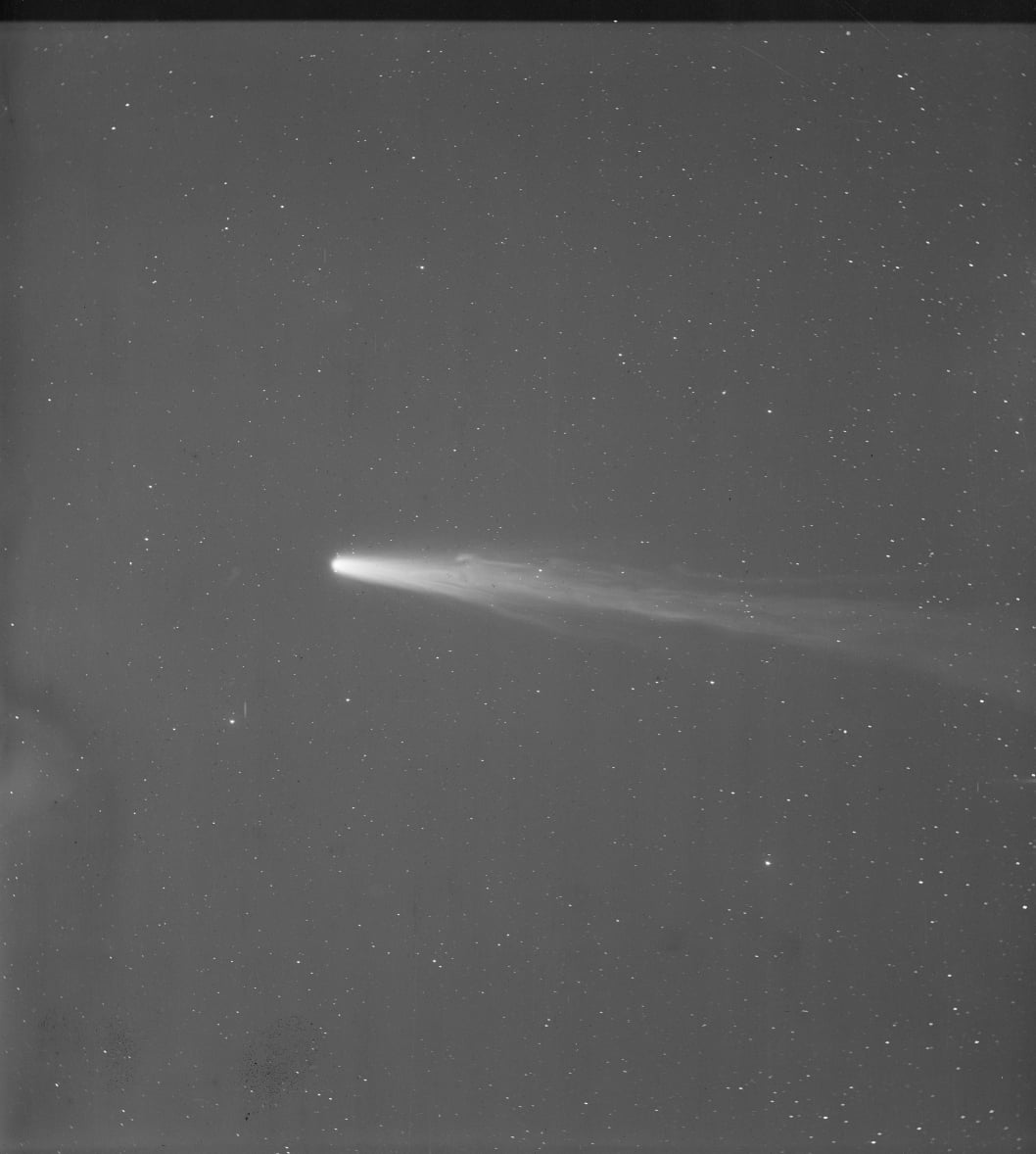
On the night of May 18 to 19, 1910, Earth moved through the tail of Halley’s Comet. For months, parts of the press had prepared readers for something more dramatic than an astronomical encounter. A poisonous substance had been identified in the comet’s light, and a real observation was repeatedly turned into a prediction of suffocation. The planet crossed the tail without any detected harm.
The facts behind the story were not invented. The orbital geometry was calculated in advance. Spectroscopy had identified what observers called cyanogen in the comet’s tail. The error was to treat detection as dosage and a tail millions of kilometres long as though it were a dense cloud settling at ground level. The omitted variable was how extraordinarily little matter the tail contained.
A predicted encounter became a poison story
Halley’s 1910 return arrived at an unusually receptive moment. Its orbit was predictable, while photography and spectroscopy promised to reveal a familiar comet as a physical object. Newspapers could report not only where it would appear, but what it contained. That new vocabulary carried scientific authority, even when the conclusions attached to it did not.
On February 7, astronomers at Yerkes Observatory announced that spectroscopy had detected cyanogen in Halley’s tail. As a Science History Institute account explains, the news followed speculation by French astronomer Camille Flammarion about possible atmospheric effects. Approximately 100 days remained before the expected crossing.
Flammarion acknowledged that the tail was extremely sparse, but also entertained vivid mechanisms for disaster. Other reports elevated the possibilities and reduced the caveats. A hypothetical became a forecast. By the time “cyanogen” appeared in headlines, a technical observation had become a simple story: Earth was heading into poisonous gas.
What astronomers had actually detected
Spectroscopy identifies matter from the pattern of wavelengths in its light. The method allowed astronomers to recognise a chemical signature in a comet too distant to sample directly. It did not mean that anyone had captured a jar of concentrated gas from the tail, or that the spectrum by itself established a hazardous dose anywhere near Earth’s surface.
Cyanogen is poisonous at sufficient concentration. A sensitive instrument can detect a substance far too dilute to affect a person. Modern comet science distinguishes cyanogen gas from the CN radical that produces familiar spectral bands, but 1910 reports commonly used “cyanogen” for the observed signature. The wording was alarming and easy to repeat.
Comet tails become visible across enormous distances because sunlight and the solar wind act on dust and ionised gas released by a warming nucleus. Length is not density. Halley’s tail could stretch across space while remaining closer to an excellent vacuum than to any cloud encountered in Earth’s lower atmosphere.
The missing measurement was density
Astronomers made this point before the encounter. On May 17, a contemporary newspaper summary quoted a Columbia University astronomer saying that even if a cubic mile of tail were concentrated in a test tube, detecting its cyanogen might require the greatest refinement of chemical analysis.
Earth’s atmosphere was vastly denser than the tail, and stood between that rarefied material and anyone at the surface. Passing through the tail was not like opening a cylinder of poison in a room. Earth’s path intersected a region where cometary particles were dispersed at extraordinary intervals.
The harmless outcome was not a narrow escape. The chemistry was real, but the exposure scenario was not. Cyanogen did not happen to miss Earth; the quantity available to interact with the atmosphere could not produce the catastrophe imagined in sensational accounts.
Uncertainty found willing salesmen
Fear created a market. NASA’s historical publication To Catch a Comet records sellers offering quinine-based “comet pills” and leather inhalers to fasten over the mouth, even while sleeping. Prices ranged from a few dollars into the twenties, substantial sums in 1910, while agents collected thousands.
Other products included gas masks and supposed anti-comet devices. A Los Angeles broker sold “comet insurance,” promising $500 to the families of customers killed by Halley’s passage. Some people paid weekly premiums. If a celestial poison killed everyone, neither the insurer nor a functioning economy would remain to honour it.
These sales show that some people were frightened and others saw an opportunity. They do not show that everyone accepted the threat. The Library of Congress guide to newspaper coverage also records comet parties, protective umbrellas and conflicting reports. Responses ranged from dread to scepticism and deliberate comedy.
The night Earth entered the tail
Halley reached perihelion on April 20. Almost a month later, on the night of May 18 to 19, Earth passed through the region swept by its tail as the comet crossed between Earth and the Sun. Some observers watched the sky, others monitored instruments, and many waited for an event newspapers had made difficult to ignore.
A tail crossing offered a rare chance to look for subtle changes in atmospheric electricity, ozone or weather. A report published in Nature soon afterward described observations made around May 18 and 19. The measurements tested a physical question without assuming a disaster.
No harmful effect appeared. There was no mass poisoning, loss of breathable oxygen or atmospheric convulsion attributable to Halley. Even the tail proved difficult to trace from some locations. Precise orbital geometry had produced no obvious terrestrial effect because the tail contained so little material.
The event became more useful than the scare
The episode illustrated the sensitivity of spectroscopy. An instrument found a chemical component in a medium so thin that Earth could pass through it without injury. The method was sound; the sensational interpretation ignored concentration, atmospheric transport and the difference between identifying matter and establishing risk.
Halley’s return left a rich photographic and scientific record. ESA’s Giotto later passed close to its nucleus in 1986 and observed jets supplying the coma and tail. A SpaceDaily account of Halley’s next return explains why 2061 should offer better viewing geometry than 1986, while brightness remains uncertain.
Earth meets material associated with Halley without waiting for the nucleus to return. The comet supplies debris streams that produce the Eta Aquariid and Orionid meteor showers. A SpaceDaily report on the Eta Aquariids describes one such encounter. Tiny grains enter the atmosphere individually; no dense cometary cloud descends.
The panic was real, but it was not the whole story
Later summaries often present 1910 as a uniform outbreak of mass hysteria. The surviving record is less tidy. There were fraudulent products, fearful precautions and isolated tragedies. There were also calm scientific explanations, jokes, rooftop gatherings and people who understood that the calculated crossing was interesting without being dangerous.
The most durable lesson is not that earlier audiences were uniquely gullible. It is that a true fragment of science can mislead when scale is stripped away. “Poison found in comet” was accurate enough to command attention. “At a concentration too small to harm anyone” was the context needed to understand it. The silent, uneventful night of May 18 to 19 supplied that second sentence.