
Halley’s Comet is already on its way back. The most famous periodic comet is calculated to reach perihelion, its closest point to the Sun, on July 28, 2061. After that, its next perihelion is expected on March 27, 2134. The gap turns an astronomical prediction into a human one: for many people alive today, the 2061 apparition will be the only realistic chance to see Halley itself.
July 28 is an orbital marker, not the only night to look
Perihelion identifies a specific point in Halley’s orbit. It does not mean the comet appears for one evening and vanishes the next. As Halley approaches the inner solar system, solar heating should release gas and dust, building the coma around its nucleus and the tails that make a bright comet recognisable. It should be followed over a much longer interval before and after July 28.
A published timetable crediting calculations by JPL comet specialist Donald K. Yeomans gives July 28, 2061 for the next perihelion and March 27, 2134 for the following one. The date is therefore useful, but the best nights for observers will also depend on the comet’s separation from the Sun in our sky, local latitude, twilight, weather and moonlight.
The prediction is part of Halley’s identity
Halley is famous not simply because it can become bright, but because it changed how people understood comets. Edmond Halley compared the paths of striking comets recorded in 1531, 1607 and 1682. Applying Newton’s account of gravity, he argued that they were repeated appearances of one object and predicted its return. It came back in 1758, after his death, and was later named for him.
NASA connects recorded appearances of Halley with observations stretching back more than two millennia. The object has therefore crossed the skies of societies that interpreted it as omen, spectacle and eventually a predictable member of the solar system. Its repeated return is the reason it carries the formal designation 1P/Halley, with the “P” marking a periodic comet.
Seventy-six years is an average, not a metronome
The familiar claim that Halley returns every 76 years is a useful approximation. It is not a fixed schedule. NASA lists observed perihelion-to-perihelion intervals as short as 74.42 years and as long as 79.25 years. The gravity of the planets slightly reshapes the orbit from one passage to the next. Gas escaping from the warming nucleus can also produce small thrusts that are not purely gravitational.
Astronomers refine the orbit as new measurements arrive, using systems such as JPL’s Horizons service to generate ephemerides. That distinction matters. Orbital mechanics can support a precise future perihelion date while the comet’s eventual brightness, activity and most rewarding observing window remain less certain.
The 2061 view should improve on 1986
Halley’s last perihelion occurred on February 9, 1986. For many observers, especially in the Northern Hemisphere, that much-advertised return was underwhelming. Near perihelion the comet was inconveniently placed relative to the Sun, and its nearest approach to Earth on the outbound leg was about 0.42 astronomical unit, or roughly 63 million kilometres.
The geometry in 2061 is expected to be kinder, with Earth and the comet on the same side of the Sun around perihelion. That should make the comet better placed than it was in 1986. It does not guarantee a particular brightness or a photograph-like naked-eye view. Comet activity can be uneven, city light can erase a diffuse tail, and forecasts made decades ahead inevitably carry more uncertainty than a calculated orbital position.
Giotto found a dark body making a bright display
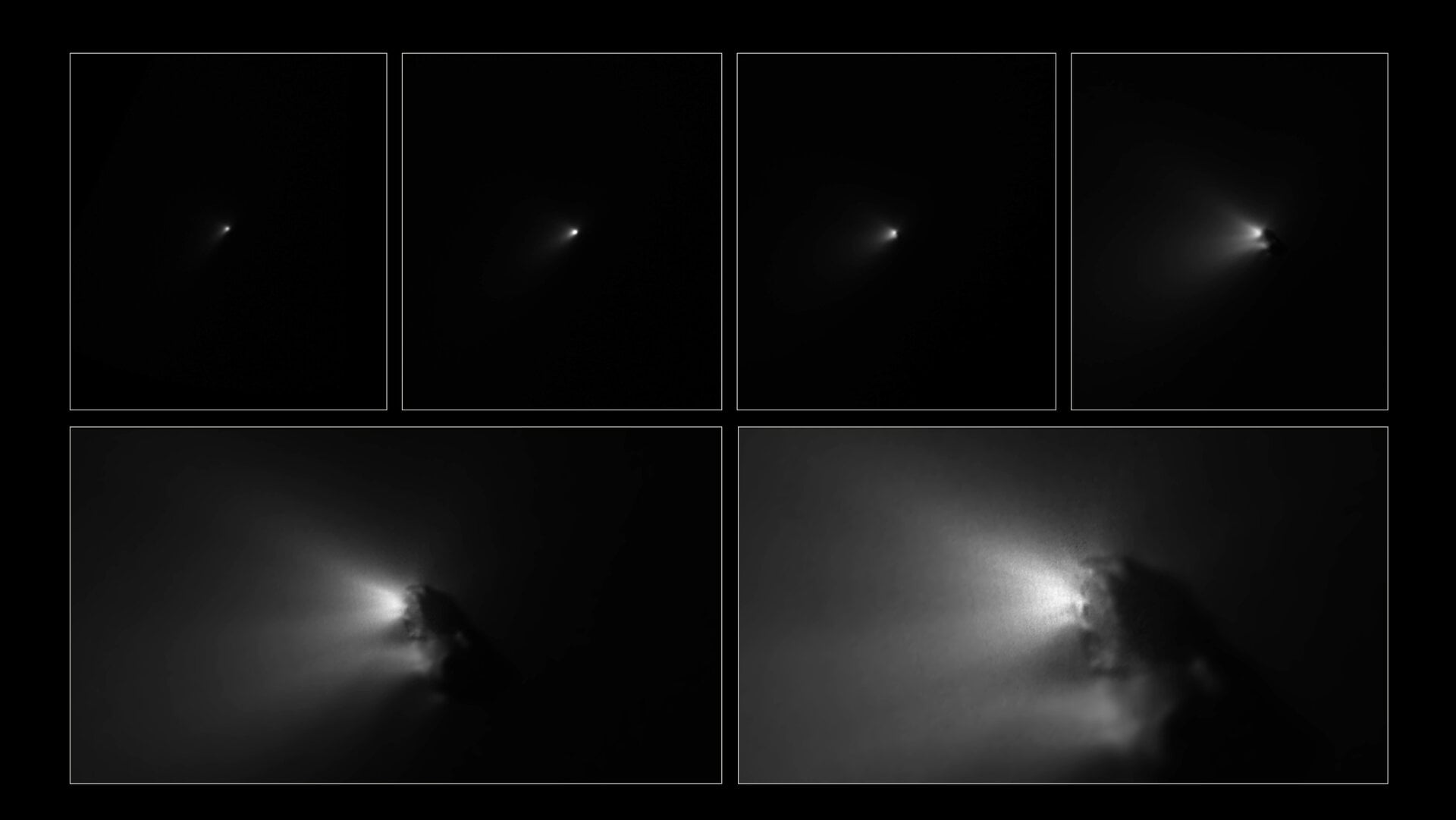
The disappointing view from some parts of Earth did not make 1986 a scientific failure. An international fleet met Halley in space, and ESA’s Giotto spacecraft passed only about 596 kilometres from the nucleus on March 14. Giotto’s approach images showed jets streaming from an irregular body that reflected remarkably little sunlight.
ESA’s account of the encounter describes an elongated nucleus roughly 15 kilometres long. Only a limited fraction of the sunlit surface appeared active. That small active area was enough to release the material that surrounded the nucleus and produced the comet’s much larger visible display. Halley is therefore an instructive paradox: one of the solar system’s darkest known surfaces can generate one of the sky’s most celebrated sights.
Earth still meets Halley’s dust every year
The comet itself is distant, but material it left along its orbit returns to Earth’s atmosphere annually. Halley is the parent body of both the Orionid meteor shower in October and the Eta Aquariids in May. The streaks are not fragments of the nucleus arriving with the comet in real time. They are tiny grains shed on earlier circuits and encountered when Earth crosses the debris streams.
NASA’s Eta Aquariid guide identifies Halley as the shower’s source. An older SpaceDaily report on Halley’s debris explains the same connection. Watching those meteors is not a substitute for seeing the comet, but it is a recurring encounter with matter from the object while the nucleus remains in the outer solar system.
One orbit can be longer than an adult life
The dates make the scale plain. A child born in 2026 would be 35 at the 2061 perihelion and 108 at the 2134 return. Some people who remember seeing Halley in 1986 may witness it again. Many adults alive now will not have another opportunity after 2061, even though the comet will continue on the same path it has followed through recorded history.
There is no reason to choose a viewing site or buy equipment 35 years early. Detailed sky charts, brightness estimates and regional advice will improve greatly as the comet approaches. July 28 may not even be the best observing date from a particular location. The sensible preparation is to save the year, understand that an apparition unfolds over months, and be ready to travel away from bright urban skies if forecasts justify it. Halley’s return can already be calculated. What no calculation can supply is a second human lifetime if the first opportunity is missed.