
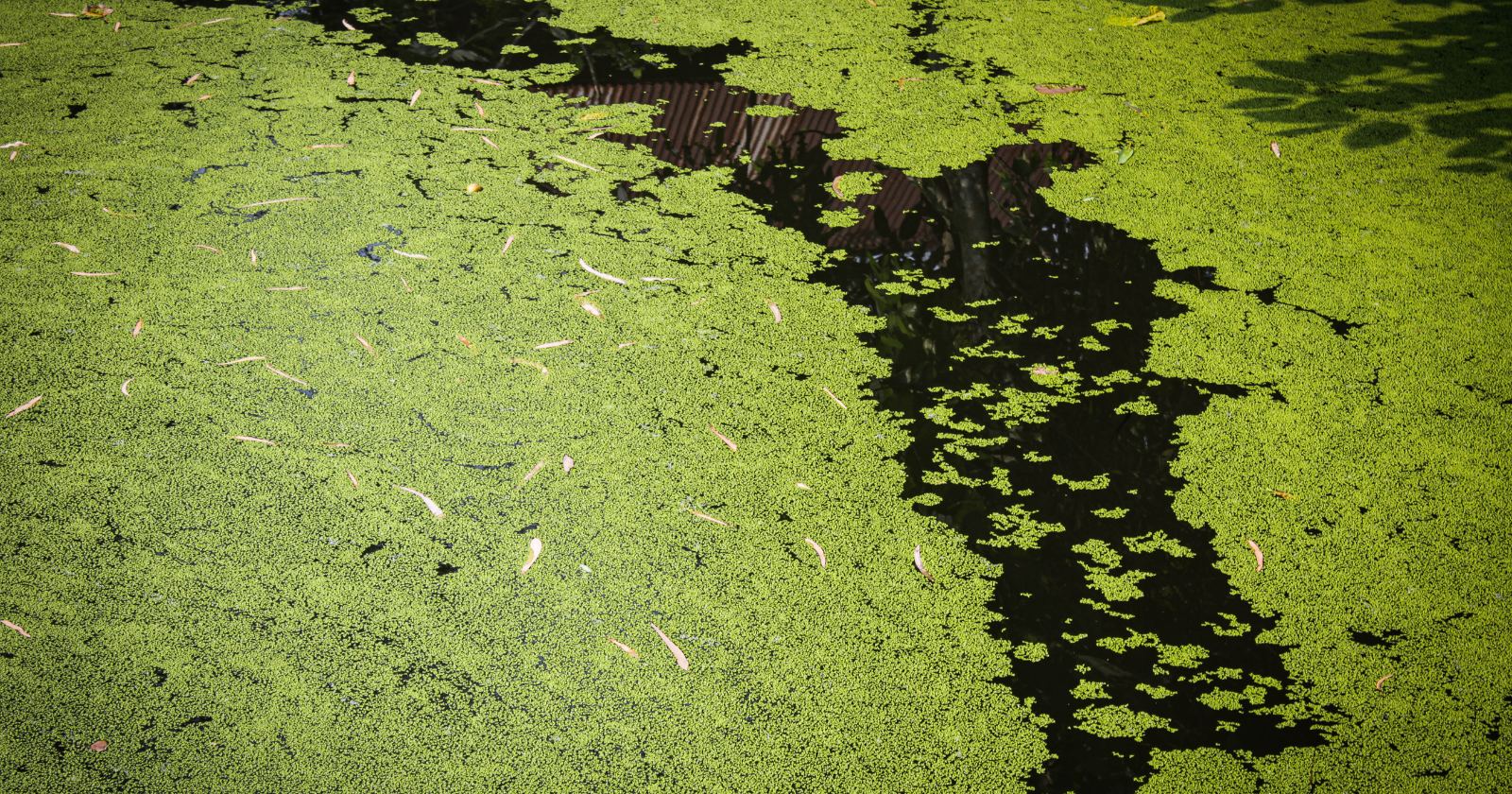
A tube of pond scum on a Cambridge windowsill spent half a year running a computer, and nobody had to feed it.
The container held blue-green algae, water and very little else, and it was roughly the size of an AA battery. Inside it, a colony of microbes harvested light, leaked electrons into a strip of aluminium and produced a current steady enough to keep a microprocessor ticking over from February to August 2021. Smithsonian magazine reported that the whole apparatus sat out a pandemic lockdown on a windowsill in the home of Cambridge biochemist Paolo Bombelli.
It ran far longer than anyone on the project expected.
What was actually inside the container
Synechocystis is a cyanobacterium, one of the ordinary non-toxic pond dwellers that has been quietly photosynthesising for a couple of billion years. Photosynthesis splits water and sends the resulting electrons down an internal transport chain inside the cell. Some of that current leaks out before it is used, and a metal anode positioned nearby can catch it. Exactly how those electrons make the jump from a living cell to bare metal is still not settled.
Bombelli and his colleagues, writing in Energy & Environmental Science, described a small housing of clear plastic and steel with an aluminium anode inside, built from inexpensive and largely recyclable parts. No feeding, no charging. Cyanobacteria make their own food as they photosynthesise, so light and water cover the entire supply chain.
Stranger still, the current did not stop at sunset. Researchers on the team suspect the microbes carry on metabolising food banked earlier in the day, which is why the cell kept nudging out electricity through the dark hours, as the Cambridge Independent reported.
How little electricity this really is
Averaged across the experiment, the cell delivered about 1.05 microwatts at 0.72 volts, figures Gizmodo set against the obvious comparisons. A fresh AA battery starts life at 1.5 volts. An efficient LED globe pulls around 10 watts. So the device was generating something in the region of a ten-millionth of a globe.
That sufficed only because the chip had been picked for extreme frugality. An Arm Cortex M0+ can tick along on 0.3 microwatts, and Arm Research built the test chip, the board and the cloud link that logged everything the microbes did. Only the chip itself ran on that current. The cloud link, which reported the results back to the researchers, needed conventional power to do its job.
Devices of this kind hold one advantage over the better-known microbial fuel cell, which needs a steady diet of organic matter to keep its bacteria working. Researchers publishing in Nature Communications noted that biophotovoltaic systems skip that input altogether, since the cells feed themselves as they go. The fuel bill is nothing and the colony renews itself, roughly the combination a sensor buried in a paddock for a decade would want.
Why a microwatt earns a paper
Who needs a computer powered by pond water? Nobody, right now. The argument is about the enormous, boring category of devices that comes next: door sensors, soil monitors, tracking tags, all the small gadgets multiplying across the world. Forecasts in the same paper put the number of connected devices on a path towards a trillion by 2035, every one of them wanting its own portable trickle of electricity. Batteries go flat, and they depend on materials that are expensive and unpleasant to dig out of the ground.
Christopher Howe, the Cambridge biochemist who co-led the work, argued in the university’s announcement that supplying all that hardware will require systems that generate energy “rather than simply store it like batteries”.
What one windowsill proves
Six months of unbroken output went into the submitted paper, and the hardware simply carried on afterwards. The funders at the National Biofilms Innovation Centre later described the microprocessor as having run for a year and counting on nothing but ambient light and water.
A single device in a single house is a demonstration, and one paper is one paper.
Two things stand between this and anything resembling a product: a great deal more current, and some agreement on how to measure it. A review in Frontiers in Microbiology characterises biophotovoltaics as a field hobbled by very low current outputs and by experimental set-ups too inconsistent to compare with each other, which stalls any systematic push to improve them. No one has fully pinned down how electrons cross from a living cell into an electrode either, so progress tends to come from trying things and seeing what sticks.
Scaling up means manufacturing thousands of these cells cheaply and reliably, and doing it before anyone has fully worked out what is happening inside them.
The processor was disconnected a long time ago. By Bombelli’s account the algae carried on making electricity regardless, entirely indifferent to whether anything was still listening.
