

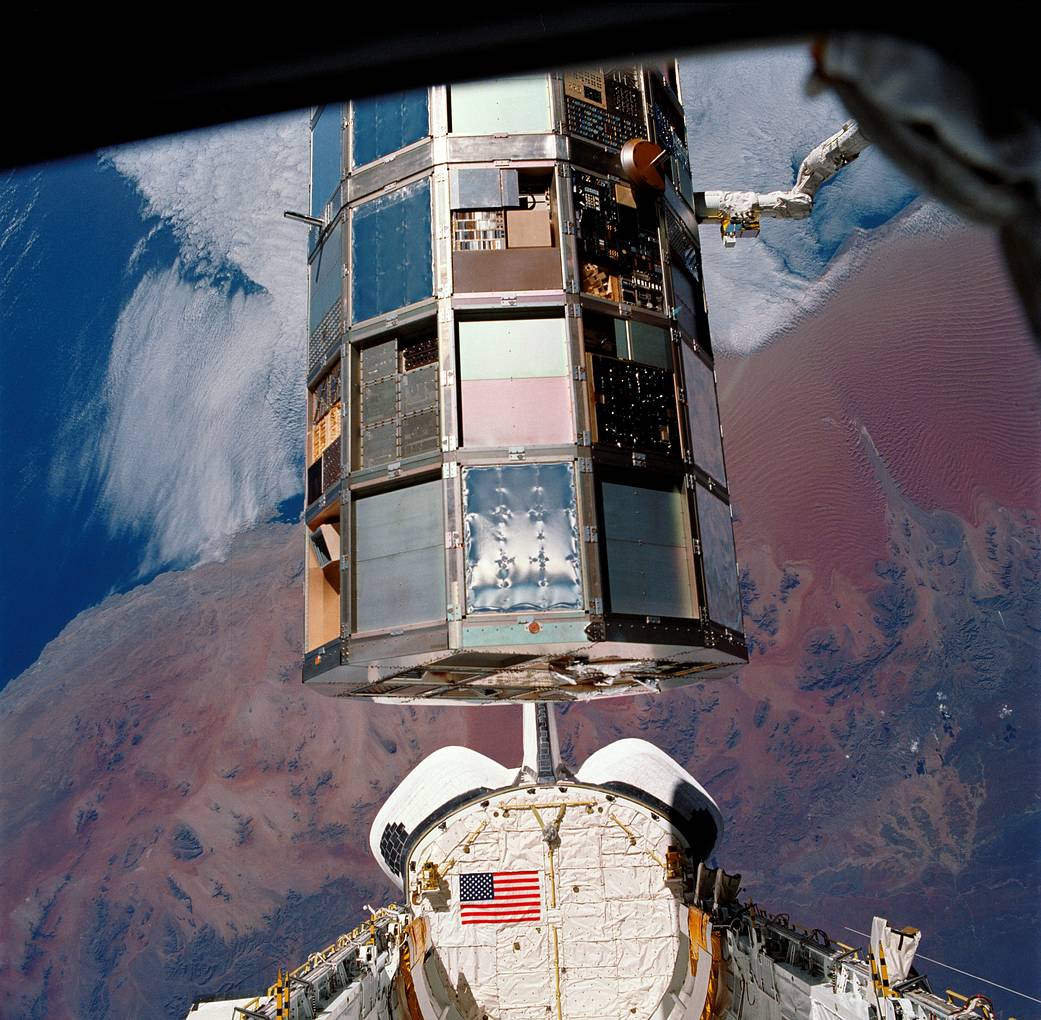
When NASA deployed the Long Duration Exposure Facility in April 1984, its experiments were supposed to spend about ten months in orbit before returning to Earth. Instead, scheduling changes and the aftermath of the Challenger accident extended the flight to 69 months. Columbia finally collected the facility in January 1990 and carried it home in its payload bay.
The satellite held 57 experiments. Its name, usually shortened to LDEF, described the job: expose materials and equipment to space, then bring them back for examination. The unexpectedly long stay made recovery more urgent while also providing an unusually extensive record of what the orbital environment could do.
A laboratory whose exterior was part of the experiment
LDEF was an uncrewed structure built to travel to and from orbit inside a space shuttle. A NASA mission profile describes a facility roughly nine metres long and 4.3 metres across, passively stabilised so its surfaces retained a consistent orientation relative to its direction of travel.
That orientation was scientifically useful. Materials facing into the direction of motion did not receive the same exposure as those facing away. A sample’s location was therefore part of the experiment, alongside its composition and the length of time it spent outside.
The structure carried test specimens in trays. Some investigations concerned the space environment itself; others asked how materials, components or systems would respond to prolonged exposure. The facility did not need a crew working inside it to function as a laboratory.
Its surfaces were recording the journey.
Returning those surfaces allowed scientists to study changes that could not be fully understood from a photograph alone. They could examine the actual material, compare exposed and protected areas, and connect physical damage with where each specimen had flown.
A retrieval delayed more than once
NASA’s history of the STS-32 recovery mission traces the postponements. Retrieval was originally assigned to a flight in February 1985. Shuttle scheduling delays pushed it to September 1986, and the Challenger accident brought another, much longer interruption.
By the time Columbia was preparing to collect LDEF, its orbit was decaying. NASA’s retrospective says trajectory specialists expected atmospheric re-entry by March 1990, making a timely recovery important. An object designed to be returned for analysis could otherwise lose both its hardware and much of its scientific value.
The long delay should not be mistaken for a planned six-year exposure campaign. It changed the experiment’s conditions after launch. More exposure could reveal long-term effects, but it also meant investigators had to interpret results against a mission history different from the one they had prepared for.
Nor did every instrument necessarily record continuously for the entire stay. The physical exposure of a specimen and the recording lifetime of an active instrument are separate things.
Columbia brought back the whole facility
On 12 January 1990, Columbia’s crew retrieved LDEF. Bonnie Dunbar operated the shuttle’s robotic arm, and the astronauts carried out a photographic survey before securing the facility in the cargo bay. Columbia landed at Edwards Air Force Base on 20 January.
A post-flight technical report records 32,422 orbits during the extended mission. Once the facility was back on Earth, work shifted from catching a satellite to systematically documenting and removing its experiments.
That transition was essential. Recovery was the route to the measurements, not the end of them. Trays had to be identified and examined in relation to their positions on the structure, while investigators distinguished environmental effects from other possible changes.
A spacecraft that returns as cargo offers a different scientific opportunity from one that transmits readings and stays aloft. The sample itself remains available for instruments, techniques and questions that may go beyond the original flight equipment.
Weathering in space has several causes
NASA’s overview of LDEF lists micrometeoroids, orbital debris, energetic particles, atomic oxygen and solar radiation among the exposures the experiments encountered. Calling the surfaces weathered is useful shorthand, but this was not terrestrial weather acting on an abandoned machine.
Atomic oxygen is one particularly important part of low Earth orbit. NASA’s materials research explanation describes how these reactive oxygen atoms can erode polymers on spacecraft surfaces. Their cumulative effects matter when engineers choose materials intended to remain outside for years.
Research from LDEF experiment A0114 included measurements of oxidation and polymer erosion, using the returned samples to investigate how surfaces interacted with fast oxygen atoms. Such measurements turned visible wear into evidence about rates and mechanisms.
The damage was part of the data.
Different materials could respond differently, and a surface’s appearance could not by itself identify every process involved. The value lay in combining inspection with measurements and the known exposure history.
The extended stay left an engineering reference
A 1994 overview of LDEF results describes more than 10,000 test specimens and the work of investigators studying the returned hardware and recorded data. The findings helped refine models of radiation, debris, meteoroids and atomic oxygen in low Earth orbit.
That is the broader importance of the mission. A laboratory test on Earth can isolate a particular effect, but an orbiting specimen encounters several influences together. Returned hardware allows researchers to compare their predictions with the combined result.
LDEF’s unusually long stay was an operational complication that became a source of scientific evidence. Columbia did more than retrieve an overdue satellite: it delivered years of exposure back to the laboratories equipped to examine it, with the marks of that history still on the surfaces.