

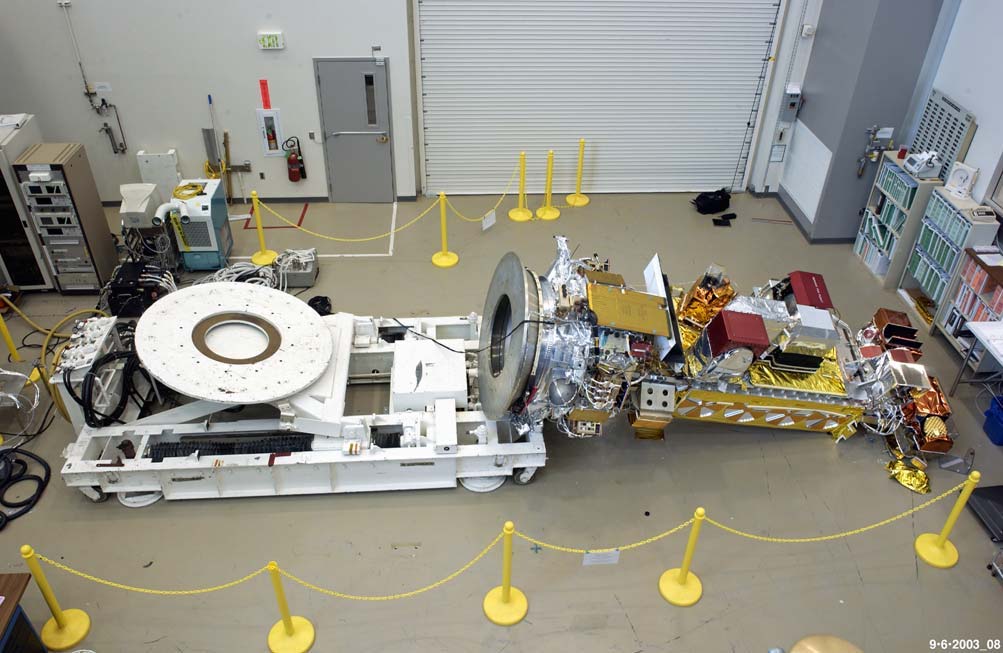
NOAA N-Prime was still inside its manufacturer’s plant when it suffered a failure that threatened its future in orbit. On 6 September 2003, the weather satellite slipped from a turnover cart at Lockheed Martin’s Sunnyvale facility and fell about three feet to the floor. All 24 bolts securing the fixture’s adapter connection were missing.
NASA’s investigation established a sequence involving shared equipment, an unrecorded change and a check performed against old paperwork. The satellite was eventually repaired and launched as NOAA-19, but the investigation treated the ground operation as a failure of both working practice and oversight.
The missing connection was beneath the satellite
The final mishap report, dated 13 September 2004, explains that another project had removed the bolts while the cart was in a shared staging area. No additional tag or other indication identified the incomplete configuration, and the change was not communicated to the NOAA team.
The distinction is mechanical: attaching the spacecraft to its adapter did not establish that the adapter was secured to the cart underneath it. Those were separate connections. The missing fasteners left the second connection unable to restrain the load as intended.
The responsible test engineer relied on documentation from an earlier operation instead of visually and physically verifying the cart. The report identified that decision as contrary to the required procedure.
A familiar operation still required a complete team
NASA’s January 2005 lessons-learned account explains why the satellite was being tilted. Workers needed access to remove the Microwave Humidity Sounder, install a shim and reinstall the instrument. That work required moving the spacecraft from its normal upright position towards horizontal.
The same account records extensive damage but no injuries to personnel.
NASA identified hurried planning, inadequate staffing and weak participation by safety and quality personnel. The agency also found that previous successful work had encouraged both contractor and government staff to regard the operation as routine. The experience of the people involved had not ensured that the required checks happened.
The response extended beyond checking bolts. NASA described formal training and certification for test conductors, clearer responsibilities, better control of procedures and ground equipment, and stronger government presence at the plant. It also called for reviewing requirements on long-running contracts, where an old approved plan might no longer reflect current practices.
Those measures address different failures: who may change equipment, how that change is recorded, who verifies its condition and who can stop an operation.
The mission was intended to preserve weather coverage
The spacecraft’s purpose helps explain why repair mattered. In NASA’s pre-launch mission overview, NOAA satellite acquisition manager Tom Wrublewski described continuity of observations as its main role. N-Prime would provide a fresh set of functioning instruments while the weather satellite programme moved towards its next generation.
That is a different objective from demonstrating an entirely new kind of observation. An operational weather system needs dependable measurements delivered repeatedly. Gaps can affect the sequence of observations available to forecasters and researchers, even when the instruments themselves belong to an established design.
The overview describes a polar-orbiting spacecraft circling Earth approximately every 102 minutes. Its observations would cover areas far beyond the United States, including remote regions where other timely weather information could be limited.
Such satellites also carry services beyond cloud imagery. The mission overview discusses search-and-rescue support and observations relevant to vegetation, ocean conditions and the space environment. The vehicle on the factory floor was one component of that broader observing system.
NOAA N-Prime reached orbit in 2009
The damage did not end the programme. NOAA’s satellite history records the 2003 manufacturing mishap and the satellite’s subsequent launch in 2009. The repaired spacecraft became NOAA-19.
United Launch Alliance’s launch announcement dates its departure to 6 February 2009, aboard a Delta II from Vandenberg in California. More than five years separated the ground accident from the successful flight. ULA reported spacecraft deployment after a 65-minute flight. The launch vehicle used three strap-on solid rocket motors, and its payload fairing enclosed the satellite during ascent.
The 2009 Aeronautics and Space Report of the President describes NOAA-19 joining Europe’s Metop-A in supporting operational forecasts. It lists temperature and humidity soundings, sea-surface measurements, fire detection and other environmental uses among the mission’s contributions.
The launch therefore marks a documented recovery of the mission. It does not change the investigation’s findings about the avoidable damage sustained before flight.
Its service continued until August 2025
NOAA’s August 2025 account of the POES constellation’s retirement records NOAA-19’s decommissioning on 13 August, more than sixteen years after launch. NOAA-15 followed later that month, ending the legacy constellation’s operations.
NOAA described these satellites as contributors to forecasting, long-term environmental records and international distress-beacon services. Its newer Joint Polar Satellite System continued the low-Earth-orbit observing role.
Decommissioning did not mean an immediate return to Earth. The older POES spacecraft lacked propulsion for a controlled re-entry. NOAA’s retirement account describes shutting them down and leaving them in orbit, with natural orbital decay expected to take roughly 150 years.