

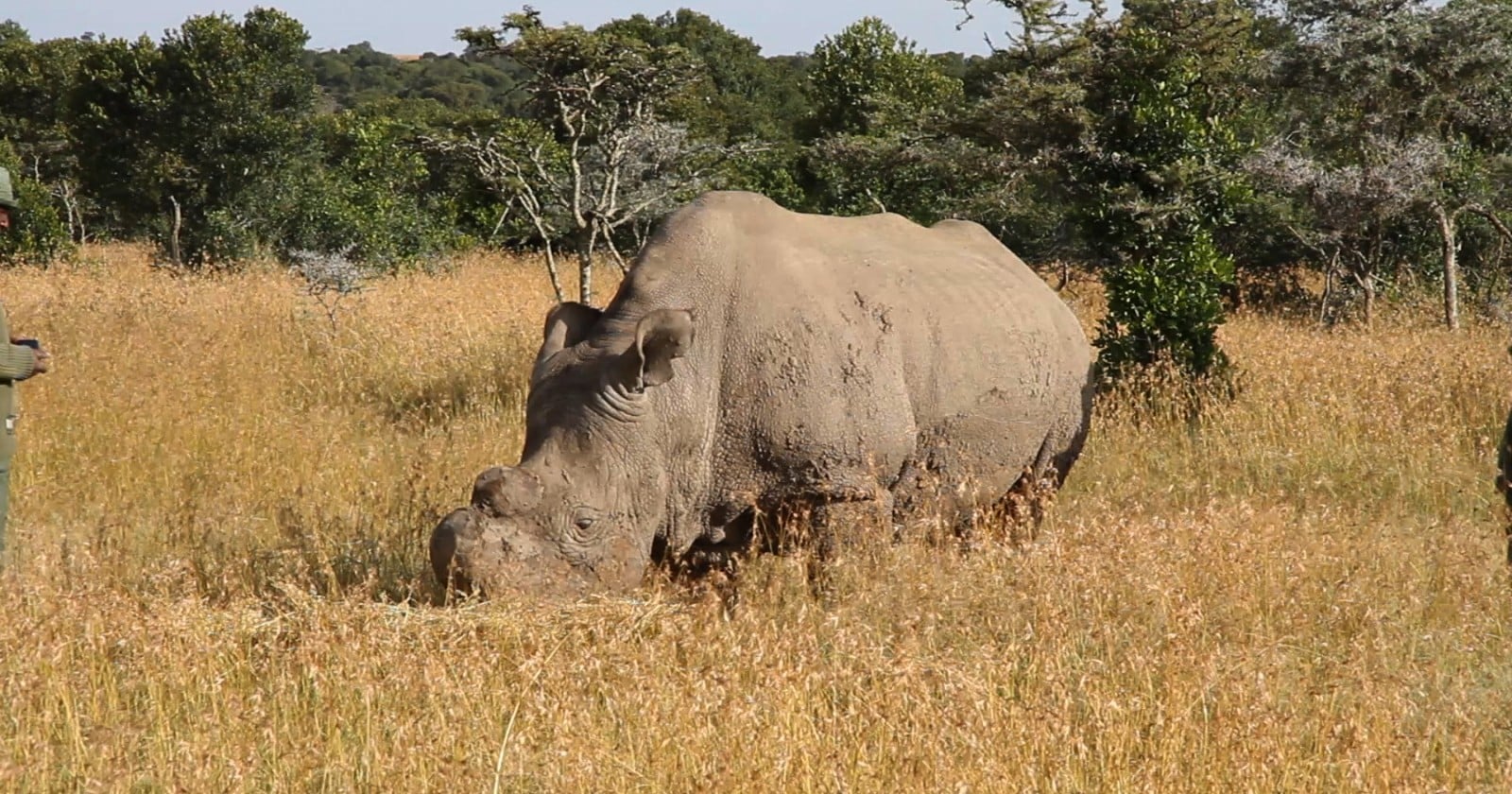
The consortium trying to keep the northern white rhinoceros from disappearing reported in April that it has produced 39 embryos of the subspecies in a laboratory. Six of those embryos have been placed in surrogate mothers, and none of the six became a lasting pregnancy.
Two northern white rhinos are alive, on the consortium’s own count of the animals known to remain. Najin was born at a Czech safari park on 11 July 1989 and her daughter Fatu on 29 June 2000, and both live under armed guard at the Ol Pejeta Conservancy in Kenya. Neither can carry a calf, which is why the eggs travel to Italy and the pregnancies are attempted in a different subspecies.
Why are there only two northern white rhinos left?
The northern white rhino once ranged over parts of north-western Uganda, southern Chad, South Sudan, the eastern Central African Republic and the north-eastern Democratic Republic of the Congo. The consortium names hunting for horn as the main threat, compounded by war across much of that range, which it says quashed protection and conservation work.
The last four wild individuals were seen in Garamba National Park in the DRC in August 2005, and signs of their existence were still being found in 2007. There was an isolated and unconfirmed report of three white rhinos in southern Sudan in 2008; surveys in June of that year failed to locate them.
Four northern white rhinos, two males and two females, were moved from the Safari Park Dvur Kralove in the Czech Republic to Ol Pejeta in December 2009. The hope was that a more natural habitat would encourage them to breed. One of the males, Suni, died in October 2014 of natural causes. The other, Sudan, died on 19 March 2018 of old age. Sudan was Najin’s father and Fatu’s grandfather.
Why can neither female carry a calf?
In 2014 both Fatu and Najin were diagnosed with severe genital pathology. Mating had been observed at Ol Pejeta and neither female had conceived, and the consortium’s own account is that the pathology was supposedly present for some time before it was found. It also notes that infertility of this kind is diagnosed frequently in female rhinoceros that have not bred for long periods.
The ovaries are a separate matter. Fatu still produces oocytes, and since October 2021 she has been the programme’s only egg donor. Najin was retired from collections after three procedures that produced no embryo. Eggs can still be taken from Fatu and fertilised outside the body even when neither uterus can hold a pregnancy. The consortium’s public wording in August 2025 was that both females are “unable to carry a pregnancy naturally”. Its longer explanation gives two reasons for not transferring an embryo into either of them: the health problems, and the value of these two individuals to the species.
That leaves the southern white rhino, the closely related subspecies whose numbers in South Africa the consortium’s undated FAQ puts at approximately 20,000, as the only available womb.
Where do the 39 embryos come from?
The first collection of eggs from Fatu and Najin took place on 22 August 2019. Six years later, in August 2025, the consortium counted 21 oocyte collections from Fatu, three of them that year, and put the running total at 38 pure northern white rhino embryos. A further collection from Fatu at the beginning of 2026 produced one more embryo and took the count to 39.
The eggs are matured and fertilised in northern Italy, at the Avantea laboratory in Cremona. The consortium credits Avantea with producing its recent embryos, using sperm frozen from northern white rhino bulls that are already dead, and Avantea describes itself as the only laboratory to have generated viable rhinoceros embryos. The consortium’s 39 is a count of embryos produced, not of embryos still in storage, because six of them have since been used.
The consortium does break the early embryos down by donor. Najin underwent three oocyte collections; none of her eggs became an embryo. The three embryos from the 2019 procedures were Fatu’s. After October 2021 the public tallies are Fatu collections only.
What can six transfers support?
Six is a small number to draw anything from. The proof of concept at the end of 2023 was a pregnancy achieved with a southern white rhino embryo, not a northern one. The first pure northern white rhino transfers came afterwards, in July 2024, December 2024 and May 2025, and three more followed in the second half of 2025. Three plus three is the six the consortium reported in April 2026, and that arithmetic is ours rather than a figure it prints. The April statement does not itself say that all six were northern white rhino transfers.
The closest any of them came is easy to overstate. Mucus developed in the recipient uterus after the December 2024 transfer. The consortium’s own summary is that the subsequent analysis was inconclusive and did not confirm northern white rhino DNA. That is not a pregnancy on the record. It is a signal that could not be resolved.
The comparison the team reaches for is human IVF, which it notes took more than 100 attempts before it worked. That is an encouragement rather than a forecast, because nothing establishes that the two procedures fail at similar rates. The rhinoceros version also depends on an egg collection the consortium itself calls a risky procedure, and on a supply its older guidance says can be tapped only two or three times a year. Twenty-one collections in the six years to August 2025 average rather more than that, so either the cap has moved or it was never a hard one.
The genetic floor matters as much as the transfer count. Across the cryobanks the consortium counts 12 cell lines from eight presumably unrelated founders, plus frozen semen from four bulls, plus the natural gametes of the two living females. Its own statement is that returning northern white rhinos to secure habitat inside their former range may only be realised in 50 to 70 years.
A separate number circulating on the consortium’s own website should not be added to the six. Its frequently-asked-questions page records seven embryo transfer attempts in European zoos, which are not the six in the April 2026 tally. That page is also undated and demonstrably old. It describes a procedure on 18 August 2020 as the third time eggs had been collected, puts the running embryo total at three, and says more embryo transfers are scheduled in the coming months. Its answer that no rhino has yet been born by IVF is one of the few statements on it that is still current.
Who would carry a northern white calf?
The surrogates are southern white rhinos held at Ol Pejeta in an enclosure that had been kept empty for the purpose. The consortium’s older account describes five of them, belonging to the Kenya Wildlife Service, and says the embryo transfer requires full anaesthesia because the animals are wild. It reported in April 2026 that two more southern white females, described as proven, had been brought into the programme as potential surrogates, to improve the odds of a pregnancy.
If a calf is ever born in Kenya it would be housed in a 700-acre secure enclosure on the conservancy. On the consortium’s account every first calf would belong to the Safari Park Dvur Kralove and every second to the Kenya Wildlife Service.
The security around the two females is described only on that older page. It counts 42 armed rangers patrolling the conservancy and 120 rhino patrol rangers, and reports no poaching on the property since 2017. None of those three figures has a more recent source than a page that still treats August 2020 as the latest egg collection.
The animal-welfare accounting is the consortium’s own. It said in August 2025 that the first pure northern white transfers had undergone a detailed ethical evaluation by experts at the University of Padua. Those transfers, it added, had no negative health effects on the surrogate southern white mothers. That statement predates the three later transfers and does not cover them. It also says Fatu’s ovarian health appears to have benefited from the repeated procedures, a phenomenon it calls ovarian cleansing therapy. Those are self-reports by the team performing the procedures.
What is the stem-cell route meant to add?
A second line of work runs alongside the eggs. Researchers at the University of Osaka and the Max Delbruck Center in Berlin are trying to make functional oocytes from pluripotent stem cells. The raw material is frozen skin tissue from a few more northern white rhinos, banked at the Leibniz-IZW and San Diego Zoo cryobanks. The point is not to replace the egg collections but to widen the gene pool that any future founding population would start from.
That work is also the least tested part of the programme, and the consortium’s academic collaborators are careful about it. A paper published by consortium members in February 2026 draws a line between what it calls classical assisted reproduction and the emerging techniques. It says outright that public acceptance of the first should not be assumed to carry over to the second. Stem-cell gametogenesis and gene editing are, in its words, less well established, less familiar and less easily understood, and they further blur the boundary between natural and artificial.
Does the public support any of this?
That February paper, in PLOS ONE, is the first the authors know of to survey public opinion on assisted reproduction in conservation. Its authors are drawn almost entirely from the consortium’s own partner institutions: the Leibniz-IZW in Berlin, the University of Padova, the zoo at Dvur Kralove and Avantea in Cremona. It was journal-reviewed; nobody outside the programme ran a separate field audit of the survey. It reports on an online questionnaire recruited in May 2022 through professional panels in Czechia, Germany and Italy, filled to quotas for geography, age and gender.
The samples were 505 in Czechia, 902 in Germany and 804 in Italy. The results are not percentages. The authors compress each item into a relative importance index running from 0 to 1. On that scale the creation of protected areas was the most acceptable conservation strategy in all three countries. It scored 0.867 in Czechia, 0.832 in Germany and 0.874 in Italy, a mean of 0.858. Assisted reproduction scored 0.741, 0.715 and 0.736, a mean of 0.731, which put it above zoos and aquariums at 0.686 and level with captive breeding at 0.730. Read plainly, respondents were positive about the technology and more positive about habitat.
The paper is silent on the rhino programme’s technical progress. It contains no embryo counts, no transfer counts and no pregnancies, and it describes embryos in the future tense as material “to be implanted into surrogate mothers”. Anyone citing it for a number about Najin and Fatu is citing the wrong document. The authors add a point the coverage tends to drop: that opposition to assisted reproduction, even from a majority, would not in itself make the technique wrong. It would, they add, indicate a need for greater attention to the conditions under which the techniques can be used responsibly.
The programme has produced a great deal that can be counted. Thirty-nine embryos, at least 22 egg collections from one animal, six transfers, an award for its project leader in Stockholm in January, a National Geographic documentary. The thing it exists to produce is not yet on that list.
Najin is 37 and Fatu is 26, on the birth dates the consortium publishes. Everything the laboratory in Cremona has to work with from living eggs comes out of a procedure performed on Fatu, which the consortium itself calls risky. The stem-cell work runs alongside that, from banked tissue, including from Najin after she was retired as an egg donor.