
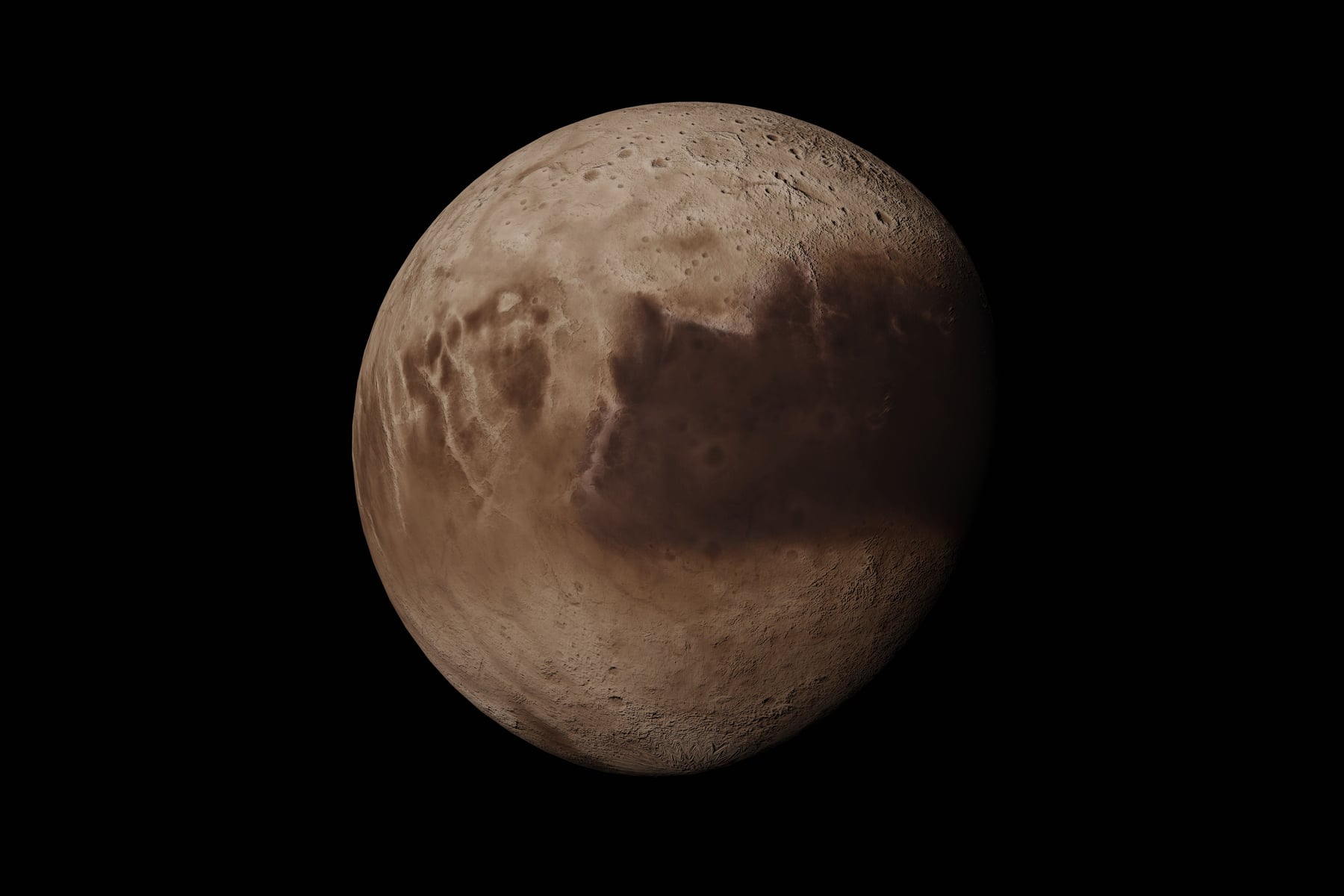
Mars looks small beside Earth. Its mean radius is about 3,390 kilometres, a little over half Earth’s, and its volume is only about 15 per cent as large. Yet if the whole Martian globe were unwrapped onto a map, its area would come surprisingly close to all the land exposed above Earth’s oceans.
The figures are roughly 145 million square kilometres for Mars and about 149 million square kilometres for Earth’s land. Depending on the reference radii and land dataset used, Mars has around 97 per cent as much surface area as the dry part of Earth.
It is a wonderfully compact comparison, but it is easy to misread. Mars is not almost as large as Earth, and it is not a planet entirely stripped of water. The similarity appears because the global ocean covers 71 per cent of Earth, while present-day Mars has no confirmed permanent lakes, rivers or seas on its surface.
Why half the diameter does not mean half the area
The surface area of a sphere is four times pi times the radius squared. Halve a planet’s radius and its surface area falls to one quarter, not one half. Mars is not exactly half Earth’s size, so the calculation is slightly larger than a quarter.
Using mean radii of about 3,390 kilometres for Mars and 6,371 kilometres for Earth, the radius ratio is approximately 0.532. Square it and Mars has about 28.3 per cent of Earth’s total surface area. That produces a Martian area near 144.5 million square kilometres, often rounded to 145 million.
Earth’s whole surface covers roughly 510 million square kilometres. If 71 per cent is ocean, the remaining 29 per cent is close to 148 million square kilometres. More detailed geographical datasets usually place global land area around 149 million square kilometres, depending on how coastlines and inland waters are treated.
The coincidence is now visible. Mars provides about 28 per cent as much total area as Earth, while dry land occupies about 29 per cent of Earth. NASA was already illustrating the comparison in its 1984 guide to Mars and Earth, placing maps of the two worlds at the same scale.
“All the continents” is useful rather than exact
The familiar wording treats “the continents” as shorthand for Earth’s exposed land. A strict geologist could object. Continental crust continues beneath shallow seas, islands are not always counted as parts of continents in ordinary speech, and Antarctica remains land even where kilometres of ice conceal its rock.
Coastlines are not mathematically fixed boundaries either. Tides, changing sea level, river mouths and the resolution of a map all alter a land-area estimate. Mars also has mountains, crater walls and canyon slopes whose true textured area exceeds that of a smooth reference sphere.
None of those complications breaks the comparison. They explain why “nearly as much” is the right phrase. The claim is not an equality carried to the last square kilometre. It is a scale comparison between Mars’s global surface and the area generally classified as land on Earth.
It would be wrong to turn that into “Mars is almost as big as Earth.” Earth’s submerged seafloor is still planetary surface. Drain the oceans and Earth would retain its full 510 million square kilometres, more than three and a half times the reference area of Mars.
No permanent surface water is not the same as no water
NASA’s current Mars overview says liquid water cannot exist for long on the surface. The reason is a difficult combination of low pressure and low temperature. Average Martian surface pressure is close to the triple-point pressure of water, below which liquid water is not a stable bulk phase. Pressure also changes sharply with elevation and weather.
In much of the climate, exposed water freezes. If sunshine warms it enough to melt, the thin atmosphere encourages rapid evaporation or boiling. Salt can lower the freezing point and might allow tiny quantities of brine to persist briefly under favourable local conditions, but that is a long way from a stable lake or flowing river.
Seasonal dark streaks once attracted attention as possible briny flows. Later topographic work found that many end at the same steep angles as avalanching sand. NASA’s account of that analysis describes granular flow as a better fit, while allowing that small amounts of water could still help trigger or modify some features.
Mars nevertheless holds large stores of water in other forms. Water ice makes up much of the permanent northern polar cap and lies beneath the surface across broad high-latitude regions. Frost appears seasonally. Hydrated minerals retain water within their structures, and buried ice occurs well beyond the visible caps.
Possible liquid reservoirs below the surface are a separate question from permanent bodies on the ground. Bright radar reflections beneath the south polar ice were interpreted as briny lakes, but alternative explanations involving rock, clay or unusual ice remain credible. New NASA radar observations reported in 2025 made the lake interpretation harder to sustain, without establishing that liquid water is impossible everywhere underground.
The dry planet carries the architecture of water
Modern Mars has no ocean to interrupt its land area, but much of that continuous ground was shaped by liquid water. Orbiters have mapped branching valley networks, flood channels, deltas and basins that once held lakes. Rovers have examined rounded pebbles, cross-bedded sediments and minerals formed or altered in water.
The contrast is particularly clear in the planet’s colour. As SpaceDaily recently reported, a 2025 study linked much of the red dust to ferrihydrite, an iron mineral normally associated with cool liquid water. If that interpretation holds, even the colour of the modern desert carries evidence of wetter conditions.
How much open water existed at once is still debated. Some reconstructions place an ocean across portions of the northern lowlands, perhaps covering roughly a third of Mars. Shoreline candidates are difficult to trace because volcanism, impacts, erosion and movement of the crust have altered the record.
The atmosphere then thinned, much water escaped to space and another portion became ice or entered the crust. SpaceDaily’s look at InSight-based estimates of water in the Martian mid-crust explored one possible destination. Those estimates depend on how seismic velocities are interpreted and do not describe an accessible underground ocean.
A planet-sized expanse is not uniformly usable
The land-area comparison can make Mars sound like one vast available continent. In reality, its surface is divided by formidable terrain. Valles Marineris drops kilometres below surrounding plateaus. Olympus Mons rises far above the reference level. Craters, dunes, boulder fields, dust deposits and polar ice complicate movement and landing.
Elevation also changes the atmosphere. Low basins have higher pressure than mountain summits, though nowhere approaches Earth’s sea-level air. Temperature, sunlight, buried ice, radiation exposure and line of sight to orbiting relays all vary by location. The most scientifically interesting site may not be the safest or most practical place for a spacecraft.
Nor is exposed area equivalent to habitable area. Earth’s continents sit beneath a thick atmosphere, participate in an active water cycle and connect to oceans that store heat and move moisture around the globe. Mars’s thin carbon-dioxide atmosphere provides little thermal buffering and only limited protection from radiation.
The statistic is therefore useful for grasping mapping scale, not for estimating how much “real estate” a future settlement could occupy. Every square kilometre on the Moon is exposed too. Accessibility and habitability require far more than the absence of an ocean overhead.
Earth is the unusual part of the comparison
Seen from another angle, the arithmetic reveals something easily overlooked about Earth. Most of the solid planet beneath human life is hidden under water. The continents dominate political maps because people live on them, but they are a minority of the globe.
Mars reverses the visual balance. Almost every mapped location is exposed land, yet it is the smaller world. Its total area nearly matches the portion of Earth that human geography has trained the eye to treat as the planet.
The similarity is mathematical, while the difference is planetary history. Mars offers a dry surface roughly equal in area to Earth’s land because Earth retained a global ocean and modern Mars did not. The missing blue between Martian landscapes is what makes two very different-sized worlds look briefly comparable on a map.