

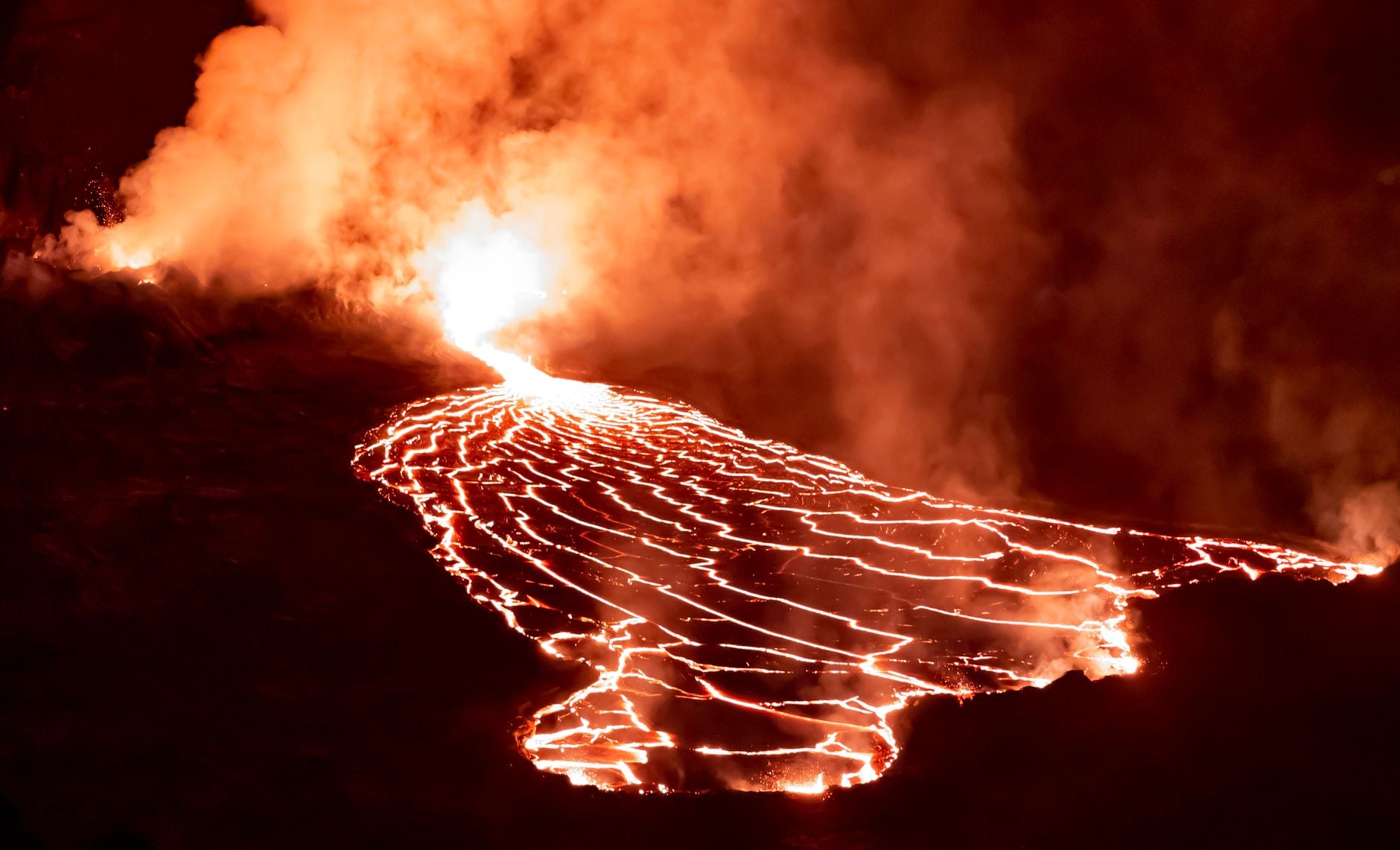
Venus carries what look, at first glance, like river systems across its volcanic plains. They meander, divide around islands and sometimes preserve abandoned bends. One of them, Baltis Vallis, runs for roughly 6,800 kilometres, making it the longest known channel in the Solar System.
Water cannot explain these landforms under present conditions. Venus’s surface is close to 465°C, and its atmosphere presses down at roughly 92 times Earth’s sea-level pressure. The channels, known as canali, are generally understood to have carried lava.
A 2025 study in Science Advances argues that the lava may have been carbonatite: a rare, carbonate-rich melt with unusually low viscosity and a melting temperature only modestly above the Venusian surface. The same eruptions could have released an enormous quantity of carbon dioxide, potentially helping to build the atmosphere that keeps Venus hot today.
The proposal joins two puzzles that have usually been treated separately. Ordinary basalt struggles to travel far enough to carve the longest canali. Basaltic volcanism also struggles to supply the carbon dioxide in the modern atmosphere without requiring a volume of magma larger than the crust itself. Carbonatite is both more mobile and far richer in carbon.
It is an elegant connection, but still a hypothesis. Magellan observed the channels, not the liquid that formed them. No spacecraft has sampled a canale, and no lander has identified a carbonatite rock on Venus. The atmospheric calculation depends on uncertain lava volumes, eruption rates, channel depths and the fraction of carbon that escaped as gas.
The rivers that could not have been rivers
NASA’s Magellan spacecraft arrived at Venus in 1990 and used cloud-penetrating radar to map almost the entire surface. NASA’s mission summary says at least 85 per cent of the planet is covered by volcanic flows. Hidden among those plains are hundreds of channels with several different forms.
The canali are the most river-like. They can display cutoff meanders, delta-shaped deposits, branching reaches and streamlined islands. Their sources and ends are often difficult to identify because younger lava has buried sections and later deformation has tilted the landscape.
Baltis Vallis is the extreme case. JPL announced its discovery in Magellan data in 1991, describing a channel longer than the Nile. Later mapping found that branches can push the measurable system beyond the familiar 6,800-kilometre figure, but that rounded length remains the standard description of its main course.
The resemblance to a river does not make the canale evidence for late surface water. Any oceans proposed for early Venus would have vanished long before the young volcanic plains visible today formed. Under modern surface temperature and pressure, liquid water is impossible.
Its profile offers another clue. A flow hot enough to melt the ground beneath it should gradually cool, reducing thermal erosion downstream and producing a shallower channel. Baltis Vallis maintains a roughly constant depth along much of its extraordinary length. That is more consistent with mechanical erosion: a low-temperature liquid physically scouring and carrying away pieces of solid substrate.
Why carbonatite is so different from ordinary lava
Most familiar lava is silicate-rich basalt. Carbonatite contains abundant carbonate minerals instead. It is rare on Earth, where almost all known carbonatites are preserved as ancient rocks. Ol Doinyo Lengai in Tanzania is the only active terrestrial volcano known to erupt carbonatite lava.
The lava there emerges at roughly 490 to 550°C, unusually cool by volcanic standards and only a few tens of degrees above Venus’s average surface temperature of about 470°C. Fresh natrocarbonatite can be dark and fluid, then turns pale as it cools and weathers.
Calling it “water-thin” is useful shorthand, not a literal equivalence. Carbonatite is not water, and its viscosity changes as it cools and crystallises. The important comparison is with ordinary silicate lava: carbonate-rich melt can be dramatically less viscous, allowing it to run quickly and remain mobile for much longer.
Venus provides an unusual thermal advantage. A basaltic flow radiates heat into surroundings far colder than itself on Earth. A cool carbonatite on Venus would move across ground already close to its melting range, so the environment would draw away heat much less efficiently. A crust could form over the flow and insulate the liquid beneath it.
Lead author Allyson Trussell and her colleagues built a one-dimensional model that coupled cooling, crystallisation, flow and erosion. They tested carbonatite against tholeiitic basalt and komatiite, an especially hot and fluid silicate lava. The model varied flow thickness, channel slope, depth and width, discharge rate and the proportion of the lava covered by crust.
For a representative canale 24 metres deep and three kilometres wide, a six-metre-thick carbonatite flow with ten per cent crust could travel about 620 kilometres on a shallow slope. Under the same assumptions, basalt reached only about 21 kilometres and komatiite about 70.
The Baltis Vallis calculation is deliberately extreme
Reproducing Baltis Vallis demanded exceptional conditions. One successful carbonatite run used a flow about 12.6 metres thick, ten per cent covered by crust, moving down a slope of 0.01 radians at an effusion rate near 2.3 billion kilograms per second. It travelled the required 6,800 kilometres while mechanically excavating a channel about 46 metres deep.
Under those same conditions, basalt reached roughly 490 kilometres and komatiite about 830. Getting basalt all the way through the calculation required flows thicker than 40 metres, more than 90 per cent crust coverage and discharge above 10 billion kilograms per second.
The carbonatite result is therefore not ordinary. Its modelled effusion rate is more than two orders of magnitude above the rates associated with large terrestrial flood-basalt eruptions. The authors describe Baltis Vallis as a feature that may require a “superlative eruption.”
There is a second scale problem. The paper estimates that explaining a feature like Baltis Vallis may require more than 100,000 cubic kilometres of carbonatite magma. Earth has no comparable eruption, and carbonatite makes up only a tiny portion of terrestrial igneous rock.
The comparison does not demonstrate that such an eruption happened. It says that among the three compositions tested, carbonatite reaches the observed distances under less implausible conditions. An extreme result can still be the best available fit while remaining difficult to reconcile with known volcanism.
The same lava could help account for the carbon dioxide
Carbonatites are generally at least 30 per cent carbonate by mass. When they erupt, some carbon escapes as carbon dioxide while the rest remains in solid carbonate minerals. Terrestrial examples release at least about ten per cent of their carbon, but nobody knows how efficiently the process would work beneath Venus’s enormous atmospheric pressure.
The researchers therefore allowed the released fraction to range from ten to 50 per cent. They combined this uncertainty with estimates of canale volume, channel depth and the age of the cratered surface. The target was the roughly 4.6 × 10²⁰ kilograms of extra atmospheric carbon dioxide Venus holds relative to Earth.
In their Monte Carlo calculation, there was a greater than 50 per cent chance that repeated canali-forming eruptions could provide that amount within roughly 550 to 790 million years, depending on whether the representative channel depth was taken as 24, 35 or 46 metres.
This is the basis for saying the eruptions may have released enough carbon dioxide to help transform the planet. It is not a direct inventory of gas trapped in lava, and it does not show that one Baltis Vallis eruption created the entire atmosphere. The result comes from scaling many generations of channels through an assumed resurfacing history.
That scaling could be too generous if canali formed only in restricted regions or during a brief episode. The degassing fraction could also fall outside the tested range under Venusian pressure. Conversely, volcanic processes other than carbonatite eruptions almost certainly contributed some gas.
A possible late catastrophe, not a settled history
The atmospheric calculation matters because the timing of Venus’s greenhouse remains unsettled. Some climate simulations begin with a slowly rotating Venus, shallow water and thick dayside clouds that reflect sunlight. Under those assumptions, temperate surface conditions can persist for nearly three billion years.
SpaceDaily’s earlier look at the habitable-Venus simulations found a genuine divide. The successful ocean scenarios produced temperatures between about 20 and 50°C. A competing model found that day-night cloud behaviour could prevent the initial ocean from condensing at all. Neither set of simulations is a recovered history.
The carbonatite paper does not prove that Venus had an ocean, life or even a clement surface. It offers a way for much of the modern carbon dioxide atmosphere to form during the age represented by the visible surface, rather than being inherited almost unchanged from the planet’s earliest years. That leaves more room for a long temperate interval, but does not establish one.
The proposed climate catastrophe is also multistep. In the authors’ preferred sequence, the gradually brightening Sun first drove a runaway greenhouse, making surface water unstable. Higher temperatures then favoured the melting and remelting of carbonate-rich material. Carbonatite eruptions returned carbon from the crust to the atmosphere and reinforced the new climate.
If oceans once existed, some original carbon could have been stored in carbonate sediments that were later buried. Carbon could instead have come directly from the mantle. Repeated volcanic resurfacing might bury carbonate-rich layers only a few hundred metres to several kilometres, enough for Venus’s high background temperature and crustal heat to melt them again.
That feedback is the paper’s most provocative idea. The surface could become hot enough to encourage a form of volcanism that releases more greenhouse gas, making the changed atmosphere harder to reverse. Yet the first step in the sequence remains the solar-driven greenhouse, not carbonatite acting alone as an instantaneous climate switch.
What is observed, and what remains inferred
The modern end state is not in doubt. As SpaceDaily recently detailed, the atmosphere exerts roughly 92 times Earth’s sea-level pressure and holds the surface near 465°C. Carbon dioxide accounts for about 96.5 per cent of that atmosphere.
The channels are also real, mapped repeatedly in Magellan radar. Their dimensions, bends and crossings with younger terrain can be measured. What remains unknown is their composition, exact age, original flow rate and the physical mechanism that cut them.
Only a handful of landers have analysed Venusian rock, and the Venera 14 and Vega 2 sites produced chemistry broadly consistent with tholeiitic basalt. That does not rule out carbonatite elsewhere. It does establish that a globally basaltic-looking surface cannot simply be relabelled as carbonate-rich.
The age of the surface carries its own uncertainty. The paper uses a mean cratering age near 240 million years and an equilibrium-resurfacing model in which older patches can approach 700 million to one billion years. Other resurfacing histories divide Venus into different episodes and ages. Changing that chronology changes the inferred rate at which canali and atmospheric gas accumulated.
Most importantly, radar morphology is not mineralogy. Magellan could show that a channel is deep, sinuous or partly buried. It could not place a sample in a laboratory and demonstrate that the former liquid contained carbonate.
The next Venus maps can test the idea
The hypothesis produces observations that future missions can pursue. NASA’s VERITAS mission is designed to improve the planet’s global radar and topographic maps by orders of magnitude while using near-infrared measurements to investigate surface composition.
ESA’s Envision orbiter will combine radar, spectroscopy and subsurface sounding. Both missions are currently planned for launch no earlier than 2031, so the decisive evidence is not imminent.
The carbonatite model predicts that canali should maintain relatively constant depths, consistent with mechanical scouring rather than thermal melting. Higher-resolution images should reveal more open-channel features rather than the collapsed roofs expected from lava tubes. Carbonate-rich material or sulfate coatings created by surface weathering may also have distinctive near-infrared behaviour.
Even positive results would require care. Low near-infrared emissivity can have more than one mineralogical cause, and a carbonate signature near a channel would not by itself reconstruct the volume or timing of ancient eruptions. A direct sample would be stronger, but no planned mission is designed to land inside Baltis Vallis.
For now, the 6,800-kilometre scar records an extraordinary flow without identifying what flowed. Carbonatite is a credible way to connect Venus’s longest channels with its carbon dioxide sky, and perhaps with the end of a temperate era. The model makes that history possible. It does not yet make it true.