

A radio signal leaves Earth at the fastest speed nature permits and still arrives at Mars minutes late. When the planets are relatively close, the crossing takes about three minutes. At the far end of their changing geometry, it takes roughly 22 minutes.
The same delay applies on the way back. At maximum separation, a question can spend around 22 minutes travelling to Mars and an immediate answer another 22 minutes returning. The resulting 44-minute exchange is an idealised minimum that assumes nobody pauses to think.
Nothing is malfunctioning during that wait. Radio waves move at the speed of light, just under 300,000 kilometres per second in a vacuum. Earth and Mars are simply far enough apart for even light to make distance visible.
Near solar conjunction, delay is no longer the only problem. The Sun sits close to the radio path, its charged outer atmosphere can corrupt transmissions, and mission teams may stop sending commands altogether. Mars communication then changes from a slow conversation into a planned period of silence.
The three-to-22-minute range follows the orbits
Earth circles the Sun once every year. Mars requires about 687 Earth days. Because the planets move at different rates, the distance between them continually expands and contracts rather than staying at the tidy spacing shown in many Solar System diagrams.
NASA’s Mars Relay Network guide gives a range from about 54.6 million kilometres, corresponding to roughly three minutes of light time, to about 400.2 million kilometres, corresponding to 22.4 minutes. The title’s three and 22 minutes are those values rounded for clarity.
These endpoints describe the broad Earth-Mars geometry. A particular spacecraft may be travelling to Mars, orbiting it, sitting on the surface or following a different trajectory, so its actual one-way light time must be calculated for its position at that moment.
The shortest distance also does not recur at precisely the same value on every close approach. Both planetary orbits are elliptical, and Mars encounters Earth at different points along them. The operational lesson is the range, not one permanently correct delay.
Forty-four minutes is only the time spent travelling
Doubling 22 minutes gives the familiar 44-minute round trip. Using NASA’s more precise 22.4-minute upper figure would make it 44.8 minutes. In both versions, the calculation includes signal propagation only.
A real exchange takes longer. The receiver must detect and decode the message. A person may need to inspect data, discuss options or perform a task before composing an answer. Communications systems then package and schedule the return transmission.
This is why a live voice call cannot work in the familiar sense. Two people would repeatedly talk across each other or wait tens of minutes for each response. Recorded messages, carefully structured updates and asynchronous conversations are more realistic.
The delay also exposes an important distinction between latency and bandwidth. A larger antenna, more transmitter power or a laser link may carry more bits per second. None can deliver the first bit sooner than light can cross the intervening distance.
Most rover data takes a two-step journey
Mars rovers can communicate directly with Earth, but doing so at useful data rates would require large, power-hungry radio equipment. Instead, they usually send science and engineering data over a shorter link to a spacecraft passing overhead.
The current Mars Relay Network uses orbiters including Mars Odyssey, Mars Express, Mars Reconnaissance Orbiter and the ExoMars Trace Gas Orbiter. Their larger antennas and greater available power make them effective couriers between the surface and Earth.
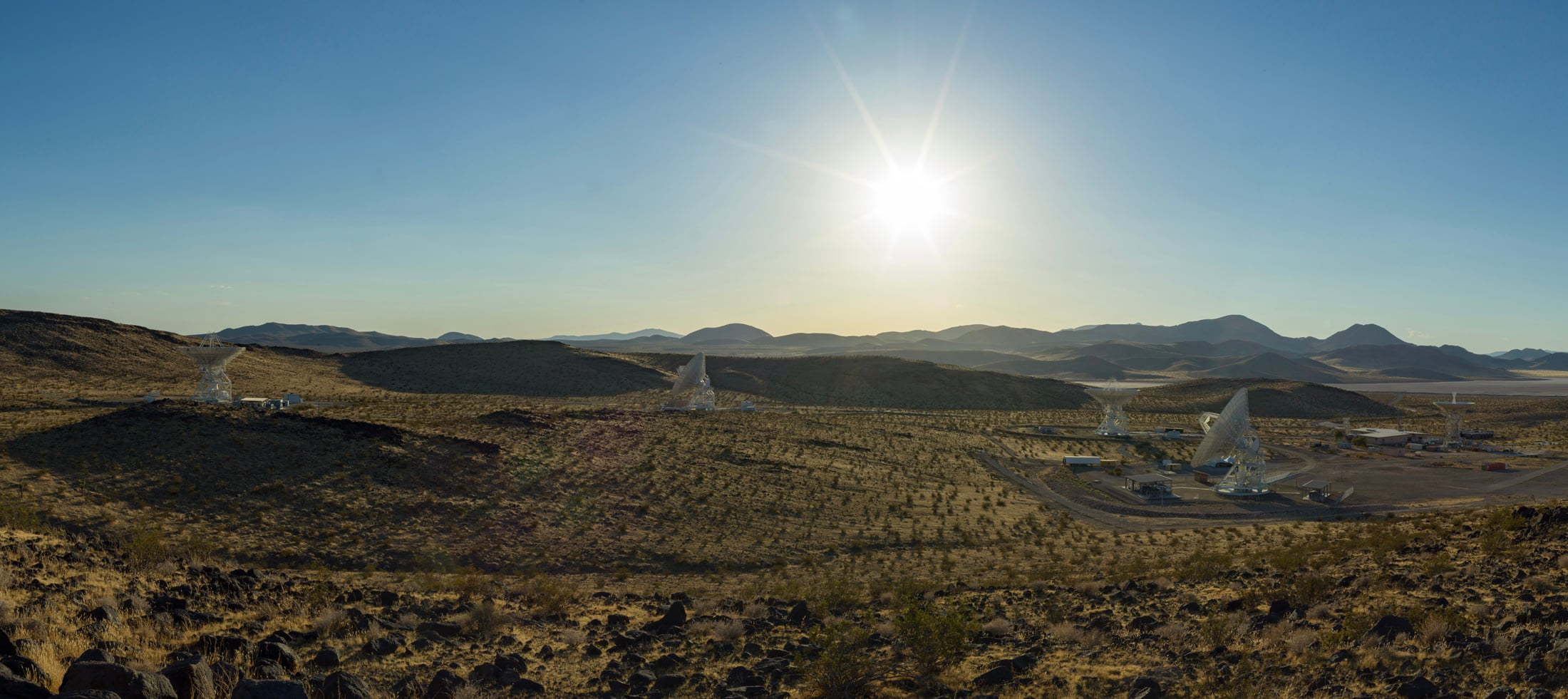
The orbiter then transmits through interplanetary space to ground antennas. NASA’s Deep Space Network has complexes near Goldstone in California, Madrid in Spain and Canberra in Australia. Their global spacing lets the network follow missions as Earth turns.
New hardware expands capacity rather than changing light time. Deep Space Station 23 entered operation at Goldstone in August 2026, adding a 34-metre multi-frequency dish to a network supporting missions from Mars Reconnaissance Orbiter to Voyager 1.
Relaying also adds scheduling realities. A rover waits for an orbiter to rise above its horizon, the orbiter may store the data before pointing towards Earth, and a ground station needs an assigned pass. The end-to-end delivery time can therefore be longer than the pure Mars-Earth light time.
Solar conjunction is interference, not extra distance alone
About every 26 months, Earth and Mars occupy nearly opposite sides of the Sun. From Earth, Mars appears close to the Sun in the sky. Astronomers call this geometry Mars solar conjunction.
This is also near the long-delay end of the cycle because the planets are widely separated. But distance is not what forces the communications pause. The direct radio path passes close to the Sun and through its extended corona, a restless plasma of electrons and ionised gas.
That plasma changes the speed and phase of parts of a radio wave, causing scintillation and other distortions. The effect worsens as the Earth-Sun-spacecraft angle shrinks. If the line runs through the solar disc itself, there is no usable direct path.
NASA’s conjunction guidance emphasises the difference between downlink and uplink risk. Gaps in science data can often be corrected by retransmitting the missing packets later. A command damaged on its way to a spacecraft could be misunderstood and produce unsafe behaviour.
Mission controllers therefore impose a command moratorium around the riskiest geometry. Its exact duration varies with the spacecraft, radio system, operating frequency and safety rules. It is more accurate to describe conjunction as a period of degraded or suspended direct communication than as one universal blackout with fixed dates.
Robots are prepared before Earth goes quiet
Conjunction does not arrive without warning. Orbital motion predicts it years in advance, so teams prepare conservative command sequences and upload them before the radio geometry deteriorates.
A rover may park on stable ground, stop driving and avoid complex use of its robotic arm. It can perform limited observations, monitor its systems and store results. Orbiters can continue selected science and collect relay data, although transmission plans differ from mission to mission.
The machines do not need Earth to approve every routine action. Fault-protection software can place hardware into a safe configuration if readings leave expected limits. Simple health tones or limited telemetry may still get through when high-rate communication is unreliable.
Once Mars has moved far enough from the Sun in Earth’s sky, engineers re-establish commanding, assess spacecraft health and download stored data. The pause is disruptive, but years of robotic operations have turned it into a managed part of the mission calendar.
A crewed Mars mission cannot copy the rover playbook
Robots can be told to reduce activity for a fortnight. A human crew still has to maintain life support, care for injuries, manage power and continue daily work. A serious leak, fire or medical emergency cannot wait for Earth to enter the decision loop.
NASA’s Moon to Mars architecture paper on communication disruption treats blackouts and delays as unavoidable design conditions. Its representative mission profiles produced one-way delays above 20 minutes and conjunction blackouts of about 13 days in a long-stay scenario and roughly three weeks in a short-stay scenario.
Those durations are examples, not schedules for every future expedition. They depend on trajectory and on the angular distance from the Sun at which a chosen communications system becomes unreliable. The paper’s broader conclusion is harder to vary: crew and vehicle autonomy must be designed in from the beginning.
Astronauts will need deeper maintenance knowledge, stronger onboard medical capability and permission to act without immediate approval. Mission control will remain valuable for long-range planning, diagnosis and specialist analysis, but it cannot supervise moment-to-moment activity as it does in low Earth orbit.
Faster onboard computers address decisions, not delay
Autonomy does not mean abandoning human judgement to an unrestricted machine. It means giving crews and spacecraft tools that can interpret local data, recognise hazards, present options and carry out bounded responses while Earth is absent from the loop.
SpaceDaily recently examined NASA’s High Performance Spaceflight Computing processor, whose early tests point to a large increase over current radiation-hardened spacecraft chips. That processing headroom could support terrain analysis, fault detection and data triage aboard future vehicles.
The distinction is worth keeping clear. A faster processor can shorten the time between a sensor detecting a hazard and the spacecraft responding. It cannot shorten the 22 minutes required for Earth to learn that the hazard existed.
Human procedures matter just as much. Messages from Earth must include context and anticipate likely follow-up questions. Reports from Mars need enough diagnostic detail for ground specialists to work without a live exchange. Crew schedules must assume that advice arrives late or not at all.
Relays can route around the Sun, but not around physics
A relay spacecraft positioned away from the Earth-Sun-Mars line could forward signals around the most disruptive conjunction geometry. NASA’s architecture work notes that relays may mitigate blackouts, and future networks could place communications assets where they maintain a safer angle from the Sun.
That solution carries costs. Relays must be launched, powered, maintained and given reliable links of their own. The indirect route is longer, and every extra handoff introduces equipment and scheduling that can fail.
Optical communications offer another improvement. Lasers can support much higher data rates with narrower beams, making it possible to return more imagery and scientific information. They remain limited by light speed, precise pointing and line of sight, and a direct optical beam cannot pass through the Sun either.
No engineering advance removes the basic travel time. A network can make communication more available, carry more information and recover better from interruption. It cannot make Earth and Mars local to one another.
Life on Mars would run without a live Earth
The three-to-22-minute delay is often presented as a curious fact about planetary distance. Operationally, it decides who must have knowledge and authority at Mars, which failures a vehicle must handle alone and how families could speak with people living on another world.
At the near end, a reply cannot arrive for about six minutes even under the impossible assumption of an instant response. At the far end, the same minimum becomes roughly 44 minutes. Near conjunction, there may be no dependable direct reply at all.
Communication would resemble a chain of complete messages rather than a flowing conversation. Questions would need to be asked carefully. Answers would have to anticipate what comes next. Silence would sometimes mean orbital geometry, not danger.
Mars is close enough for people on Earth to remain involved, but too far away for them to remain in control of every moment. The radio delay is the boundary that turns a distant expedition from remote operation into a genuinely independent human presence.