

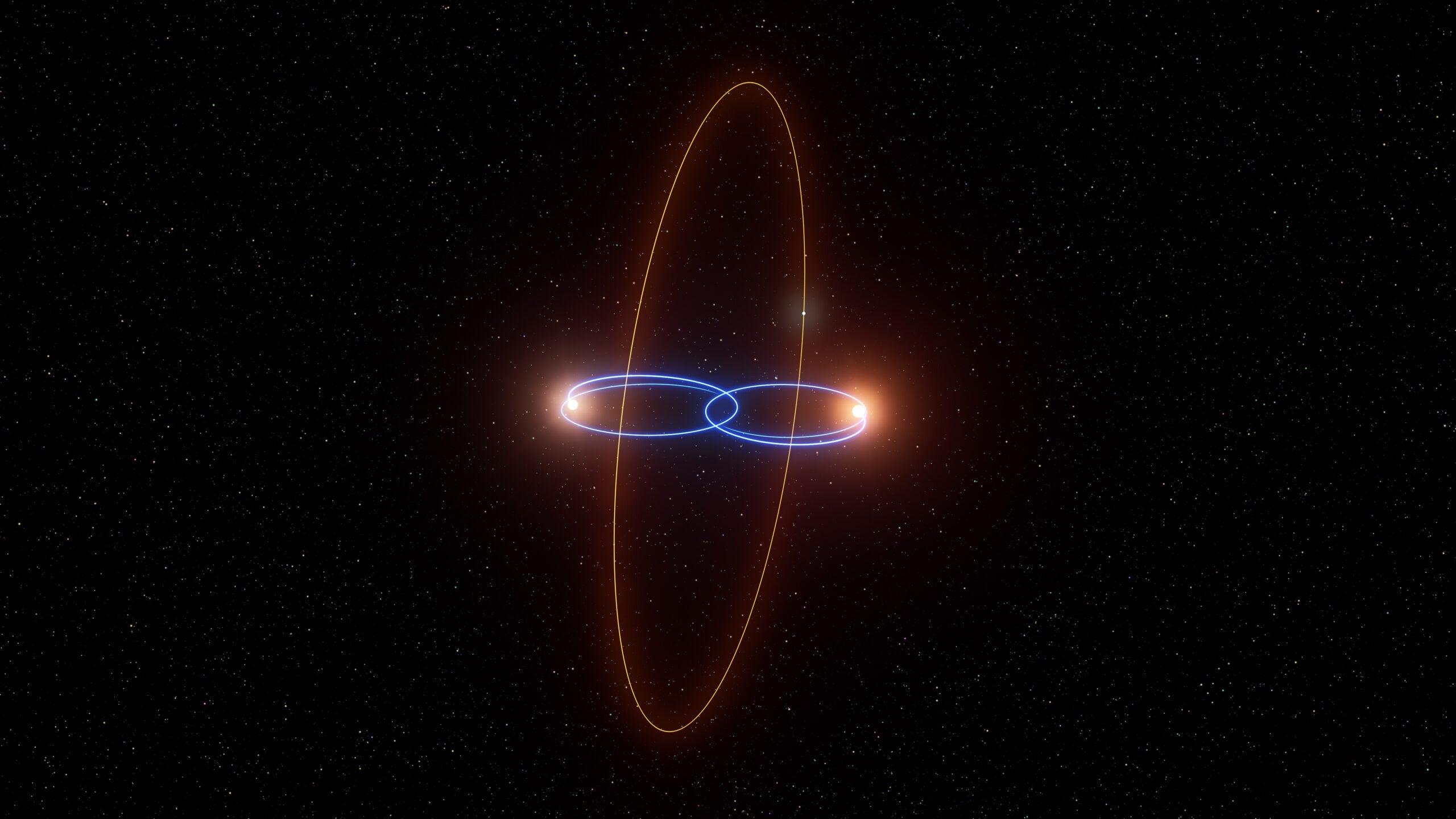
The picture was wonderfully strange: two young brown dwarfs circling one another in a flat, eccentric orbit while a planet looped over both poles, its path turned almost exactly sideways. Nothing like it had been confirmed around a binary. In April 2025, astronomers reported that a system called 2M1510 might contain the first example.
But no telescope had photographed the planet, watched it transit or measured a regular wobble caused directly by its gravity. The proposed world was the explanation for a much subtler result: the elongated orbit of the two brown dwarfs appeared to be turning backwards.
A later analysis found that the signal may have been created by inconsistent timestamps in the Doppler data. After correcting those times, the backward rotation disappeared. The polar planet is therefore not a confirmed discovery. It is a striking candidate whose only supporting signal may have been a clock error.
A rare binary before any planet entered the story
2M1510, short for 2MASS J15104786-2818174, lies about 120 light-years away. Its central pair consists of two young brown dwarfs, objects more massive than giant planets but too light to sustain the hydrogen fusion that powers ordinary stars. Each member is close to 35 times Jupiter’s mass.
The pair is valuable even without a planet. The two bodies travel around their common centre of mass every 20.9 days on an orbit with an eccentricity of about 0.36. From Earth, the geometry allows one brown dwarf to eclipse the other, making 2M1510 one of only two known bona fide eclipsing double-brown-dwarf systems when it was characterised.
Eclipses give astronomers unusually direct information about radii and orbital inclination. Spectral lines from both brown dwarfs also shift back and forth as they orbit, allowing their masses to be measured. These systems help calibrate evolutionary models used for brown dwarfs and young giant planets that cannot be weighed so cleanly.
A third brown dwarf, 2M1510 C, lies about 250 astronomical units from the inner pair in projection. It is gravitationally associated with the system, but the 2025 discovery team concluded that it was much too distant to produce the particular orbital change they measured.
The 2025 signal was not light from a planet
Thomas Baycroft and colleagues used archival and newly collected radial velocities from UVES, the high-resolution spectrograph on the European Southern Observatory’s Very Large Telescope. Their paper in Science Advances refined the motion of both brown dwarfs and reported that a model allowing the orbit to precess fitted better than a fixed Keplerian orbit.
Apsidal precession is a rotation of an orbit within its own plane. Imagine the ellipse traced by the binary slowly turning so that the direction of closest approach changes over time. General relativity, tidal distortion, rotation and the pull of another body can all contribute.
The unusual part was the direction. The analysis produced a precession rate of minus 343 arcseconds per year, with an uncertainty of 126 arcseconds. In other words, the line of apsides appeared to turn backwards. The authors placed the probability of a negative rate at 99.7 per cent in their model.
The team did not find the proposed planet’s own Doppler signal. Instead, it reasoned that familiar effects should push the binary’s apsides forwards, while a third body in a nearly polar orbit could drive them backwards. After testing alternatives, the researchers interpreted the precession as evidence for 2M1510 (AB) b. The ESO announcement described it as credible evidence, while the original SpaceDaily report captured the importance of the proposed geometry.
Why a polar orbit made dynamical sense
Most circumbinary planets discovered so far travel roughly in the same plane as their two host stars. That alignment reflects a common origin in a broad, rotating disc of gas and dust. A planet moving at nearly 90 degrees looks improbable by comparison, but it is not dynamically forbidden.
For an eccentric binary, a sufficiently tilted circumbinary orbit can settle into a stable state around the binary’s eccentricity direction. Rather than precessing around the binary’s angular-momentum axis like an aligned planet, the tilted orbit can librate around a polar configuration.
Astronomers had already observed the likely raw material for such systems. In 2019, ALMA revealed a gas-and-dust disc around the binary HD 98800 B oriented close to perpendicular, a result covered by SpaceDaily’s report on the first confirmed polar circumbinary disc. Theory therefore had a formation route and a stable endpoint. What it lacked was an identified planet occupying one.
The 2M1510 geometry also explained why the candidate did not announce itself by more familiar means. The brown dwarfs eclipse, so their mutual orbit is seen nearly edge-on. A planet travelling perpendicular to that plane would be seen closer to face-on, producing little line-of-sight reflex motion and no likely transit across the pair.
The mass and period were never separately measured
The inferred precession constrained a relationship between the planet’s mass and orbital period, not a unique value for either. If the world orbited close to the inner stability boundary with a period near 100 days, the models allowed a mass of roughly ten Earths. A period near 400 days could instead correspond to about 100 Earth masses.
That range spans very different kinds of planets. It was not an estimate with ordinary error bars around one known solution. It was a wedge of possible combinations capable of producing the proposed torque on the binary.
This evidentiary boundary distinguishes 2M1510 from a planet whose light has been separated from its hosts. A more recent SpaceDaily feature on HD 143811 AB b, for example, discussed repeated images of a circumbinary planet at several epochs. Here, the world existed only as one explanation for an evolving binary orbit.
TESS established a different clock
Later in 2025, Seb Millward and Vedad Kunovac approached the system through photometry rather than Doppler shifts. They analysed full-frame images from NASA’s Transiting Exoplanet Survey Satellite across four observing sectors spanning seven years. The combined light curve contained a periodic eclipse signal stronger than ten sigma.
Their paper in Monthly Notices of the Royal Astronomical Society: Letters measured the binary period as 20.897782 days, with an uncertainty of 0.000036 day, or about three seconds. That sharply refined the earlier photometric ephemeris and reduced the uncertainty in predicting a present-day eclipse from roughly 18 hours to eight minutes.
The Doppler study underlying the planet claim had found 20.907495 days. The difference was only about 14 minutes per orbit, but the quoted uncertainties made it a 110-sigma disagreement. Across many cycles, a small period error compounds into a large shift.
The conflict was visible in an observation that predated both papers. When Millward and Kunovac propagated the Doppler solution backwards, it placed the known 2017 SPECULOOS eclipse 13.5 hours later than the time at which the eclipse had actually been observed.
Twenty-two timestamps carried a half-day mismatch
The later team then reconstructed the velocity analysis using the epochs published with the UVES measurements. They could reproduce the negative precession when they used those times. The concern emerged when they compared the table with the raw observations in the ESO archive.
Twenty-two of the 33 published epochs were recorded in Modified Julian Date even though the column identified them as Barycentric Julian Date. The conventions differ in several ways, but the immediate bookkeeping problem here was a 0.5-day offset. The team also converted the UTC observations to the appropriate barycentric time standard and shifted each epoch to the middle of its exposure.
With consistent timestamps, the same kind of orbital fit no longer showed evidence for apsidal precession. That matters because the polar planet had not been detected independently. Remove the backwards precession and the observation that required the planet vanishes with it.
The episode is a useful reminder of how time enters precision astronomy. A spectrograph records velocities, but those velocities are interpreted at exact positions along an orbit. Mix time conventions across years of data and ordinary orbital motion can resemble a slow change in the orbit itself.
The reanalysis weakens the planet without proving absence
It would be too simple to say that correcting one column produced a clean, final solution. The corrected radial velocities still fitted poorly. To make the residuals behave statistically, the later team had to inflate the velocity uncertainties by about 0.6 kilometres per second, roughly an order of magnitude above the quoted errors.
When they forced the model to respect the new photometric period and eclipse time, the additional scatter needed rose to about four kilometres per second. Possible causes include incomplete corrections to the published velocities, calibration drift or sensitivity to how spectral lines from the two brown dwarfs were modelled.
Millward and Kunovac therefore used careful language. They concluded that the existing data did not indicate a circumbinary planet and that 2M1510 (AB) b may be a false positive. They also said their correction should be checked by recomputing the radial velocities from the spectra with consistent timestamps and a fuller treatment of uncertainty.
That is why “unconfirmed” is more accurate than either “discovered” or “disproved”. The original evidence has a plausible data-level explanation, and the published velocity solution cannot presently be reconciled with the eclipses. A planet could still exist in the system, but the current observations do not require this one.
The idea of polar planets survives the candidate
A false positive would not make polar circumbinary planets impossible. The orbital mechanics were developed independently of 2M1510, polar planet-forming discs have been observed, and simulations published after the candidate announcement showed how a disc around a brown-dwarf binary could evolve toward polar alignment.
Nor would it make the 2025 analysis pointless. The original team identified an apparent dynamical signal and laid out a testable configuration. The later team brought in an independent seven-year photometric record, found a contradiction, traced much of it to time handling and defined what must be reprocessed. That sequence is science correcting the strength of a claim as new constraints arrive.
The system itself remains unusually valuable. Accurate eclipse timing can reveal whether the binary’s orbit changes over longer baselines. New high-resolution spectra can test whether any precession remains after the timestamps and velocity uncertainties are handled consistently. Astrometry may eventually constrain an unseen companion’s orbit, while observations with Webb or other photometric facilities could refine the eclipse clock further.
What confirmation would now require
The first task is a complete re-reduction of the UVES spectra from raw files, using one time standard, mid-exposure epochs, updated barycentric corrections and uncertainty terms that account for calibration and spectral modelling. If a retrograde precession remains, it should appear coherently in new velocity measurements collected over a longer baseline.
Independent evidence would make the case much stronger. Repeated eclipse-timing variations could reveal the gravitational influence of a third body. Precise astrometry could detect motion of the binary around the wider system’s centre of mass. Either method could begin to separate the candidate’s mass from its orbital period instead of leaving both on a broad curve of possibilities.
Until then, the ESO illustration of a golden polar loop crossing the blue orbit of two brown dwarfs should be read literally as an artist’s reconstruction of a proposed configuration. It is not an image of the planet and no such planet has yet been confirmed.
The extraordinary world may still be there. But the observation that once made it seem necessary may have started with two clocks set half a day apart.