

The modern scientific search for life beyond Earth began with instruments modest enough to feel almost intimate. In 1960, Frank Drake pointed an 85-foot radio telescope at two nearby stars and listened through a single narrow receiver. The experiment found no interstellar transmission. Sixty-six years later, the instruments have changed almost beyond recognition, but the final answer has not.
NASA’s public position remains unambiguous: it has found no credible evidence of extraterrestrial life, and no evidence that unidentified anomalous phenomena are extraterrestrial. That statement does not mean the universe is lifeless. It means that no claim has yet crossed the line from an intriguing observation to a confirmed biological or technological detection.
Three kinds of fragment show why that line is so difficult to cross. Perseverance has examined a Martian rock with a potential biosignature. Webb has measured disputed chemistry in the atmosphere of a planet 124 light-years away. Governments have accumulated thousands of reports about events that observers could not immediately identify. Each fragment is worth studying. None currently answers the question people most want it to answer.
The modern search began with two stars
Project Ozma is a useful place to start the clock behind “nearly 70 years”. From April to July 1960, Drake’s team at Green Bank listened for six hours a day toward Tau Ceti and Epsilon Eridani, both about 11 light-years away. The receiver swept a band around the 1,420-megahertz line of neutral hydrogen, chosen as a frequency another technological civilisation might also recognise.
An early alert was probably aircraft radar. Otherwise, the loudspeaker produced static and the chart recorder drew no meaningful feature. It was a tiny search by current standards, but it established the basic discipline: choose a plausible signal, observe, test interference and report the null result.
Later surveys covered far more sky, bandwidth and signal types. The scale can sound exhaustive when described by raw numbers. As SpaceDaily’s account of SETI@home explained, volunteer computers processed about 12 billion threshold events before a decade of filtering reduced the data to roughly 100 sky positions worth another look. Those billions were not billions of possible alien messages. Most were radio interference, statistical fluctuations or other products of an instrument listening from a noisy technological planet.
Even the largest search samples only a sliver of the possible combinations of sky position, frequency, time, signal shape and transmitter power. A civilisation could be quiet, use a method not being monitored, transmit in another direction or exist millions of years out of step with the brief era in which Earth can listen.
A detection is not yet a confirmation
The word “evidence” covers several levels that are easily collapsed in public discussion. A detector may register a feature. Researchers may show that the feature resembles a molecule or process associated with life. They must then ask whether the feature is real, whether the identification is unique and whether geology, chemistry, contamination or technology can explain it.
A biosignature is therefore not a synonym for an organism. NASA defines a potential biosignature as a substance or structure that might have a biological origin but requires more evidence before a conclusion can be reached. A technosignature has the same logic: it is an observable sign that could reveal technology, not any unexplained event by default.
Confirmation would demand convergence. Independent instruments should recover compatible results. Alternative explanations should be actively tested rather than merely overlooked. The evidence must fit its environment, because a molecule produced by life in Earth’s oceans may have a different source in a hydrogen-rich atmosphere, and a light moving strangely in a compressed video may move normally once range and camera motion are known.
The Martian rock is a serious candidate, not a biological sample
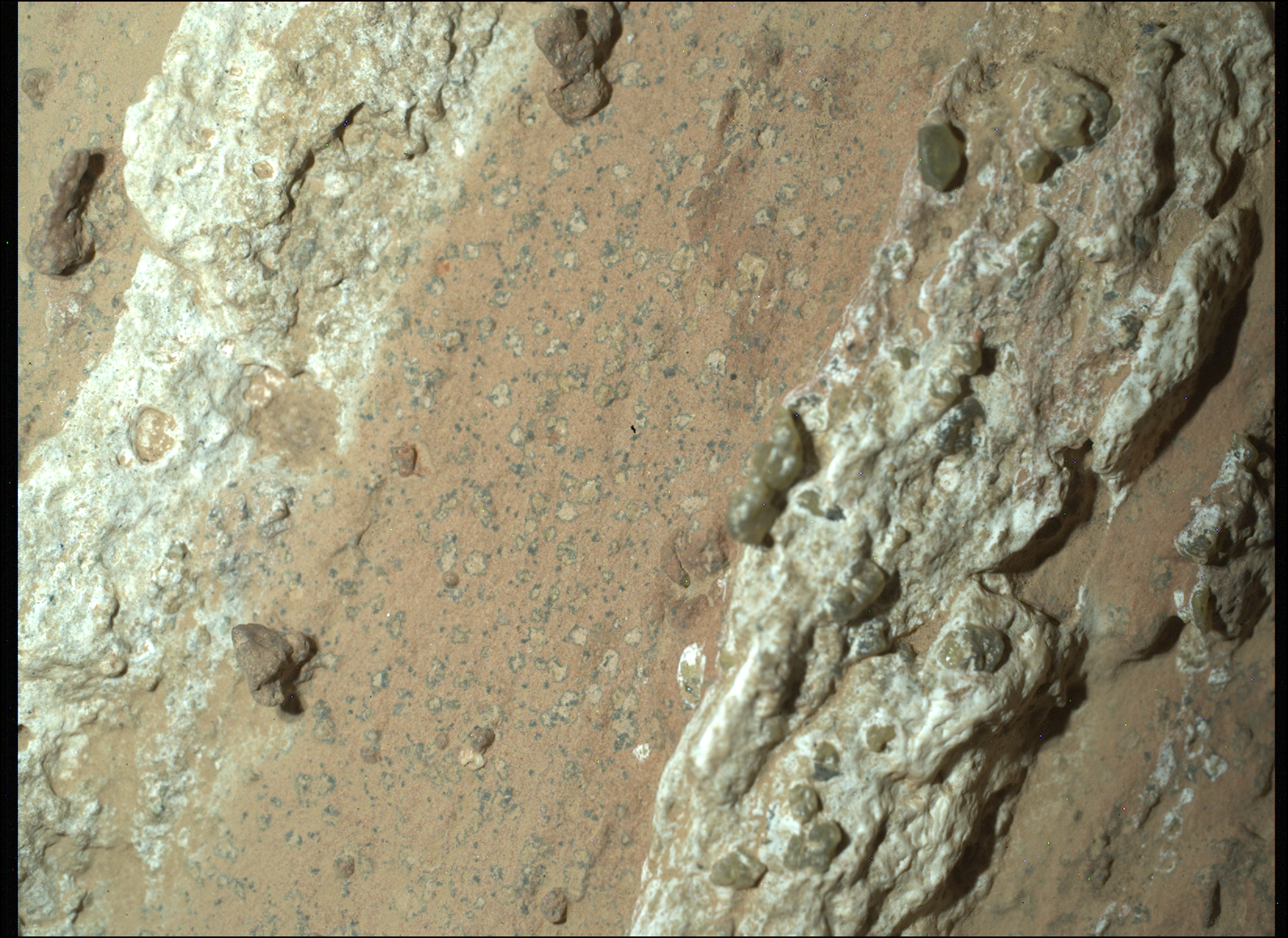
The most tangible of the current fragments sits inside a sealed tube on Mars. Perseverance drilled the Sapphire Canyon core from a rock called Cheyava Falls in Jezero Crater in July 2024. The rock formed in an ancient river-valley setting and contains fine clay and silt, organic carbon, sulphur, oxidised iron and phosphorus.
In a 2025 peer-reviewed analysis in Nature, the rover team described millimetre-scale reaction fronts nicknamed leopard spots. Instrument data were consistent with two iron-rich minerals, vivianite and greigite, arranged where electron-transfer reactions had occurred between sediment and organic matter.
That combination matters because related reactions on Earth can support microbial metabolisms, and microbes can participate in the formation of these minerals. The wet sedimentary setting could also preserve traces of ancient life. NASA consequently described Sapphire Canyon as Perseverance’s best candidate for signs of ancient microbial processes.
But the minerals can form without biology. Heat, acidic conditions and reactions involving organic compounds offer abiotic routes, and the rover cannot reproduce the range of microscopy, isotope measurements and controlled experiments available in an Earth laboratory. SpaceDaily’s earlier examination of Cheyava Falls reached the necessary boundary: this is a compelling pattern in a habitable context, not a fossil, cell or confirmed product of metabolism.
At 124 light-years, chemistry is reconstructed from starlight
K2-18 b is more remote in every sense. The planet is about 124 light-years away, roughly 2.6 times Earth’s radius and 8.6 times its mass. It orbits in the conventional habitable zone of a cool red dwarf, but that does not establish an ocean or a surface where familiar life could live.
Webb observes the planet during a transit. As K2-18 b crosses its star, a small amount of starlight filters through the upper atmosphere. Researchers measure minute changes with wavelength and compare them with models of which gases could have absorbed the missing light. Webb is not collecting alien air, and its spectrum does not directly reveal conditions deep below the atmosphere.
A 2023 analysis found strong methane and reported a lower-confidence hint of dimethyl sulphide, or DMS. A second study in 2025 used mid-infrared data and reported an approximately three-sigma preference for DMS and/or dimethyl disulphide. DMS drew attention because Earth’s atmospheric supply is closely associated with marine microbes, although that connection does not make it an exclusive product of life everywhere.
Independent analyses weakened the claim. One team processed the near-infrared observations through many pipeline and model combinations and found methane but no reliable statistical evidence for DMS. Other researchers showed that wavelength grouping, instrumental systematics and a wider library of possible molecules could materially change the result. The episode is covered in detail in SpaceDaily’s earlier K2-18 b overview.
The disputed chemistry is therefore a fragment twice removed. The first question is whether the sulphur-bearing gases are present. Only after that would researchers ask how they formed. Even a secure detection of DMS would not by itself demonstrate an ocean, a habitable climate or biology.
Thousands of UAP reports ask a different question
UAP reports belong to another evidence category altogether. They concern events observed in Earth’s atmosphere, oceans or nearby space, often through human testimony or sensors designed for defence rather than scientific measurement. “Unidentified” describes the status of an observation. It does not describe the origin of an object.
The historical volume is undeniably measured in thousands. According to the US National Archives, Project Blue Book collected 12,618 sightings between 1947 and 1969, leaving 701 categorised as unidentified. More recently, the All-domain Anomaly Resolution Office, or AARO, held 1,870 reports as of 30 May 2025. Those counts come from different programmes and should not be added into one clean statistical series, but they show how many reports can accumulate without producing an extraterrestrial conclusion.
AARO’s latest annual report received 319 cases and resolved 114 of them, while also closing 256 older cases. All 370 resolutions involved ordinary objects or events, including balloons, satellites, birds, aircraft, drones, one rocket launch and one manned jet pack. The office moved 191 new reports into an active archive because the available data were insufficient and sent nine for deeper intelligence, scientific or technical analysis.
Insufficient data can preserve an unknown indefinitely. A sincere witness may not know distance or speed. A short infrared clip may lack original metadata. A bright satellite flare can appear to move or hover in surprising ways. AARO resolved 238 older reports as satellite flaring after adding three-dimensional modelling, an unusually clear example of better analysis converting mystery into identification.
This does not make UAP investigation pointless. An unidentified event near an aircraft can represent a flight hazard, a drone, foreign surveillance or a sensor problem even if it has nothing to do with extraterrestrial life. It does mean that volume is not proof, a distinction also central to SpaceDaily’s coverage of recent Pentagon UAP releases.
Why the fragments resist simple answers
All three cases suffer from limited access, but in different ways. Cheyava Falls is a physical sample from a once-wet environment, yet the most capable laboratory is millions of kilometres away. K2-18 b is observed as a tiny modulation in the light of a star, so noise and model assumptions can imitate chemistry. UAP records concern nearby events, but many were not collected with the calibration, metadata and repeatability a controlled scientific observation would require.
The limitations create three distinct risks. Mars can preserve non-biological chemistry that looks suggestive in a life-friendly setting. Exoplanet retrievals can prefer a molecule because the tested model library is incomplete. UAP cases can remain unresolved because essential measurements were never taken. Calling all three “evidence for aliens” erases the very information needed to judge them.
The fragments also invite a common human shortcut. Once an observation fits a hoped-for story, every remaining uncertainty can feel like an empty space waiting for that story. Science treats the empty space differently. It asks what additional observation would distinguish the proposed explanation from its rivals.
A null result is not an empty result
Nearly 70 years without confirmation sounds like a verdict only if the search is assumed to have been complete. It has not been. Radio SETI has examined a small portion of a vast parameter space. Mars rovers have sampled a few locations on one planet. Webb has begun atmospheric studies of worlds whose signals sit near the limits of its instruments. Ocean worlds such as Europa and Enceladus have not yet been sampled directly for life.
Null results still narrow the possibilities. A silent radio survey constrains certain transmitters at certain times and frequencies. A disputed spectrum exposes which systematics must be controlled in the next observation. An ordinary explanation for a UAP helps investigators recognise the same optical or orbital effect in future reports.
Nor does the absence of confirmed life support the opposite claim that Earth is alone. Detection and prevalence are different questions. A search may fail because life is rare, because technology is brief, because the target is wrong or because the instrument is not yet sensitive to the signal that exists.
What genuine confirmation would look like
On Mars, confidence would rise if multiple independent lines of evidence converged on biology: diagnostic microscopic structures, distinctive isotope patterns, complex organic distributions and a geological context that excludes plausible abiotic formation. Bringing a well-documented sample into a controlled laboratory would allow tests Perseverance cannot perform, although contamination control would remain essential.
For an exoplanet, repeat spectra across instruments and transits would need to recover the same molecular features. Researchers would then have to show that the gases coexist in quantities difficult to maintain without biology under a physically credible model of the planet. One molecule, especially one inferred near the noise floor, is unlikely to carry the conclusion alone.
A technological signal would need equally strong provenance. A radio transmission might repeat from the same point on the sky, show structure inconsistent with natural emission and survive checks against terrestrial and satellite interference. A UAP case would need calibrated multi-sensor data, precise geometry and a documented chain of custody before extraordinary performance could even be established. Extraordinary motion inferred from an underdetermined image is not yet extraordinary technology.
The careful answer in 2026 is therefore less dramatic than either certainty. Humanity has not confirmed extraterrestrial life, and it has not shown that life is absent beyond Earth. It has a Martian sample worthy of better tests, an exoplanet spectrum teaching astronomers how fragile remote biosignatures can be, and a large archive showing that an unresolved observation is not an identified alien craft.
The answer still arrives only in fragments. The task is not to dismiss them, and not to assemble them into a conclusion too soon. It is to keep asking which fragment survives the next measurement.