

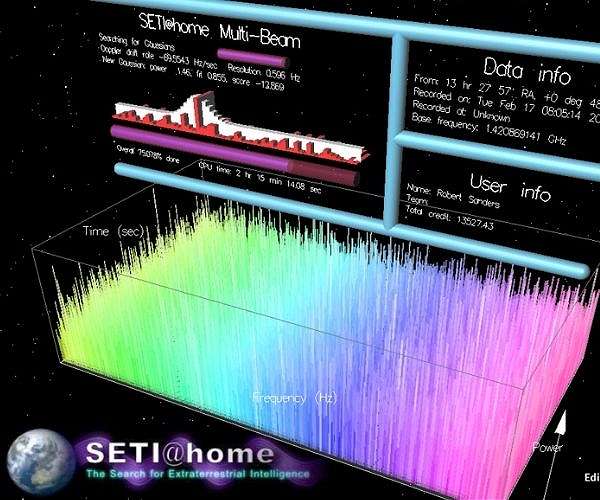
For 21 years, a global network of ordinary computers performed an extraordinary amount of radio astronomy. From 1999 until SETI@home stopped distributing new work in 2020, millions of volunteers let UC Berkeley use idle processor time to examine recordings from radio telescopes for signs of technology beyond Earth.
The software returned about 12 billion detections. A decade-long back-end analysis then compressed that mountain into roughly a million candidate groups, a manually reviewed top tier and about 100 sky locations and frequency ranges judged worth observing again.
The scale is impressive, but the language needs discipline. Those 12 billion detections were not 12 billion possible alien messages. The final hundred are not a list of suspected extraterrestrial transmitters. They are the small residue of an experiment designed to notice faint, unusual patterns inside a radio environment dominated by noise and human technology.
A virtual supercomputer assembled through dial-up internet
SETI@home began when personal computers were much slower and many volunteers connected to the internet by modem. The project divided telescope recordings into small work units, sent them to participants and received compact result files after each computer finished its calculations.
The idea was distributed computing: a large problem could be split among machines that would otherwise be idle. UC Berkeley initially estimated whether the project could do useful science with 50,000 volunteers. It soon had around a million, and within a year about two million people had joined.
SpaceDaily marked the project’s tenth anniversary in 2009, when 140,000 active participants and 235,000 computers were still processing Arecibo data. By then graphics processors were joining central processors, making some work run about ten times faster.
The infrastructure outlived the original search. David Anderson developed the Berkeley Open Infrastructure for Network Computing, or BOINC, so volunteers could donate time to many projects. BOINC has since supported research on protein folding, pulsars, gravitational waves and particle collisions.
Arecibo listened while doing other astronomy
Most SETI@home data came from the 305-metre Arecibo radio telescope in Puerto Rico. The SETI receiver often operated commensally, recording signals while other astronomers controlled where the dish was looking for their own research.
That arrangement gave the project enormous sky coverage without requiring exclusive telescope time. Over 14 years of primary data collection, nearly the entire sky visible from Arecibo was observed. Each accessible area was seen at least a dozen times, while some were revisited hundreds or thousands of times.
The trade-off was control. SETI@home could not choose every target, frequency or observing cadence. Its strongest result therefore applies to the sky and signal types that Arecibo happened to cover with the relevant receivers, not to every possible extraterrestrial technology.
The telescope collapsed in 2020, the same year SETI@home entered hibernation. The archive nevertheless remained scientifically alive. The project had finished the volunteer front-end computation, but it had not yet completed the harder task of deciding what the billions of returned detections meant.
What one of the 12 billion detections actually was
UC Berkeley’s January 2026 account of the completed analysis defines a detection as a momentary excess of energy at a particular frequency from a particular sky position. It is a software event, not an interpretation.
The SETI@home front end searched for five broad forms, including narrowband spikes, Gaussian-shaped events, pulses, repeating triplets and autocorrelation patterns. A deliberate beacon might appear as a very narrow tone because natural astrophysical sources seldom concentrate energy into an extremely small radio-frequency channel.
Motion complicates the search. Earth rotates and orbits the Sun. A transmitter on another planet could also rotate and orbit its star. Relative acceleration changes the received frequency over time, producing Doppler drift.
The front-end paper in The Astronomical Journal reports coherent searches across 123,000 possible drift rates from minus 100 to plus 100 hertz per second. Volunteer computing made that exceptionally broad calculation practical. At peak, the system supplied roughly 1015 floating-point operations per second.
A threshold crossing can still be ordinary receiver noise, a statistical fluctuation or radio-frequency interference. Twelve billion detections measure how many items entered the filter, not how many emerged as credible astrophysical sources.
The second half of the project took another decade
The team had concentrated first on distributing telescope data and finding events. Anderson later acknowledged that until about 2016, the project had not fully worked out how it would turn the accumulated detections into a final ranked list.
That back-end system, called Nebula, needed substantial memory and storage. A computing cluster supplied by the Max Planck Institute for Gravitational Physics in Hanover helped remove likely interference and group detections that came from approximately the same sky direction and frequency over time.
The companion analysis paper describes groups that could plausibly represent one persistent source across observations spanning years. The pipeline reduced billions of individual events to roughly a million or a few million candidate groups, depending on the processing stage and selection definition.
Researchers ranked those groups, manually inspected the top thousand and selected a much smaller follow-up set. Project documents use counts from about 92 to a few hundred for different versions and stages. The public summary rounds the highest-priority re-observation list to about 100.
That variation is not evidence that candidates appeared or vanished mysteriously. It reflects changing cuts between an analysis paper, a working target list and the final telescope schedule. “Roughly 100” is the right scale; treating it as a fixed census of signals is not.
Three thousand fake aliens tested the filter
Removing interference creates a central SETI dilemma. A permissive filter leaves too many false alarms for humans to inspect. An aggressive filter may delete the genuinely unusual transmission the experiment was built to find.
The team tested that trade-off by inserting about 3,000 artificial persistent signals, informally called birdies, into the analysis. Researchers tuning the algorithms were blinded to their exact properties. They could then ask how often birdies of known power, bandwidth and motion survived the same rejection pipeline applied to the real data.
This turns a non-detection into a calibrated measurement. If a sufficiently strong simulated beacon in a searched part of parameter space was reliably recovered, the team can quantify its sensitivity there. If birdies disappeared, that region of the search was less complete than a simple telescope-noise calculation would imply.
The exercise also exposed limitations. Front-end choices made for 1999-era computers restricted how data were packaged and searched. The papers preserve those decisions rather than claiming the survey was exhaustive. Eric Korpela has said he would reanalyse the archive differently if funding allowed.
Why the last hundred are targets, not alien candidates
The final list identifies directions and frequency ranges where repeated observations looked more interesting than the enormous background. To learn whether anything persistent remains there, the team turned to China’s Five-hundred-meter Aperture Spherical Telescope, or FAST.
FAST has roughly eight times Arecibo’s collecting area. The follow-up programme observes each SETI@home location for about 15 minutes, looking for a signal at a compatible frequency and sky position. Berkeley’s January status report said the data had not yet been fully analysed. The project has not announced a confirmed technosignature.
A repeat would be important, but it would begin confirmation rather than end it. Other telescopes would need to observe the same sky position. Researchers would test whether the signal disappears when pointing away, whether its drift matches plausible celestial motion and whether known satellites or electronics can reproduce it.
SpaceDaily made the same caution explicit when FAST observations generated alien-signal headlines in 2022: a narrowband event is not a discovery until interference has been excluded. The SETI@home targets sit even earlier in that process.
Earth is very good at imitating extraterrestrial radio
Radio and television transmitters, aircraft radar, satellites, mobile systems, laboratory electronics and microwave ovens can produce narrowband emissions. Some switch on and off. Some drift in frequency. Reflections can make a local source seem associated with one telescope direction.
The Breakthrough Listen candidate BLC1 showed how far a false positive can travel through a careful pipeline. It appeared during observations of Proxima Centauri, persisted for hours and showed Doppler-like drift. Later analysis found related signals in off-target data and traced the family to human interference.
SpaceDaily’s report on the BLC1 investigation described four million initial hits in that dataset alone. Standard cuts reduced them sharply, yet one still looked unusual enough to demand months of work. SETI@home began with three thousand times as many detections.
Newer verification methods may help. One proposal looks for scintillation imprinted as a narrowband signal crosses turbulent plasma between the stars. SpaceDaily covered the interstellar-scintillation test as a possible way to distinguish a distant transmission from interference generated near Earth.
No single test is universal. A nearby extraterrestrial transmitter may not accumulate measurable scintillation, while an intermittent signal may not repeat on demand. Reliable confirmation will come from several independent properties and, ideally, several observatories.
A null result still draws a boundary around the unknown
If FAST finds no repeat, SETI@home will not have proved that no one is transmitting. A radio search samples a multidimensional space of sky direction, time, frequency, bandwidth, drift rate, repetition, polarization and power. Other civilizations might use signals the software was not designed to recognise, transmit elsewhere or remain radio silent.
What the project can say is narrower and scientifically useful. For certain persistent signal classes above certain power levels in the observed sky, SETI@home would probably have found them. The birdies let the team attach measured recovery probabilities to that statement.
The experiment also produced a procedural result for future surveys. Recording detections is only the front half of the problem. Projects need a back-end plan, stored contextual information, measurable rejection performance and enough people to examine what survives.
Modern computers and broadband could support a successor processing larger work units and wider bandwidths. Volunteer enthusiasm is probably not the limiting resource. Korpela argues that the harder constraint is paid staff: distributed computing can donate processor cycles, but it cannot replace the scientists and engineers who design, audit and interpret the search.
The reduction from 12 billion detections to roughly 100 targets is therefore not a story about almost finding 100 alien signals. It is the result of taking every threshold-crossing blip seriously enough to reject it carefully. If the second look finds nothing, the volunteers will still have helped define where a powerful, persistent radio beacon was not hiding and how the next search should look more intelligently.