

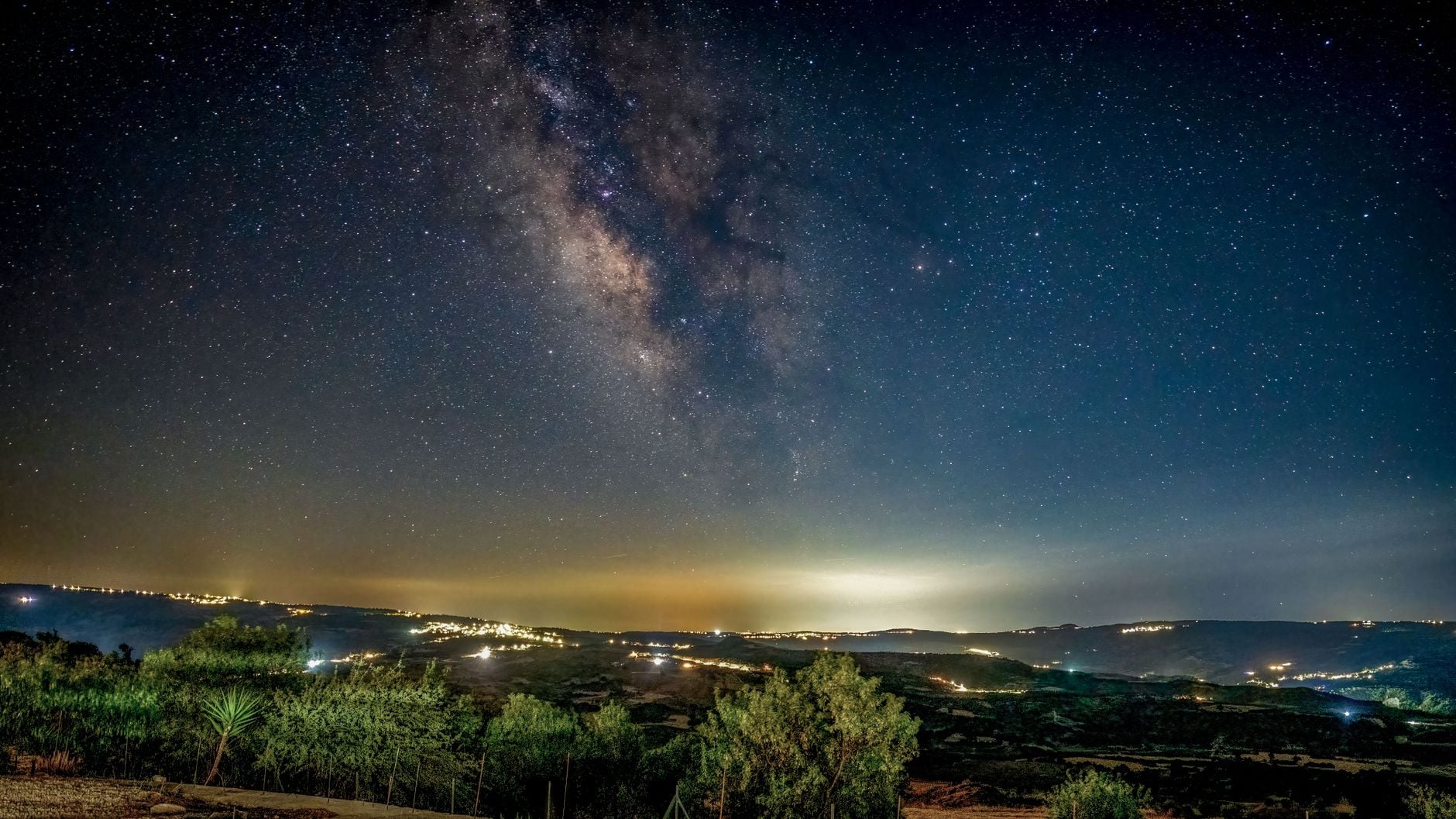
Wait long enough under a genuinely dark sky and the night changes character. The black above becomes textured. More stars appear as the eye adapts, then a pale, uneven band resolves across the heavens, mottled by bright knots and dark lanes.
That band is the Milky Way, seen from within. For nearly all of human existence it was not a destination reserved for observatories or remote holidays. Under clear, moonless conditions it was part of the ordinary night.
The galaxy itself has not become fainter during the electric age. The air between it and us has become brighter.
A 2016 world atlas of artificial night sky brightness estimated that the Milky Way was no longer visible to more than one-third of humanity from where people lived. The figure reached 60% in Europe and nearly 80% in North America.
Those numbers remain the most widely cited global benchmark, but they need their date and method attached. They were modelled largely from satellite data collected in 2014, not counted by visiting every household, and they are not a fresh census of the sky in 2026.
We see the Milky Way because we live inside it
The Solar System lies within a flattened disc of stars, gas and dust. When we look above or below that disc, our line of sight leaves the crowded galactic plane relatively quickly. When we look along it, we peer through a much greater depth of the galaxy.
Countless distant stars overlap in that direction. Most are too faint or crowded for an unaided eye to separate, so their combined light forms a diffuse river. Interstellar dust blocks background starlight in places, producing the dark rifts that make the band look structured rather than smooth.
Its visibility changes with latitude, season and time of night. The bright central region is much more prominent from southern latitudes and is seasonally placed. Clouds, haze, moonlight and poor transparency can hide it even where artificial light is absent.
That is why “could see the Milky Way” has always implied suitable conditions. A clear, moonless sky and enough time for dark adaptation matter. So does a horizon not overwhelmed by a nearby town.
The star field itself is not a cemetery of lights that have all gone out. As SpaceDaily has previously explained, the stars visible without a telescope are close enough and usually live long enough that the naked-eye sky is almost entirely alive. What cities remove is not an obsolete picture but a view of our present galactic neighbourhood.
Skyglow is light that returns through the atmosphere
An unshielded lamp may send some of its light directly above the horizontal. Even a downward-facing fixture can contribute when pavement, concrete, signs or building fronts reflect light upward. Molecules and aerosols then scatter some of that radiation back toward the ground.
The result is skyglow: a bright dome over a settlement and a raised background across the sky. It can remain noticeable far beyond the streets that produced it, especially near the horizon where light travels through more atmosphere.
Skyglow does not need to be bright enough to resemble twilight before it causes damage to the view. The Milky Way is a broad, low-contrast feature. When the foreground sky becomes a little brighter, the difference between the galactic band and its surroundings becomes too small for an eye to distinguish.
This is separate from glare, the excessive brightness that makes seeing uncomfortable or difficult, and light trespass, illumination spilling into a place where it was not intended. One badly aimed floodlight can create all three, but only skyglow describes the atmospheric veil spread across a large area.
The natural night is not perfectly black either. Airglow, unresolved stars, zodiacal light and scattered sunlight contribute. The pollution is the artificial addition, not every photon in a moonless sky.
What “more than one-third” actually measured
Fabio Falchi and colleagues built the 2016 atlas from several layers of evidence. The Suomi National Polar-orbiting Partnership satellite measured upward nighttime radiance. A computer model estimated how that light travelled through the atmosphere, while more than 35,000 ground observations helped calibrate the result.
The researchers defined a light-polluted sky as one where artificial brightness at the zenith exceeded 14 microcandelas per square metre, about 8% above the natural background used in the model. On that definition, roughly 83% of the world’s population lived beneath light-polluted skies. The figure exceeded 99% in both the United States and Europe.
Losing the Milky Way required a brighter threshold, 688 microcandelas per square metre of artificial zenith brightness in the atlas classification. When the model was combined with population data, more than one person in three fell above it.
This was an estimate of typical clear-sky conditions, not a record of what each person reported seeing. Eyesight, local obstacles and dark adaptation vary. A resident might travel outside the modelled home location, or see the band on an exceptionally transparent night from somewhere close to the boundary.
The reverse is also possible. Smoke, humidity or a newly installed source can make a particular night worse. The atlas was a standardized global comparison, valuable precisely because it held many of those changing conditions constant.
A transformation compressed into roughly 140 years
Firelight, oil lamps and gas street lighting altered night long before electricity. But their brightness, reach and operating cost constrained them. Large-scale electric illumination made it possible to extend the day across entire urban regions.
The chronology is remarkably short. A Library of Congress history places electric street-light demonstrations in American cities in the late 1870s, the first electrically lit US municipality at Wabash, Indiana, in 1880, and Edison’s Pearl Street generating station in New York in 1882.
Adoption was not instantaneous or uniform. Washington still had thousands more gas lamps than electric ones in 1894. Rural electrification came much later in many places. Yet within several generations, exterior lighting grew from a novelty to continuous infrastructure covering roads, industrial sites, homes, car parks and advertising.
A later study suggests the view continued to deteriorate after the atlas data were collected. Researchers analysed 51,351 Globe at Night reports made by citizen scientists from 2011 to 2022. Participants compared the stars they could see with reference charts.
The decline was consistent with sky brightness increasing by roughly 7% to 10% per year across the sampled locations. That is an alarming rate, but the locations were not evenly distributed around the planet. It cannot simply be applied to the 2016 percentages to manufacture a new global headcount.
LED efficiency does not guarantee a darker night
LEDs can deliver useful illumination with far less electricity than older lamps. That is a real advantage. It does not decide how many fixtures are installed, where they point, how bright they are or whether they remain at full output through an empty night.
Lower operating cost can encourage more lighting, sometimes called a rebound effect. Replacing one old lamp with an efficient source may save energy. Replacing it with several brighter fixtures, adding decorative lighting and leaving everything on longer can surrender part of that gain while increasing skyglow.
Spectrum matters too. Many white LEDs emit strongly at short, blue-rich visible wavelengths that scatter efficiently in the atmosphere. The day-night band on the VIIRS satellite instrument used by the atlas is relatively insensitive below 500 nanometres. A shift toward bluer lighting can therefore affect human vision more strongly than the satellite trend alone suggests.
This helps explain why the 2023 citizen observations found a faster deterioration than satellite radiance measurements. Satellites mostly look down at upward light from above. People look through the brightened atmosphere toward stars, using detectors called eyes whose spectral response is different.
Long-exposure photographs add another distinction. A camera can accumulate faint starlight for seconds or minutes and reveal far more Milky Way detail than a person saw at the scene. Such images can illustrate the boundary between a galaxy and distant glow, but they do not measure naked-eye visibility by themselves.
The unusual pollution that can vanish at the switch
Restoring darkness does not require abandoning necessary outdoor light. It requires deciding what the light is for. A useful fixture illuminates the needed surface, not the sky, neighbouring windows or an empty area beyond it.
The joint principles from DarkSky International and the Illuminating Engineering Society are deliberately plain: make lighting useful, targeted, low level, controlled and warm-coloured. In practice that means shielding and aiming it downward, avoiding excess brightness, limiting blue-rich output where possible, and using timers, dimmers or motion controls.
Not every site can be treated identically. Transport, industrial work and emergency access have real lighting requirements. Good design begins with those requirements rather than assuming that more lumens always produce more safety.
Artificial skyglow is unusual among large environmental changes because the emitted portion ends as soon as the responsible lights are switched off, dimmed or redirected. The atmosphere does not need decades to digest it. One property can improve immediately, though the sky above it still reflects choices made across the wider region.
Ground lighting is no longer the only challenge to the inherited night. SpaceDaily recently examined modelling of a proposed million-satellite orbital data-centre system that could place more moving spacecraft than visible stars in large parts of the sky. Satellites and atmospheric skyglow are different physical problems, but both alter a view no generation explicitly voted to surrender.
The Milky Way has not faded. We have brightened the air between it and ourselves.