
A liquid is normally defined partly by motion. Its atoms do not occupy the fixed, repeating lattice of a crystal. Yet inside molten metal nanoparticles, Christopher Leist and colleagues found conspicuous exceptions: individual platinum atoms that remained fixed on the timescale of their microscope while the platinum around them was liquid.
The study, published in ACS Nano in December 2025, followed nanoparticles of platinum, palladium and gold on graphene as the researchers changed the temperature between 20°C and 800°C. The decisive cooling sequences involved platinum particles just 3 to 6 nanometres across. This is one study, not settled consensus, and its findings belong to supported nanoparticles rather than a macroscopic pool of metal.
How an atom can look stationary inside a liquid
At room temperature, a crystalline platinum nanoparticle produces visible atomic columns and the diffraction signature of a face-centred cubic lattice. When the particle melts, its rapidly moving atoms contribute a nearly uniform blur during the microscope’s exposure. Their individual positions average away, and the droplet becomes sufficiently transparent to reveal the graphene lattice underneath.
A platinum atom held at a defect in that graphene behaves differently. It appears as a distinct point of contrast that remains in the same place for one second or longer. That is what “motionless” means in the headline. It does not mean an atom had been stripped of every vibration or remained fixed indefinitely. The paper reports that atoms bonded at vacancies in the graphene sheet were effectively immobilised over the image-acquisition interval, while some atoms attached to an open graphene edge occasionally hopped between positions.
The result softens a familiar distinction. Liquid does not require every atom in a sample to move in the same way. A small population can be immobilised by its local surroundings while most of the metal remains mobile enough to be liquid.
The microscope was also a tool for making the corral
The team used low-voltage, aberration-corrected high-resolution transmission electron microscopy. The electron beam served two roles. At moderate flux it produced the time-series images. At higher flux it knocked carbon atoms from graphene, creating vacancy defects that could trap individual platinum atoms.
That gave the researchers a limited form of control. By irradiating the area around a chosen molten particle, they could increase the number of stationary atoms and change their arrangement. The experiment did not merely discover a naturally completed ring and then watch it. Beam exposure, the atomically thin carbon support and the defects in that support were active parts of the system.
This qualification matters because electron microscopy can perturb the specimen it observes. Here that influence was not hidden. The paper measured the beam flux, deliberately used stronger exposure to engineer defects, and compared particles sharing the same field of view and temperature.
With only a few pinned atoms, crystals could still start
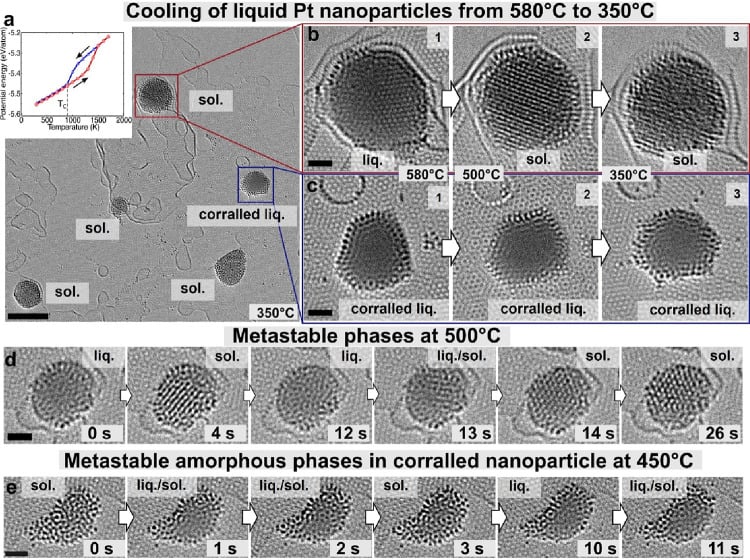
When a molten platinum particle contained fewer than roughly ten stationary atoms and those atoms were distributed randomly, the ordinary crystalline route remained open. At 500°C the microscope recorded ordered regions appearing and disappearing within the same particle before a crystal finally persisted.
In one 26-second sequence, the particle moved from liquid to crystalline, back to liquid, through a mixed state and eventually to a solid crystal. The behaviour fits a central feature of nucleation: a fleeting patch of order is not automatically a durable nucleus. It may dissolve again unless the cluster crosses an energetic barrier and becomes large or stable enough to grow.
Earlier atomic-scale work has also shown that crystal formation can proceed through unstable intermediate clusters rather than one clean flip. A 2019 atomic electron tomography study, for example, reconstructed nucleation in four dimensions and found small ordered regions developing and reorganising before crystallisation. The new platinum work adds a controllable boundary condition to that wider picture.
When the atoms formed a ring, the route closed
The behaviour changed when a larger number of stationary platinum atoms lined the particle’s perimeter. The authors called the resulting droplets “corralled.” In the clearest comparison, an uncorralled particle crystallised as it cooled from 580°C to about 500°C. A corralled neighbour in the same field remained liquid at 500°C and still retained a liquid core at 350°C.
At 450°C, other corralled particles fluctuated between liquid and amorphous states. When a small corralled droplet was cooled to around 200°C, it did not settle directly into platinum’s normal face-centred cubic crystal. It became a metastable amorphous solid, with its atoms frozen into disorder. That phase could later crystallise if the surrounding corral broke spontaneously or after further electron-beam stimulation.
Location was as important as number. More stationary atoms did not act like a conventional seed that invited the liquid to copy a crystal pattern. Arranged around the edge, they constrained the droplet and raised the barrier to the density and structural changes needed for crystallisation.
Why “more than 1,000°C below” is true but incomplete
The Royal Society of Chemistry gives bulk platinum’s melting point as 1,768.2°C. A platinum core remaining liquid at 350°C is therefore 1,418.2°C below that familiar bulk value. The headline’s temperature comparison is numerically conservative.
It is not, however, the amount by which the ring alone lowered the transition. Nanoparticles have much more surface relative to their volume than bulk metal, and their melting and freezing temperatures can be dramatically depressed. The paper’s own calculation for a free-standing 5.8-nanometre particle reflects this size effect, often described through the Gibbs-Thomson relation.
The stricter experimental comparison is between neighbouring nanoparticles. An uncorralled platinum droplet crystallised at about 500°C, while the corralled one remained liquid at 350°C and did not become amorphous until roughly 200°C. The ring therefore supplied an additional barrier within an already nanoscale system. It did not take a chunk of platinum that would otherwise freeze at 1,768°C and single-handedly lower its freezing point by more than a thousand degrees.
Graphene made contraction energetically expensive
Crystalline platinum is denser than liquid platinum. As a particle crystallises, it needs to contract. An unconfined molten droplet can alter its shape and volume as its atoms assemble into planes. A corralled particle is attached around the edge through strong platinum-carbon bonds to a graphene sheet.
The authors argue that contraction must then do one of two costly things: break the bonds that make the corral or pull against graphene’s exceptional in-plane stiffness. This mechanical constraint adds to the activation barrier for a crystal nucleus. It can leave the mobile interior in a supercooled state even though the temperature strongly favours a solid.
Molecular-dynamics simulations supported that interpretation. In a roughly 3-nanometre corralled droplet at 1,027°C, central atoms made large displacements while platinum atoms bonded at the carbon boundary remained localised. Simulated microscope images derived from those trajectories resembled the experimental contrast. As the simulated system cooled, the stationary population grew and the particle formed an amorphous solid rather than an ordinary crystal.
The mechanism recalls an earlier, materially different example in which a substrate inhibited rather than promoted freezing. A 2010 study of gold-silicon droplets found that contact with a structurally mismatched surface could enhance supercooling. Both cases show why a boundary can determine whether a liquid finds a viable route into a crystal, although the materials and atomic arrangements are not interchangeable.
This is not a new bulk state of matter
The result is unusual without requiring a new category of matter. The centre of a corralled droplet behaved as a supercooled liquid; at lower temperatures it became an amorphous solid; later it could form a crystal. Those are recognised phases and transitions operating under an unusually strong nanoscale constraint.
Nor did every metal in the study reproduce platinum’s full sequence. Stationary atoms appeared in liquid gold and palladium nanoparticles, but gold changed little under stronger irradiation and palladium transformed too rapidly for the same cooling analysis. The open-access paper and its figures show the strongest mechanistic evidence for platinum on graphene. Generalising it to different metals, supports or particle sizes will require separate experiments.
The scale is easy to lose in translation. Three nanometres is roughly the width of a few dozen atoms, depending on how it is counted and oriented. At that size, a small set of edge atoms is not a decorative boundary around an otherwise independent object. It is a substantial part of the object’s physics.
Why controlling solidification could matter
Metal nanoparticles on carbon supports are widely used in heterogeneous catalysis. Their shape, crystal structure and exposed atomic sites influence how molecules attach and react. If support defects can steer a particle toward a crystal, an amorphous solid or a deeply supercooled liquid, defect engineering may eventually offer another way to control catalyst preparation and behaviour at high temperatures.
The conditional words matter. The researchers did not demonstrate a more efficient catalyst, a new alloy-making process or a practical reservoir of low-temperature liquid platinum. The paper identifies a mechanism and proposes relevance to nanoparticles on carbon in catalysis and other thermally activated processes. Turning that observation into useful material would require stability tests, chemical measurements and production methods outside an electron microscope.
Its immediate achievement is more fundamental. The team made individual stationary atoms visible inside liquid metal, increased their number deliberately, watched a ring form and then followed the consequences second by second. The particle did not ignore temperature. It was trapped on a different route through the phase diagram because a handful of atoms at its edge made the usual crystal difficult to begin.
